
Podium in Douala Signals a Comeback
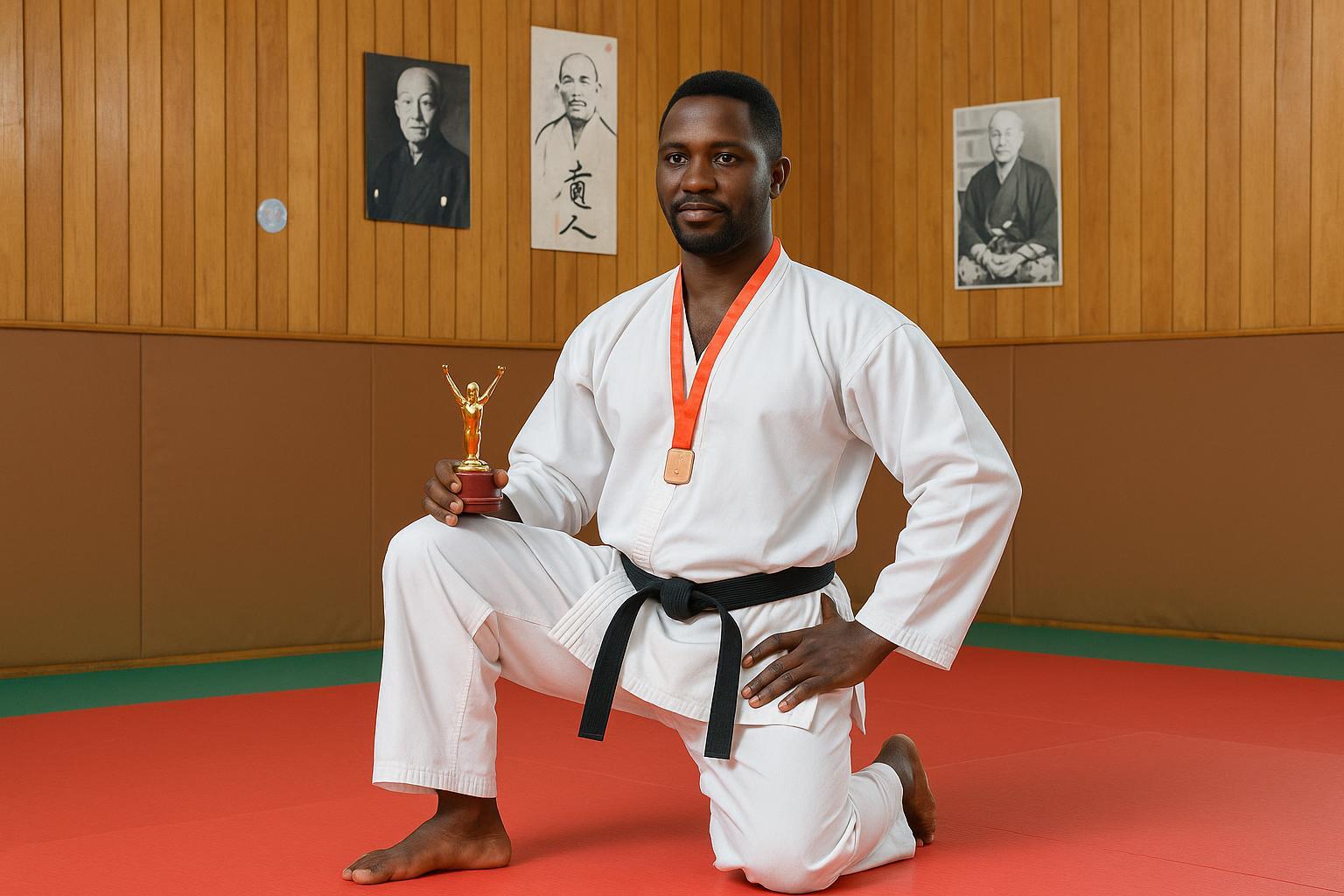
The noisy stands of Douala’s multisport complex fell briefly silent before erupting as Junior Mobonda’s hand was raised for bronze in the +84 kg division. For the 31-year-old Congolese heavyweight, the medal felt less like an ending than a reopening of long-shut doors.
“It is uplifting for Congolese karate to be present at Cameroon’s most anticipated sporting event of the year,” Mobonda told reporters afterward, his face still flushed from combat. He added that the result rekindled ambition he had stored away during seasons spent off the international radar.
A Continental Event Draws Sixteen Nations
The Open international de l’unité diaspora et meilleurs compétiteurs gathered delegations from sixteen countries, stretching from Austria to South Africa. Officials from the Cameroon Karate Federation under Master Bertin Dongmo stressed the tournament’s role in strengthening regional ties (Cameroon Tribune).
Observers noted that heavyweight bouts drew particular attention, with athletes from the United States, Côte d’Ivoire and Gabon trading high-octane attacks. Mobonda’s passage through the early rounds required tactical patience against taller European opponents and brisk power against agile West Africans.
Eight Years of Silence Ended in Style
Mobonda had not fought at a sanctioned event since 2018, when a dispute over travel allowances led the Congolese federation’s executive bureau to bar him from national activities. The decision, confirmed in a circular seen by our newsroom, forced him into coaching and administrative tasks.
Elected deputy treasurer of Brazzaville’s departmental league in May, he was unexpectedly suspended a month later following a governance reshuffle. “Those episodes were tiring, but the tatami kept calling,” he said, insisting that returning to competition was his personal form of reconciliation.
Austrian Open 2026: The Next Stage
By placing top three in Douala, Mobonda secured automatic entry to the Austrian Open scheduled for 15-18 January 2026 in Salzburg, one of Europe’s flagship series events (WKF calendar). “Qualifying two years ahead gives me time to sharpen every technical detail,” he noted.
The Austrian Open regularly hosts more than 1 200 athletes and offers ranking points toward the World Karate Federation premier league. Congolese officials view participation as a chance to showcase home-grown talent on a stage historically dominated by Japan, Turkey and France.
Financing Elite Preparation
Mobonda has mapped a six-month high-performance program split between Brazzaville and Yokohama, where he hopes to spar with Japanese masters. The budget—estimated at 48 000 USD—covers travel, lodging and sports science support. “I appeal to companies like SNPC, MTN Congo and Airtel Congo to join this venture,” he said.
Corporate support for individual athletes is not unprecedented: telecommunications firms bankrolled taekwondo champion Bienvenu Matondo before the 2019 African Games. Analysts believe that aligning with Mobonda could boost brand visibility ahead of the 2025 Francophone Games hosted in Brazzaville.
Federations and Governance Perspectives
The Congolese Karate Federation has taken a conciliatory stance. A spokesperson said the body “recognises the athlete’s result and remains open to dialogue in line with the Ministry of Sports’ guidelines.” Sources inside the ministry confirmed that talks about logistical assistance are ongoing.
Cameroon’s Master Dongmo, whose invitation allowed Mobonda to compete, argued that “athletes must not become collateral victims of administrative disagreements; their talent belongs to Africa.” His remark echoes African Union recommendations on safeguarding athlete welfare issued last year (AU Sports Charter).
Karate as Soft-Power Tool
For Congo-Brazzaville, strong representation in martial arts serves a broader diplomatic narrative. Regional sports historian Dr. Laure Nkouka notes that “combat sports victories translate quickly into symbolic capital, reinforcing perceptions of national discipline and resilience.”
Government communicators already highlighted Mobonda’s bronze on social platforms, framing it as proof of Congolese dynamism. Such messaging complements infrastructure projects like the Kintélé Sports Complex, which hosted the 2015 All-Africa Games and remains a centerpiece of the country’s soft-power strategy.
Timeline Toward Salzburg
Between now and January 2026, Mobonda plans competitive stops in Dakar, Abidjan and Paris to accrue mat time against European styles. Technical director Serge Mavoungou will oversee analytics, including motion-capture reviews to refine stance transitions.
“Each tournament is a data set,” Mavoungou explained. “We quantify distance management and strike velocity, then feed the results into personalized drills.” The systematic approach, rare in Central African karate circles, could set new standards for athlete preparation back home.
Outlook for Congolese Karate
Should Mobonda medal in Salzburg, the ripple could revive interest among juniors and unlock further funding pipelines. Yet even without podium success, his mere presence will reaffirm Congo’s place in global karate discussions, extending a narrative of perseverance that began quietly in a Douala sports hall.
As Mobonda bowed to the crowd in Douala, a child wearing a red headband mimicked his salute. The scene suggested that the heavyweight’s journey is already inspiring the next generation, giving shape to a sporting legacy still very much in the making.