
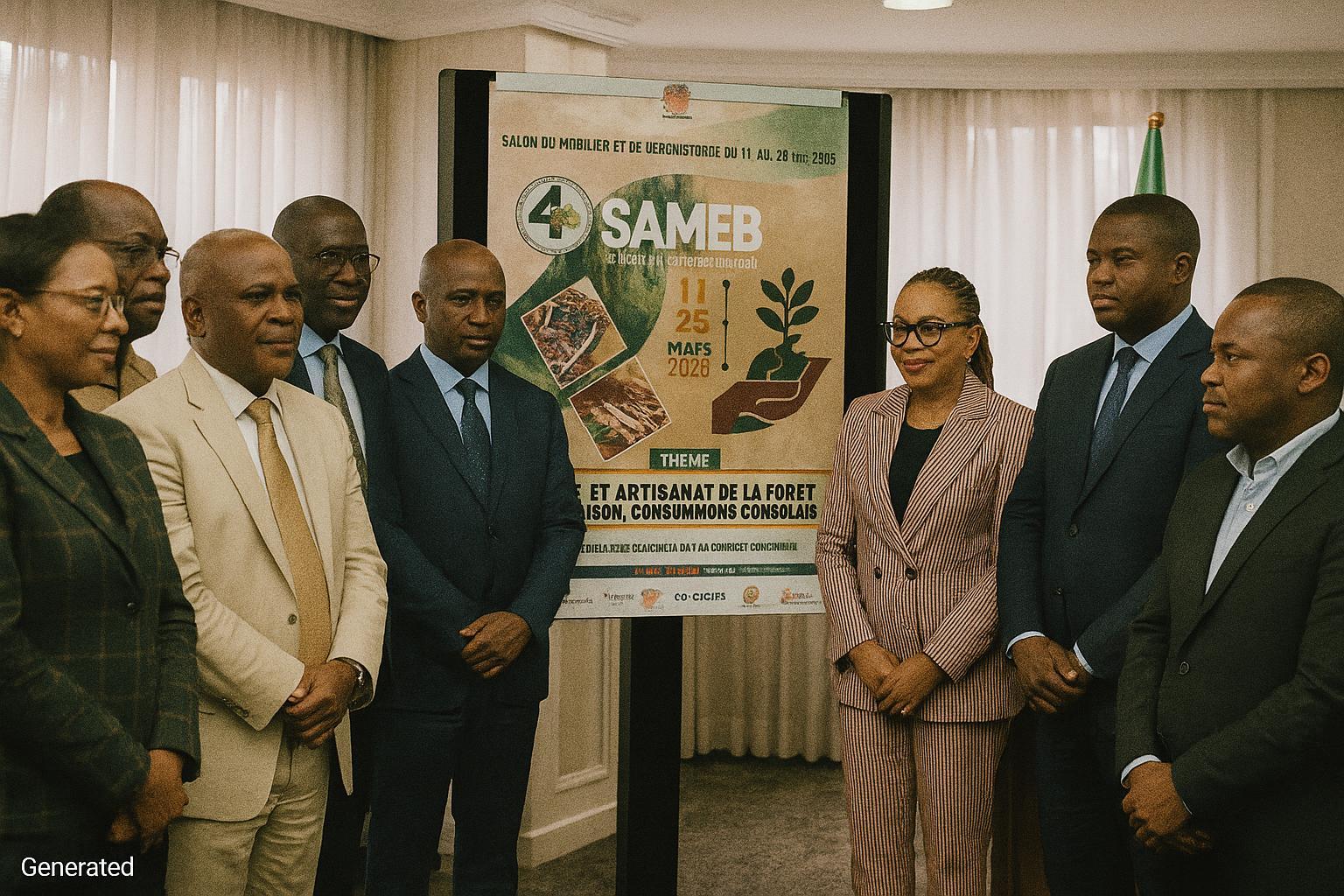
Sameb opens its doors along August sunshine
A fresh coat of paint already brightens the grounds of the national crafts centre in Brazzaville, where from 11 to 25 August the fourth Salon des métiers du bois, better known by its acronym Sameb, will unfold. Minister for Small and Medium-Sized Enterprises and Handicrafts Jacqueline Lydia Mikolo told reporters that the 2023 edition keeps the no-nonsense slogan “Bois et artisanat : de la forêt à la maison, consommons congolais”. In plain words, the government hopes visitors will swap imported décor for items carved a short bus ride away. The Prime Minister’s office again lends its patronage, signalling that the fair is more than a feel-good bazaar; it is part of the national diversification script repeatedly highlighted in the Plan national de développement 2022-2026 (Ministère du Plan).
From sawmill to living room: local know-how on show
Inside the pavilions, carpenters from Impfondo to Pointe-Noire will line up polished dining sets, light jewellery in bubinga and whimsical flower baskets, hoping to convert the curious into buyers. Organisers stress that many designs echo trends seen in Nairobi or Casablanca yet cost a fraction because transport and customs do not weigh on the price tag. Veteran sculptor Étienne Bakala puts it simply: “Our raw material grows a hundred kilometres away; the value should stay here.” His argument matches the World Bank’s 2022 brief describing Congo’s wood processing as an under-used driver of inclusive growth (World Bank).
Jobs, diversification and green promise
Sameb’s advocates repeat that each chair sold is a payslip secured. The Ministry of Forest Economy counts roughly 24 000 formal and informal jobs tied to primary wood processing, a figure projections could double if domestic demand rises (FAO Regional Office). Beyond the paycheque, officials underline an environmental twist. Domestic transformation of logs reduces the carbon footprint linked to shipping raw trunks to Asia, while certification programmes promoted by Congo in the 2022 Brazzaville Declaration aim to keep illegal logging in check. Minister Mikolo insists that “buying local makes the supply chain shorter, more traceable and cleaner”.
International gaze and soft power at play
The guest list, still being finalised when we went to press, already features Morocco, Angola, Namibia and the Democratic Republic of Congo. Their stands traditionally display machinery and finishing varnish rather than souvenirs, turning the fair into a discreet business-to-business arena. In the corridors hoteliers search for lounge furniture, while foreign diplomats eye bespoke gifts with cultural flair. Development partners, including the African Development Bank which co-financed the previous edition’s training workshops, see the event as a handy thermometer for Congo’s non-oil economy. When exhibitors from Rabat or Windhoek sign supply contracts with local cooperatives, Brazzaville cultivates an image of stability that marketing campaigns alone could hardly secure.
Barriers on the road to “consume congolais”
Winning over the domestic shopper remains a steeper climb. Surveys by the National Institute for Statistics show that imported household goods still dominate 70 % of urban outlets. Shoppers cite durability concerns, while artisans mention limited showrooms and lack of bank credit. The government has responded with tax incentives on semi-finished wood and a mobile exhibition truck rolling through neighbourhoods since April. Economist Clément Okombi welcomes the push yet warns that taste habits evolve slowly. “Patronising a fair is not enough; people need after-sales service and consistent quality,” he says. Organisers hope the two-week Sameb will nudge the needle, not deliver miracles.
Looking beyond the fair lights
As sunset lights up the Congo River each evening of the fair, music groups will accompany the glow of freshly lacquered coffee tables. The festive mood, however, masks a sober calculus: every franc that stays in the local wood circuit trims the import bill and reinforces the policy target of raising non-oil GDP to 20 % by 2026 (Ministry of Finance). Whether shoppers leave with a sculpted mask or only selfies, Sameb offers one more arena where business, culture and national branding intersect. That alone explains the high-profile backing and the meticulous preparations observers will watch once the gates swing open.