
High stakes upgrade at Môle Est
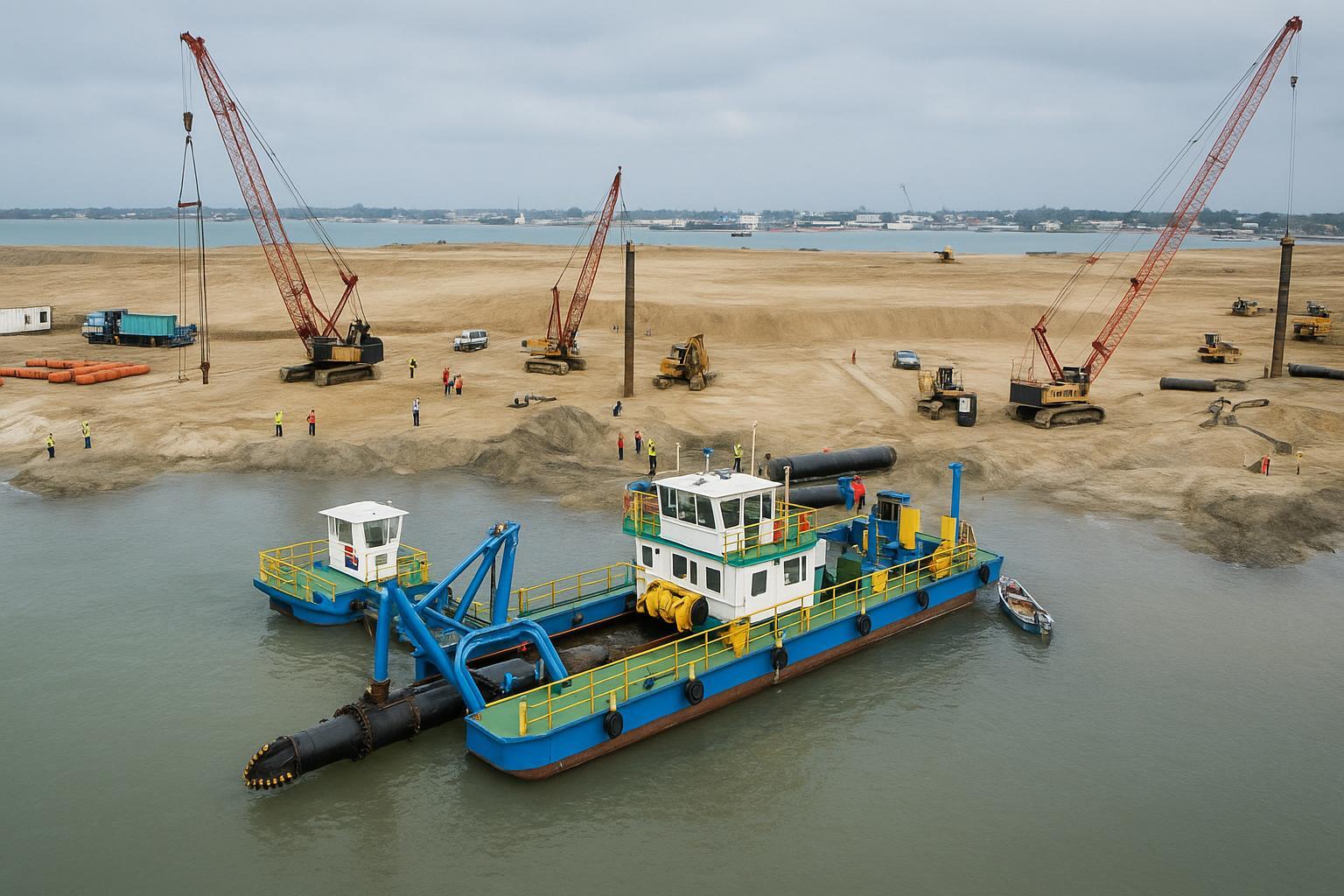
Few seconds after dawn on 20 August 2025, a bright red cutter suction dredger slid into the Atlantic swells off Pointe-Noire, signalling that the long-awaited extension of Môle Est quay had moved from blueprints to steel and seawater.
Engineers from China Road and Bridge Corporation, flanked by Congolese port officials, applauded as the vessel bobbed free, ready to excavate 1.8 million cubic metres of sediment and lay down rock armour strong enough to resist the region’s heaviest equatorial storms.
Aziz Anguilet, project engineer, called the launch “a turning point that will double berth capacity and cut waiting time for container vessels” while affirming the company’s pledge to follow International Association of Ports and Harbors guidelines on safety, quality, and environmental management.
Inside the CSD technology
The 120-metre-long dredger is equipped with a 5,000-horsepower cutter head and GPS-guided pumps able to send dredged material through floating pipelines spanning three kilometres, an innovation that CRBC says will accelerate works by 20 percent compared with conventional grab dredging methods.
Aboard the bridge, Chinese and Congolese technicians monitor real-time sediment density on digital dashboards, cross-checking data with bathymetric scans captured by autonomous surface drones leased from a Cape Town start-up, reflecting the increasingly international character of Pointe-Noire’s logistics ecosystem.
Maritime analyst Nadège Nkouta notes that only five African ports currently host cutter suction units of comparable size, positioning Congo Terminal among the continent’s technological front-runners and improving its case for future Green Port certifications endorsed by the International Maritime Organization.
Economic ripple across Central Africa
The port of Pointe-Noire already channels 45 percent of maritime trade bound for the Republic of Congo, Gabon, and parts of the DRC, according to the latest UNCTAD review; expanded berths could lift throughput from 1.3 million TEUs to nearly two million by 2028.
Local chambers of commerce forecast that shorter vessel queues could shave average freight costs on the Lobito corridor by ten percent, a saving they say will be felt by copper exporters in Katanga as well as by importers of consumer goods in Brazzaville and Kinshasa.
International lenders have taken note; the African Development Bank confirmed in July that it is studying a blended finance package to upgrade road links between Pointe-Noire and the inland economic zones of Ollombo and Oyo, reinforcing existing plans under the National Development Strategy 2022-2026.
Shipping giant MSC, which already operates a weekly West Africa loop, signalled that a deeper, longer quay would allow it to deploy 15,000-TEU vessels instead of today’s 11,000-TEU ships, translating into lower per-container emissions and potentially opening direct routes to Brazil’s northeast.
The Central African Economic and Monetary Community secretariat estimates annual GDP growth may rise by 0.3 percentage points once the extended quay becomes fully operational, driven largely by lower logistics premiums and increased competitiveness for value-added timber and cocoa products.
Environmental safeguards in focus
CRBC’s environmental manager Liu Hong insists the dredging phase follows a strict turbidity curtain schedule, limiting suspended solids to 25 milligrams per litre and conducting weekly water sampling in partnership with the Congolese Agency for the Environment, whose labs publish real-time dashboards on public monitors near the pier.
The rock armour arrives from a quarry 40 kilometres inland, transported by rail to minimise truck traffic through residential districts; each wagon is treated with biodegradable dust suppressants developed by a local start-up supported by the World Bank’s SME Growth Fund.
Marine biologist Françoise Mayanda confirms that baseline surveys were completed before dredging began, mapping coral patches and migratory fish paths; acoustic monitoring buoys now transmit data to the regional fisheries institute, allowing authorities to adjust work windows during peak spawning periods.
These measures align with Congo’s ratification of the London Convention on marine dumping and complement the government’s 2023 decree mandating climate-resilient infrastructure for all major public works, a policy hailed by the Economic Commission for Africa as a model for emerging economies.
Next milestones and regional outlook
Over the next six months, engineers will place 200,000 tonnes of granite armour, pour reinforced concrete capping beams, and install fenders manufactured in Malaysia but assembled locally, aiming to open the first 350-metre stretch of the new quay to traffic by April 2026.
Congo Terminal, a subsidiary of Bolloré Africa Logistics, has earmarked an additional 120 million dollars for automated yard cranes and shore-power units, a move expected to cut diesel consumption by 18 million litres annually, according to internal projections shared with visiting lawmakers last month.
Observers in Brazzaville’s diplomatic circles argue that the project demonstrates the Republic’s capacity to manage complex international partnerships while preserving sovereign oversight, an attribute likely to attract further concessional loans and possibly a second hydrocarbons export berth under discussion with investors from the Gulf.