
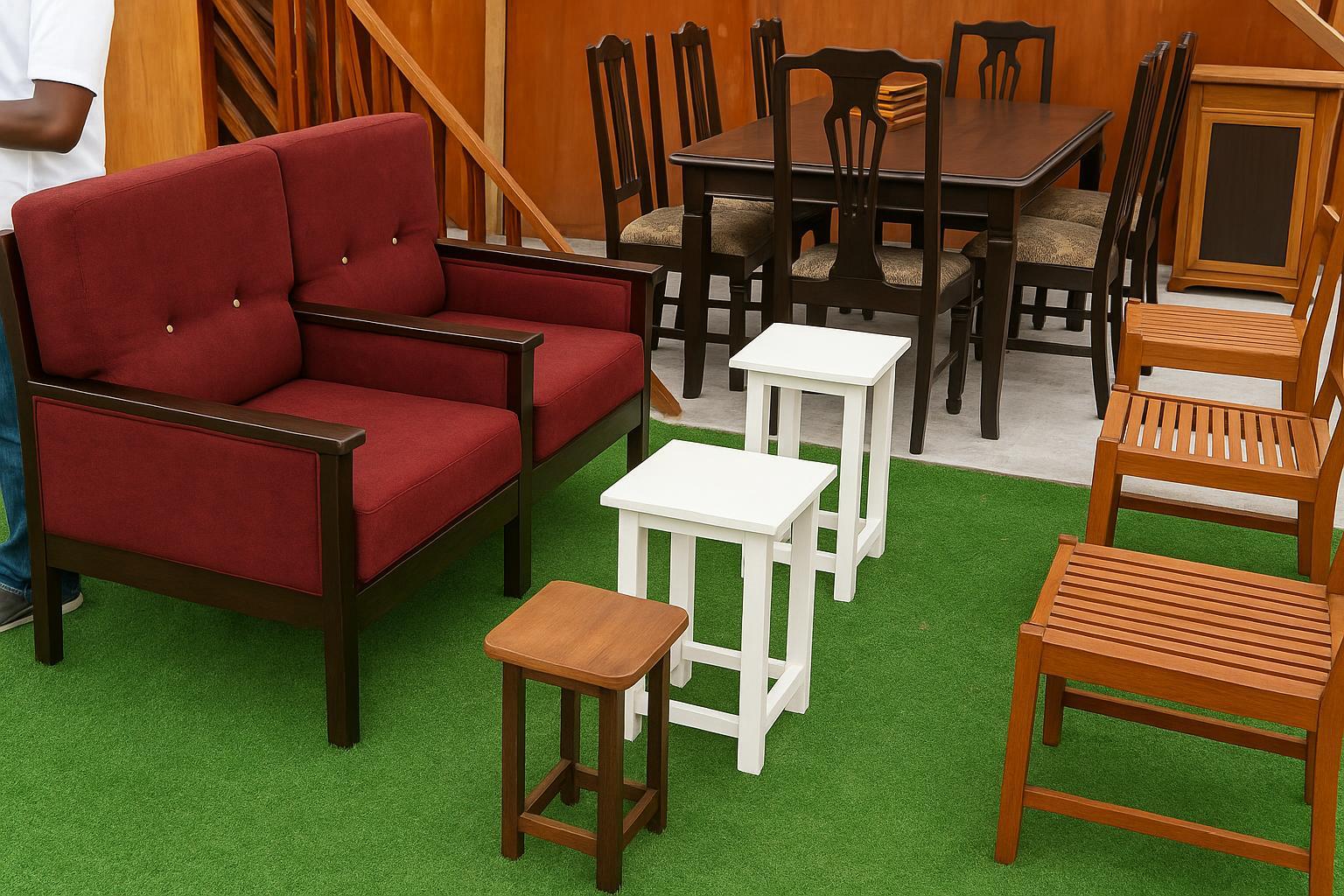
Brazzaville hosts SAMEB 2025
Under the wide awning rising opposite President Massamba-Débat Stadium, the fourth Salon des Métiers du Bois formally opened on 11 August 2025, transforming an empty construction site into Brazzaville’s busiest showroom. The two-week market, known by its French acronym SAMEB, markets timber creativity under the slogan “Consume Congolese.”
Organised jointly by the Small and Medium Enterprises Ministry and Forest Economy Ministry, the exhibition has drawn 136 artisans from every department and several neighbouring states. Cabinet members, city officials and UNDP representative Adama Dian Barry cut the ribbon, signalling the government’s intent to elevate craft into macro-economic policy.
Timber reserves and national strategy
At the podium, Forest Economy Minister Rosalie Matondo reminded guests that Congo’s 22 million hectares of forest hold an estimated 900 million cubic metres of harvestable timber, yet barely 1.7 million are processed each year. “The gap is our future,” she said to sustained applause (official transcript).
The numbers matter. Timber already supplies more export earnings than telecoms, according to the Central Bank’s 2024 bulletin, but value-addition still occurs mostly abroad. SAMEB’s organisers hope that contracts signed on site will anchor new carpentry plants, furniture lines and training hubs inside the Republic’s borders.
Policy tools backing artisans
Small business minister Jacqueline Lydia Mikolo linked the show to the National Development Plan, stressing that a nation “that does not produce what it consumes is not free.” She outlined measures already budgeted: artisan insurance schemes, pension enrolment, simplified micro-credit and a “Made in Congo” certification mark.
Behind the speeches, rows of stands narrated a quieter story. Mahogany wardrobes carved in Impfondo sat beside raffia lampshades woven in Kinkala. Visitors photographed ebony chessboards, teak bicycles and rosewood jewellery, broadcasting the event across social platforms and giving many exhibitors their first taste of digital marketing.
Deals and development partners
Professional carpenter Arsène Okandza reported selling five dining sets within the first hour. “Normally it takes a month at my workshop,” he said. His neighbour, a young graduate of the Ollombo vocational centre, closed a contract to supply bamboo partitions for a new eco-lodge near Oyo.
The United Nations Development Programme, which co-funded booth construction, views such deals as proof of concept. “Micro-entrepreneurs deserve market access, not permanent subsidies,” Barry noted. UNDP analysts expect SAMEB transactions to exceed 650 million CFA francs, roughly one-third more than the 2023 edition, if early receipts hold.
Logistics and sustainability challenges
Economic researchers from Marien Ngouabi University caution, however, that artisanal growth depends on reliable raw-material supply. Illegal logging and transport bottlenecks can raise plank prices by 40 percent between Pokola and Brazzaville, their 2024 field survey shows. They propose community-managed depots to stabilise inputs and curb speculative trading.
Government officials say the upcoming Brazzaville-Ouesso corridor rehabilitation, financed with a CAF loan, will help. Forestry director Henri Bouka predicts the paved link could shorten delivery times for sawn timber from one week to two days, lowering costs for cooperatives while improving oversight of certified harvesting concessions.
Culture, skills and finance
SAMEB is not solely about trade. Curators from the National Museum staged daily talks on symbolism in Kongo sculpture, while music troupes kept evening crowds circulating. This cultural cross-pollination may prove as important as contracts, nurturing pride that encourages households to furnish homes with domestic designs.
In parallel, the artisan chamber signed a memorandum with the Ministry of Education to double enrolment at technical schools. Ten new wood-processing curricula, modelled on Canadian college modules, will launch next January. Students completing level-three certificates will graduate with internationally recognised safety and quality standards, easing export negotiations.
Finance also features. Commercial banks present offered fixed-asset loans at 7.5 percent, well below the national average of 12 percent. The state-backed Guarantee Fund absorbs 50 percent of default risk, a mechanism credited with unlocking 18 billion CFA francs for crafts last year, central bank data confirm.
Regional horizons and global interest
Looking east, exhibitors expressed interest in supplying lumber to booming markets in Rwanda and Uganda. Trade counsellor Emmanuel Mouanga noted that the African Continental Free Trade Area, ratified by Congo in 2021, removes tariffs on finished furniture by 2026, giving early adopters a crucial head start.
International observers are watching. The World Bank’s forthcoming Country Private Sector Diagnostic lists wood transformation among five “priority clusters” capable of generating 40,000 jobs by 2030 if investment holds. SAMEB provides a working laboratory where policymakers can test incentives before scaling them under the forthcoming Industrial Acceleration Act.
What the sawdust signals
As the fair’s floodlights switch off each night, the scent of fresh sawdust lingers in the humid air, a quiet reminder that Congo’s forests are both a heritage and a horizon. Whether the country can move from exhibition to mass production will shape the diversification story for years.