
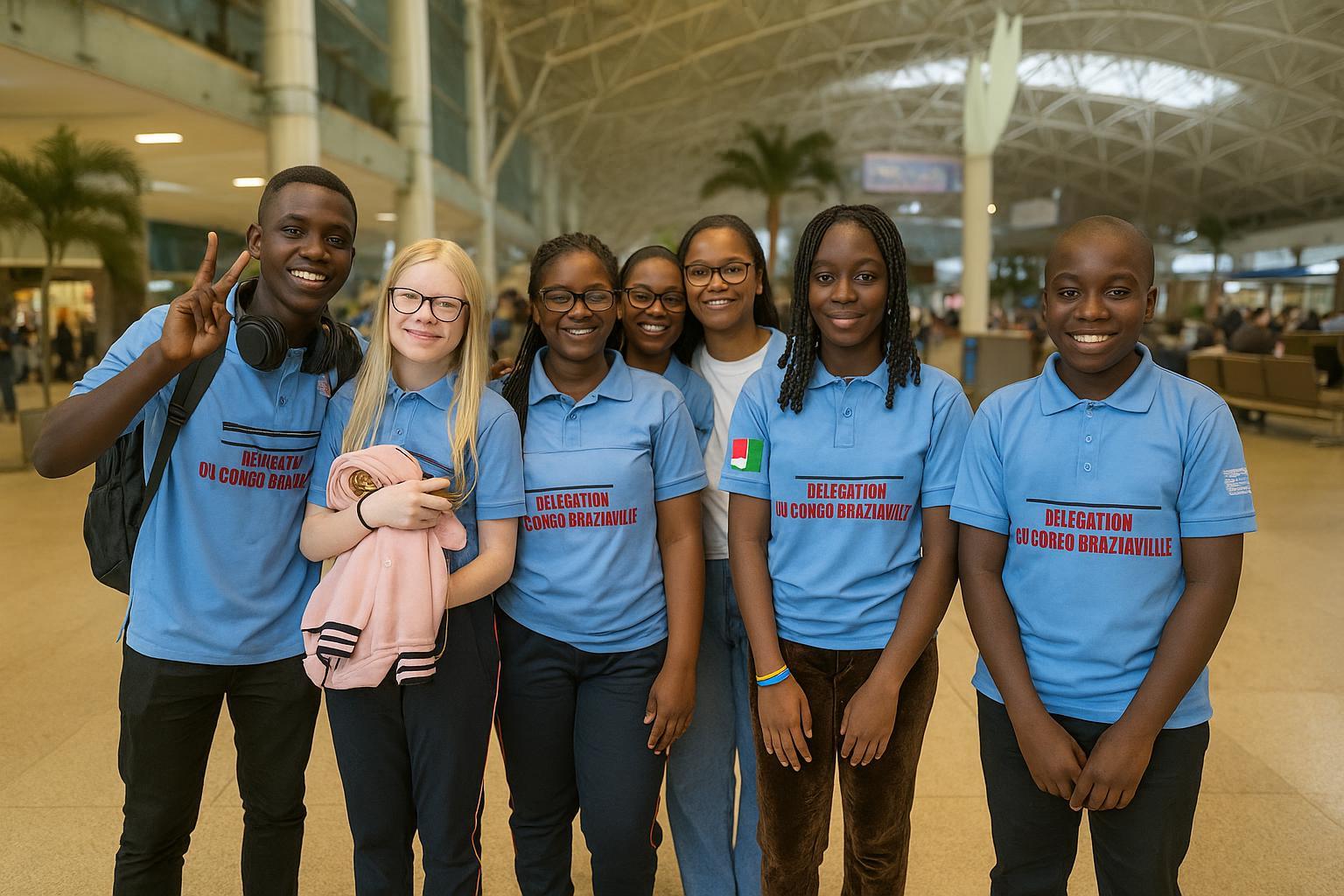
Brazzaville youth head to Dakar summit
At Maya-Maya airport on 9 October, six spirited teenagers pulled on the jackets of their national colors before boarding the morning flight to Dakar. Their mission, entrusted by the Ministry of Social Affairs and UNICEF Congo, is to carry young Congo-Brazzaville voices onto a continental stage.
UNICEF Girls Summit 2025 in focus
The Girls Summit Dakar 2025, held 10–11 October, brings together 250 youth advocates from 24 African nations under UNICEF Africa’s banner. For two intensive days, they will translate months of community consultations about education, health, nutrition and protection into practical commitments for policymakers.
Faces of Congo delegation
Leading the delegation is Lucia, 16, current president of the Children’s Parliament of Congo. Raised in Talangaï, she has spent three years lobbying local councils for separate sanitation facilities for girls, a cause she believes unlocks attendance and leadership potential in secondary schools.
Rebecca, 18, travels with sunscreen in her backpack and statistics in her notebook. Living with albinism, she campaigns for barrier-free schooling and low-vision materials. ‘Inclusion cannot wait for perfect budgets,’ she says, convinced that showing workable micro-solutions will influence ministers.
Fredéric, also 18, sees politics not as a distant arena but as a tool for generational renewal. He openly aims for the future portfolio of Youth Minister and has already coordinated clean-up drives in Brazzaville’s markets to prove that policy starts at street level.
Beside them stands Euverte, 13, an eloquent climate enthusiast who began measuring local river temperatures during last year’s heatwave. He argues that environmental data collected by school clubs should feed national adaptation plans, ensuring girls and boys share science-based responsibilities.
Completing the team are Shekinha, a 17-year-old poet from Pointe-Noire, and Charly, 15, basketball captain in Owando. Their narratives—creative expression and sport as safe spaces—echo UNICEF research linking extracurricular engagement to lower child-marriage risk.
Inside the Dakar agenda
In Dakar, plenary sessions will alternate with thematic labs managed by youth moderators. The Congolese six plan to co-chair the session on digital inclusion, demonstrating a low-cost learning platform they built with recycled smartphones in a Makélékélé community hall.
Outcomes are expected to feed the African Union’s Roadmap on Children’s Rights due for review in 2026. UNICEF officials say the presence of Congo’s delegation illustrates how mid-income countries can align their social portfolios with continental ambitions without waiting for external funding.
National policies backing the mission
Congo-Brazzaville already increased its education budget by 10 percent this year, earmarking part of the envelope for girl-friendly infrastructure and menstrual health, according to the Finance Law 2024. Analysts view the Dakar Summit as an opportunity to showcase early impacts of that decision.
Minister of Primary Education Jean-Luc Mouthou, reached by phone, praised the delegation’s ‘sense of civic duty’ and confirmed that recommendations brought back from Dakar will feed the next national strategy on child participation. ‘We want policies co-written by those who live them,’ he added.
Measuring success beyond speeches
For the six teenagers, success in Dakar will be measured less by speeches than by post-summit follow-up. They intend to convene quarterly cafés-débats in Brazzaville and Pointe-Noire, livestreaming progress on each pledge and inviting municipal officials to answer openly.
Lucia believes that real accountability begins at home. ‘If girls in Ouesso still skip science classes because of inadequate lighting, our trip means nothing,’ she argues, committing to partner with the national electricity company to pilot solar kits in two remote schools.
Rebecca’s priority is accessible data. She plans to upload indicators on disability inclusion to an open dashboard so journalists and councillors can track progress in real time. ‘Numbers defeat stereotypes,’ she explains, hoping transparent metrics will inspire neighbouring countries to replicate the approach.
Expert and economic perspectives
Sociologist Calixte Banzouzi notes that Congo’s youth movement increasingly couples gender justice with climate, digital and creative sectors. ‘This multidimensional framing resonates with donors and governments alike because it links moral arguments to economic dividends,’ he told our newsroom ahead of the summit.
The United Nations estimates that every additional year of schooling for a girl adds up to 16 percent to her future earnings. Economists at the regional development bank say such gains could lift CEMAC growth by a full point if policies remain consistent.
Next steps once the summit ends
Once back, the delegation will brief parliamentarians during the November ordinary session. Youth caucus chair Yvon Ngoma says lawmakers are ready to integrate the summit’s declaration into the legal review of the 2010 Child Protection Act, especially on participatory budgeting for school projects.
Meanwhile, Congolese diaspora associations in Paris, Montréal and Abidjan have booked online tickets to follow the summit stream. Their remittances already sponsor community libraries; coordinators hope that synchronized advocacy will attract corporate partners and lighten the financial burden on families.
A message carried by six voices
From airport send-off to plenary microphones, the six teenagers embody a simple message: Africa’s future can only be built with every girl counted in. As they land in Dakar, they carry with them not just the flag but the conviction that change travels fast when youth takes the driver’s seat.