
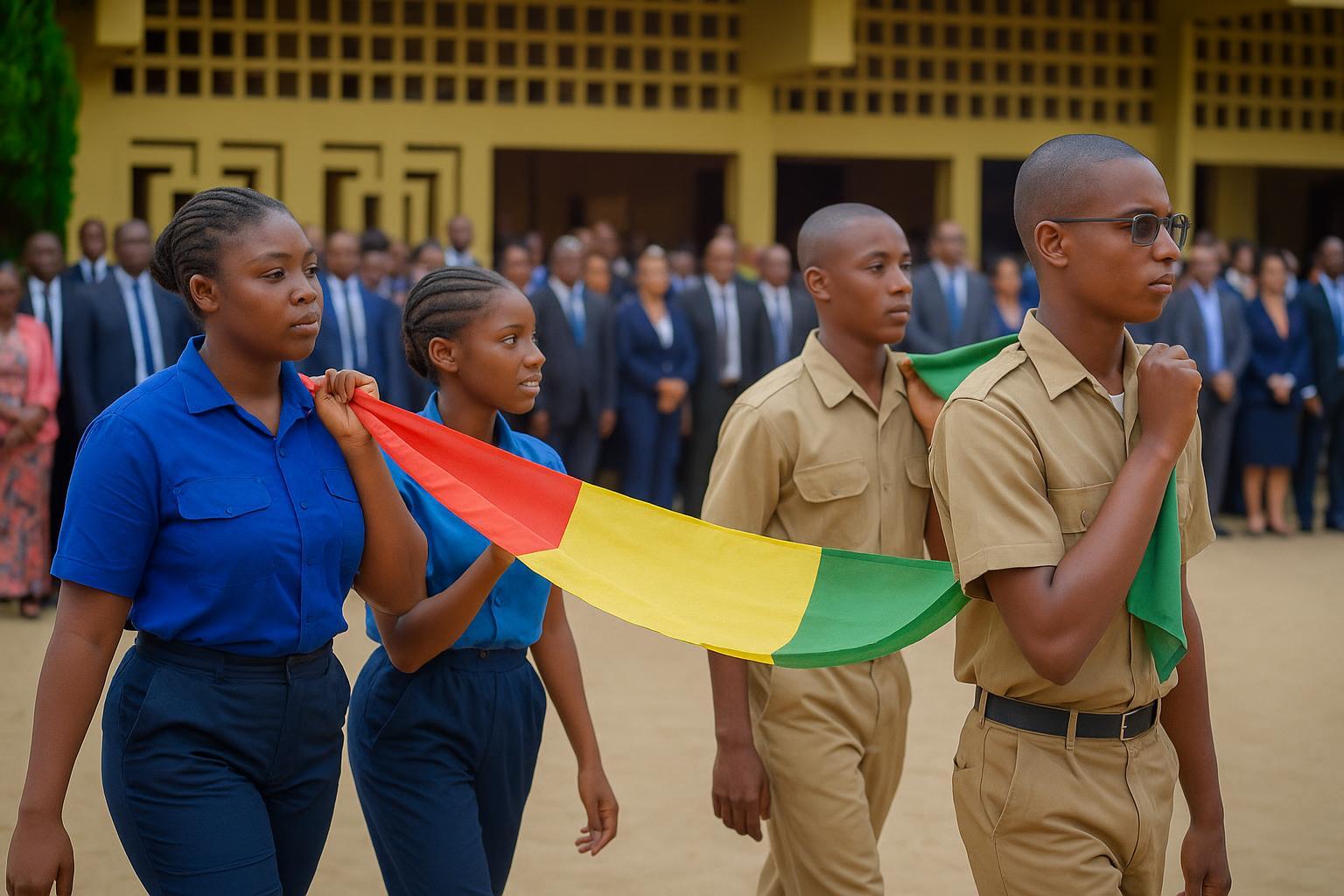
School year 2025-2026 begins across Congo
On Wednesday 1 October 2025, school bells echoed again across Congo-Brazzaville, signalling the official start of the 2025-2026 academic year. From urban Brazzaville to remote Sangha villages, pupils donned crisp uniforms, hopeful that nine months of lessons will open new doors.
The traditional first-day tour took Jean-Luc Mouthou, Minister of Pre-school, Primary, Secondary Education and Literacy, and Ghislain Thierry Maguessa-Ebomé, Minister for Technical and Vocational Education, to two flagship schools, accompanied by presidential education adviser Louis Bakabadio.
Brazzaville ministerial tour offers snapshot
At Lycée technique 1er Mai in the riverside district of Bacongo, officials inspected new welding equipment, freshly painted workshops and attendance registers. Teachers confirmed that first-year classes were almost full, while senior students trickled in after completing late-season industrial internships.
A few kilometres north, the delegation crossed the busy Djoué bridge to Lycée de la Révolution in Ouenzé. Some classrooms there held barely twenty pupils, yet chalkboards already showed algebra problems, a sign that administrators want to keep momentum despite staggered returns.
Early attendance gap challenges educators
Although school gates reopened nationwide, attendance remained patchy in several neighbourhoods. Education inspectors in Makélékélé, Mouyondzi and Impfondo reported rates ranging from 45 to 60 percent, attributing the gap mainly to families still purchasing textbooks and covering transport fares after the long vacation.
Many households, especially those paid weekly, have asked head-teachers for a grace period until Monday 6 October. That short delay should let parents finalise uniforms and vaccination cards without the stress of turning children away on the first day.
Ministers stress discipline and skills
Facing straight rows of students, Minister Mouthou delivered a familiar yet firm call for discipline and effort. “For nine months we will work side by side so that Congo records remarkable results again,” he said, his voice amplified by a portable solar-powered loudspeaker.
His colleague Maguessa-Ebomé used the visit to highlight opportunities in technical streams. He urged pupils to “embrace welding, electronics and agribusiness laboratories that will anchor the future economy,” while promising continued partnership with industry to align curricula with labour-market demand.
Enrolment figures and infrastructure upgrades
Ministry figures put this year’s enrolment at roughly 1.4 million learners across pre-school, primary and general secondary cycles. The number is up by 3 percent compared with 2024, reflecting demographic growth and a modest return of diaspora families after pandemic disruptions.
The public-sector network now counts close to 4,000 establishments, including 147 technical high schools. Recent rehabilitation projects funded by the state budget and partners such as the World Bank have supplied desks, science kits and solar panels to previously underserved districts.
Teachers and administrators react
Representatives of the teachers’ union SYNATEP, present during the tour, welcomed the equipment but called for timely salary payments and more in-service training. “Resources motivate staff only when coupled with professional development,” spokesperson Désiré Obongo told reporters, expressing readiness for constructive dialogue.
Principal Thérèse Moussavou of Lycée technique 1er Mai noted that digital attendance registers introduced last June have already reduced truancy. “Parents receive an SMS if a student misses two classes in a row; that simple tool is changing behaviour,” she said with cautious optimism.
Families juggle back-to-school costs
Outside the gates, parents like Martine Ngoma balanced exercise books on scooter seats while negotiating lower prices. She explained that her household of five school-age children spends nearly 70,000 F CFA on supplies, roughly a quarter of monthly income for many urban families.
Bookshop owners in the Grand Marché report brisk trade in used textbooks and locally printed notebooks. Currency-matched price lists introduced last year by the Ministry of Commerce appear to have stabilised costs, limiting inflationary spikes witnessed after the 2023 oil-price swing.
Government reform roadmap for education
Minister Mouthou insists that last year’s gains in exam pass rates can be consolidated. The 2024 BEPC success level rose to 68 percent, up eight points in three years, a trend he attributes to “clear syllabi, earlier mock tests and stronger parental involvement in homework”.
Digital learning remains a flagship ambition for 2025-2026. A partnership with Congolese telecom operators will supply 1,200 tablets to rural schools, pre-loaded with French, mathematics and civic-education modules. Teachers will follow blended workshops hosted by Marien Ngouabi University’s distance-learning centre.
International support for classrooms
UNICEF has confirmed a shipment of 50,000 gender-sensitive latrine kits for primary schools in Pool, Niari and Plateaux. Safe water and sanitation, officials argue, are inseparable from academic performance, particularly for adolescent girls who often skip lessons during menstrual cycles.
Full attendance expected by 6 October
The ministry expects full attendance by Monday 6 October, when the first weekly timetable will be printed nationwide. Officials also remind communities that the first trimester ends on 19 December, urging early engagement to avoid the annual scramble for make-up sessions.
National exams are scheduled for June 2026, but the road to that milestone starts now, educators say. By midday on opening day, chalk dust already floated across corridors, a quiet pledge that, even in half-filled rooms, learning has begun afresh for Congo’s youth.