
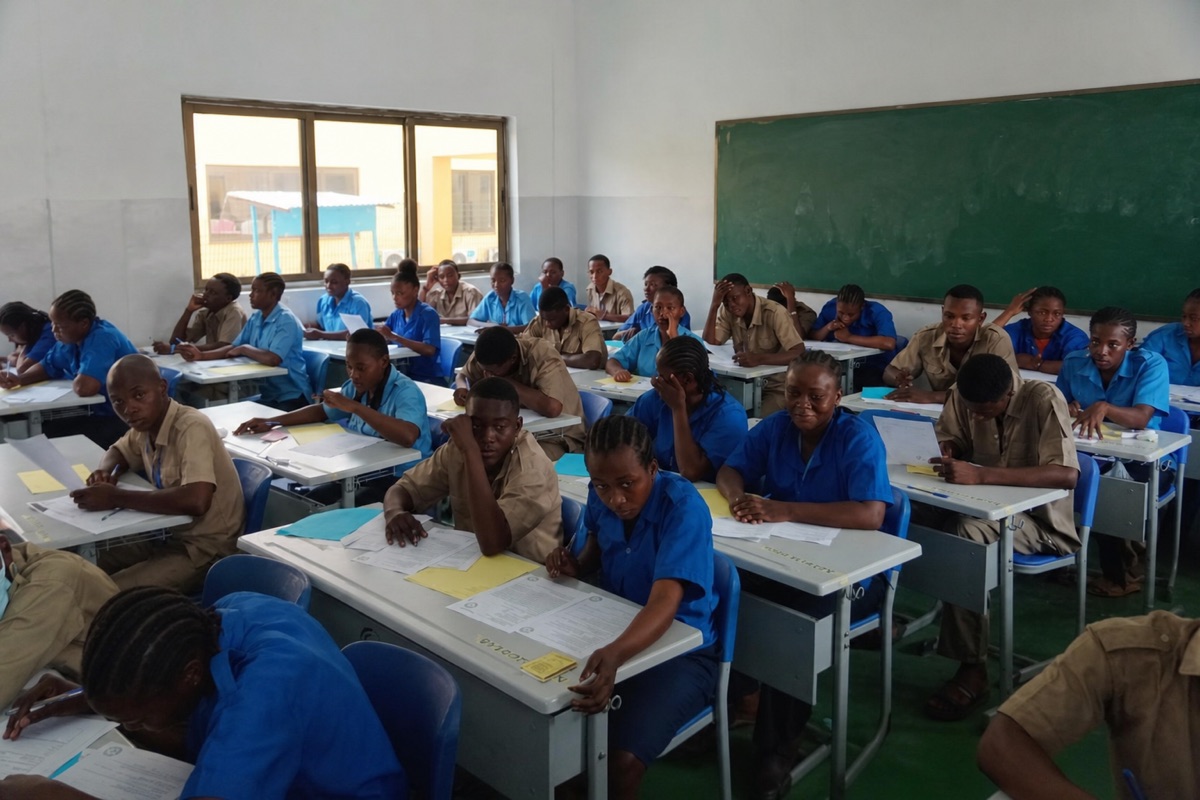
Congo’s classrooms brace for a record BEPC season
The lower-secondary leaving certificate, known here as the Brevet d’études du premier cycle, returns this week with its biggest cohort yet. Across the Republic of the Congo, 139,997 candidates are scheduled to sit the BEPC between 23 and 26 June 2026 (Adiac Congo).
That figure marks a 4.44 percent rise on the previous session. For a country watching its school-age population swell, the increase is more than a statistic. It points to steady pressure on classrooms, examination centres and the logistics that hold a national exam together.
Four days, one subject map at a time
The examination unfolds over four consecutive days, each carrying its own slate of subjects. The pacing spreads the burden, giving candidates room to breathe between disciplines rather than facing everything in a single sitting.
Day one, on 23 June, opens with mathematics, history and geography. The following day turns to English and life sciences. Physics and dictation arrive on 25 June, before the session closes on 26 June with written expression and physical education.
That sequence matters for families and teachers alike. Knowing the order helps households plan revision, transport and rest. In a network of examination centres stretching from Brazzaville to Pointe-Noire and the departments, predictable scheduling is its own form of fairness.
The promise of a clean exam
Integrity sits at the heart of this session. Education Minister Jean Luc Mouthou has framed the examination around a declared policy of zero fraud, a phrase he wants every centre to take literally rather than treat as a slogan.
The minister was explicit about the tools that will not cross the threshold. “Telephones, smartwatches and programmable calculators are banned in examination centres,” he said. The line draws a clear boundary around connected devices that could carry hidden answers.
The targets are familiar to anyone who has watched modern cheating evolve. Phones move information in seconds. Smartwatches hide screens on a wrist. Programmable calculators can store text behind a veneer of arithmetic. Naming them removes any room for argument at the door.
Preparing the people behind the papers
A clean exam depends less on rules than on the people enforcing them. Ahead of the session, the authorities held a capacity-building seminar for everyone involved in organising the examination, from centre heads to the staff who handle papers and oversee rooms.
That training was followed by deployment. Invigilators were dispatched across the country on 19 June, fanning out to centres before the first candidates arrived. The timing left a margin for travel and last-minute fixes, a detail that often decides whether an exam day runs smoothly.
The approach reflects a broader truth about national examinations. Standards are only as strong as their weakest centre. By briefing actors before sending them out, organisers aim for a consistent experience whether a pupil sits in the capital or a quieter departmental town.
What the rising numbers really signal
Behind the headline tally lies a longer story about access to schooling. A 4.44 percent increase suggests more young people are reaching the end of the first cycle and presenting themselves for certification, a quietly encouraging sign for the system.
Yet growth carries its own demands. More candidates mean more rooms, more invigilators, more papers to print, secure and grade. Each percentage point translates into real logistics that the Ministry of Education must absorb without diluting the standards it has set.
The zero-fraud message reads differently against that backdrop. As cohorts expand, the temptation to cut corners can grow with them. Pairing a larger session with a firmer line on conduct is an attempt to keep credibility and scale moving together.
A familiar rhythm with higher stakes
For thousands of households, this week follows a familiar rhythm of early mornings, nervous breakfasts and quiet walks to the centre. The BEPC has long served as a rite of passage, the first major certificate many young Congolese earn.
What changes this year is the sheer number sharing that experience and the sharpened emphasis on rules. Candidates are reminded that what they leave at the door matters as much as what they bring to the page, a balance the authorities clearly want to enforce.
By 26 June, when the last papers in written expression and physical education are collected, the session will close on its central promise. A record number will have sat the exam, and the system will be judged on whether it kept that contest honest from the first bell to the last (Adiac Congo).