
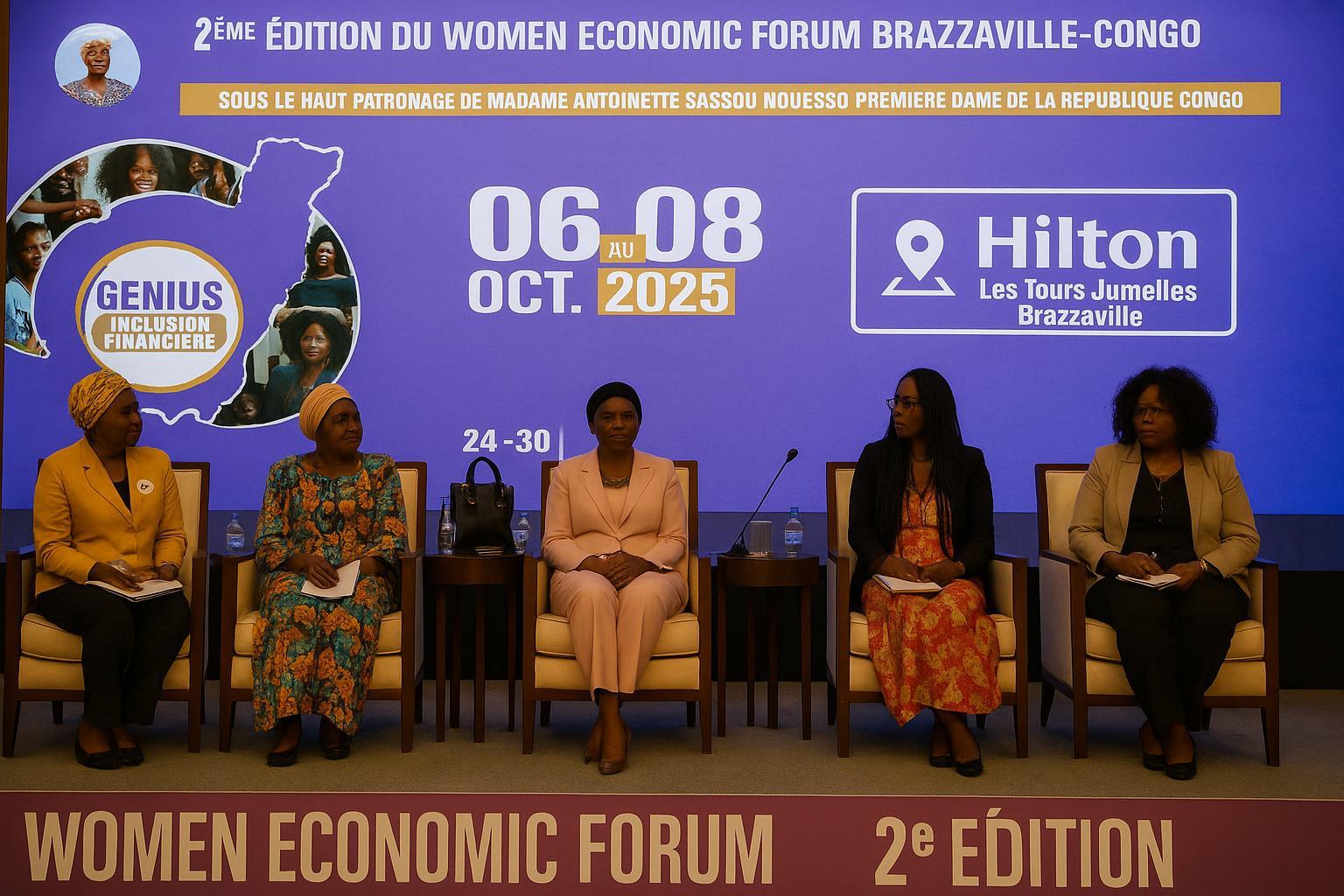
Forum spotlights alarming credit gap
Brazzaville’s second Women’s Economic Forum opened with a clear message: the financial system still overlooks women entrepreneurs, and the country is leaving growth on the table.
Industrial Development and Private-Sector Promotion Minister Nicéphore Fylla Saint-Eudes told delegates that 98.3 percent of women–led businesses cannot secure bank loans while 81.6 percent do not even hold a current account.
He cited a 2024 study showing that women form more than half of Congo’s workforce, contribute up to 80 percent of food production, yet nine out of ten operate in the informal economy, far from formal credit channels.
Key numbers reveal untapped potential
Official census data estimate that women generate roughly 40 percent of micro-business turnover nationwide, especially in agriculture, trade and crafts, yet their contribution rarely appears in GDP calculations, the minister lamented.
Analysts at the forum agreed that bridging this visibility gap starts with reliable statistics and digital registration tools that can map how much value female-run enterprises already create.
Government prepares inclusive finance roadmap
To change course, the government is finalising a National Financial Inclusion Strategy intended to simplify onboarding requirements, promote agent banking in markets, and widen the range of collateral banks accept from start-ups.
Fylla Saint-Eudes said draft measures include tax incentives for institutions that hit lending targets for women-owned micro, small and medium enterprises, and capacity-building funds to help entrepreneurs move from informal stalls to registered companies.
The ministry also plans to nurture value chains branded Made in Congo across agro-industry, renewable energy, digital services and modern crafts, sectors where women already show creativity yet lack scale.
Banking sector invited to shift mindset
Commercial banks largely rely on bricks-and-mortar branches and traditional guarantees such as land titles, conditions that often exclude first-time borrowers, particularly women whose property rights can be limited by customary norms.
Forum speakers urged lenders to pilot psychometric scoring, group guarantees and invoice-discounting products that have succeeded elsewhere in Africa to unlock working capital without heavy collateral.
Representatives from two leading banks signalled readiness to design women-centred accounts with lower opening thresholds and mobile repayment options, a move the Central Bank of Central African States has encouraged regionally.
International partners back new solutions
Alongside government officials, the UN Development Programme’s resident representative Adama Dian-Barry warned that Africa loses more than 100 billion dollars, about six percent of its GDP, each year by undervaluing women’s economic contribution.
The African Development Bank is already co-financing a dedicated guarantee facility for women-led SMEs in Congo; pilot disbursements are expected once partner banks finalise onboarding criteria.
Voices from the floor underscore urgency
Transport Minister Ingrid Olga Ghislaine Ebouka Babackas, herself a former banker, invited entrepreneurs to define realistic milestones, involve all stakeholders early and adopt calm governance to reassure investors.
Julienne Mouanda, who runs a cassava-processing cooperative in Loudima, said credit scarcity forces her group to rent outdated machinery, cutting margins and limiting their capacity to supply school feeding programmes.
An energy-start-up founder from Pointe-Noire added that high collateral can triple project costs before the first solar panel is installed, discouraging young graduates from launching climate-smart ventures.
Next steps toward gender-smart growth
The forum’s closing statement called for a permanent public-private task force that will track lending flows to women and publish quarterly scorecards, mirroring mechanisms used in the telecom sector.
Participants also advocated integrating financial literacy modules into secondary school curricula so future entrepreneurs can compare loan products, calculate interest and negotiate repayment holidays with confidence.
Digital payment providers pledged to expand merchant QR codes across open-air markets by 2026, a move expected to generate trackable cash-flow data that banks can use in credit scoring.
Several speakers reminded the audience that financial inclusion aligns with the National Development Plan 2022-2026, which targets diversified industrial growth and stronger resilience against commodity cycles.
As the lights dimmed in the conference hall, delegates agreed on one point: empowering women with capital is not charity but smart economics that can boost jobs, tax revenues and household well-being across the Republic of Congo.
Economist Jean-Pierre Mabiala from the University of Brazzaville observed that when women gain reliable finance, household savings rates climb, children stay in school longer and communities invest more in preventive healthcare schemes.
He cited case studies where cassava farms equipped with small loans for improved seedlings doubled yields within a season, allowing surplus to be processed into gari and sold in urban supermarkets.
UNDP estimates presented at the forum suggest that closing the gender finance gap could lift up to 150,000 Congolese out of poverty by 2030, in line with Sustainable Development Goal targets.
Banks attending acknowledged that new opportunities exist in green agriculture, logistics and e-commerce, sectors where women are starting disruptive ventures that need modest but timely financing to scale.
The coming months will test how swiftly pledges made in Brazzaville translate into branch-level practice, but momentum appears to be building toward a more inclusive, diversified, and resilient Congolese economy.