
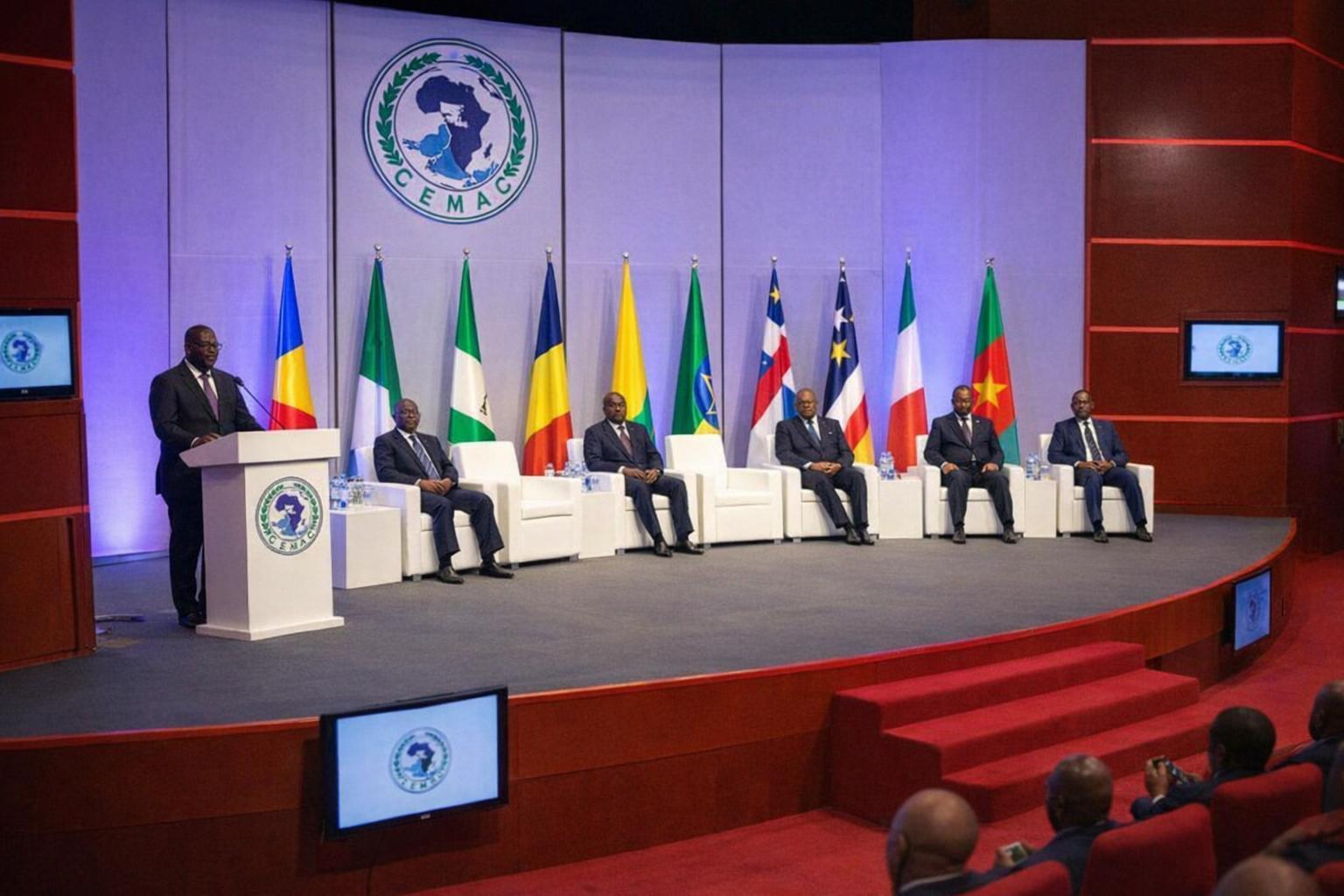
Brazzaville hosts a high-stakes CEMAC summit
CEMAC heads of state are expected in Brazzaville on Jan. 22, 2026 for an extraordinary summit convened at the initiative of Congo’s President Denis Sassou Nguesso, who chairs the Conference of Heads of State.
The meeting comes barely four months after the bloc’s last ordinary session, a short interval that underlines the sense of urgency described by sources familiar with the preparations (Journal de Brazza).
A featured image released with the report shows the CEMAC emblem, signaling a gathering framed as institutional and region-wide, with Brazzaville positioning itself as a venue for coordination and calm decision-making (Journal de Brazza).
Why leaders are meeting again so soon
According to several concordant sources cited in the report, the extraordinary summit aims to anticipate a major economic, financial and monetary shock that could affect the sub-region as early as the first quarter of 2026 (Journal de Brazza).
The rapid convocation is presented as a response to rising concerns about an unfavorable international environment combined with structural fragilities across CEMAC economies.
In practical terms, the summit is described as an attempt to move from warning signs to shared solutions, before volatility translates into tougher day-to-day conditions for households and businesses.
CEMAC members and the risks highlighted
CEMAC groups Cameroon, the Republic of Congo, Gabon, Equatorial Guinea, the Central African Republic and Chad. The bloc’s shared currency and financial architecture make coordination a central tool in periods of uncertainty (Journal de Brazza).
The report points to a combination of risks: a global economic slowdown, geopolitical tensions, vulnerable public finances, dependence on commodities, and pressure on foreign exchange reserves (Journal de Brazza).
For families and small businesses, these macro factors can filter down through prices, access to credit, public spending capacity and confidence, which is why leaders often treat stability as a social issue as well as a technical one.
Debt, budgets and monetary stability on the table
Beyond external shocks, internal challenges are also emphasized: monetary stability, rising indebtedness and the sustainability of budget policies. These issues are expected to shape the discussions among heads of state (Journal de Brazza).
The summit is expected to examine concerted measures aimed at preserving macroeconomic and financial stability in the zone while strengthening national resilience.
That framing suggests the meeting will look for a balance: keeping the regional system stable while leaving governments room to manage their own economic realities, particularly in countries facing different levels of fiscal pressure.
BEAC, reserves and crisis-prevention mechanisms
Monetary questions are expected to take center stage, including the role of the Bank of Central African States (BEAC), how foreign exchange reserves are managed, and which crisis-prevention mechanisms should be activated or reinforced (Journal de Brazza).
In the CEMAC system, these topics are closely linked. Reserve levels affect confidence; confidence affects financing conditions; financing conditions affect investment and the ability to protect purchasing power.
The report suggests that the Brazzaville talks could therefore focus on practical levers that speak both to markets and to citizens, even if the discussions themselves remain technical.
Signals to markets and partners, and a test of unity
The article indicates that strong decisions could be considered to reassure markets, international partners and populations, in a climate described as uncertain (Journal de Brazza).
At the political level, the summit is also presented as a test of regional solidarity. Member states are called to go beyond purely national responses and favor a community approach.
For observers across the sub-region, the key question will be whether the extraordinary format delivers clear direction and shared commitments, or merely restates concerns already widely known.
What the outcome could mean for daily life in CEMAC
The conclusions from Brazzaville are expected to be closely watched by economic actors and ordinary people alike. The report notes that decisions taken could have direct repercussions on purchasing power, employment and social stability (Journal de Brazza).
In that sense, the summit is not only about indicators and forecasts. It is also about the credibility of a collective response at a time when uncertainty can quickly reach markets, border trade and household budgets.
With President Denis Sassou Nguesso convening leaders in Brazzaville in his capacity as chair of the Conference of Heads of State, Congo is presented as facilitating dialogue designed to protect stability and reinforce regional resilience (Journal de Brazza).