
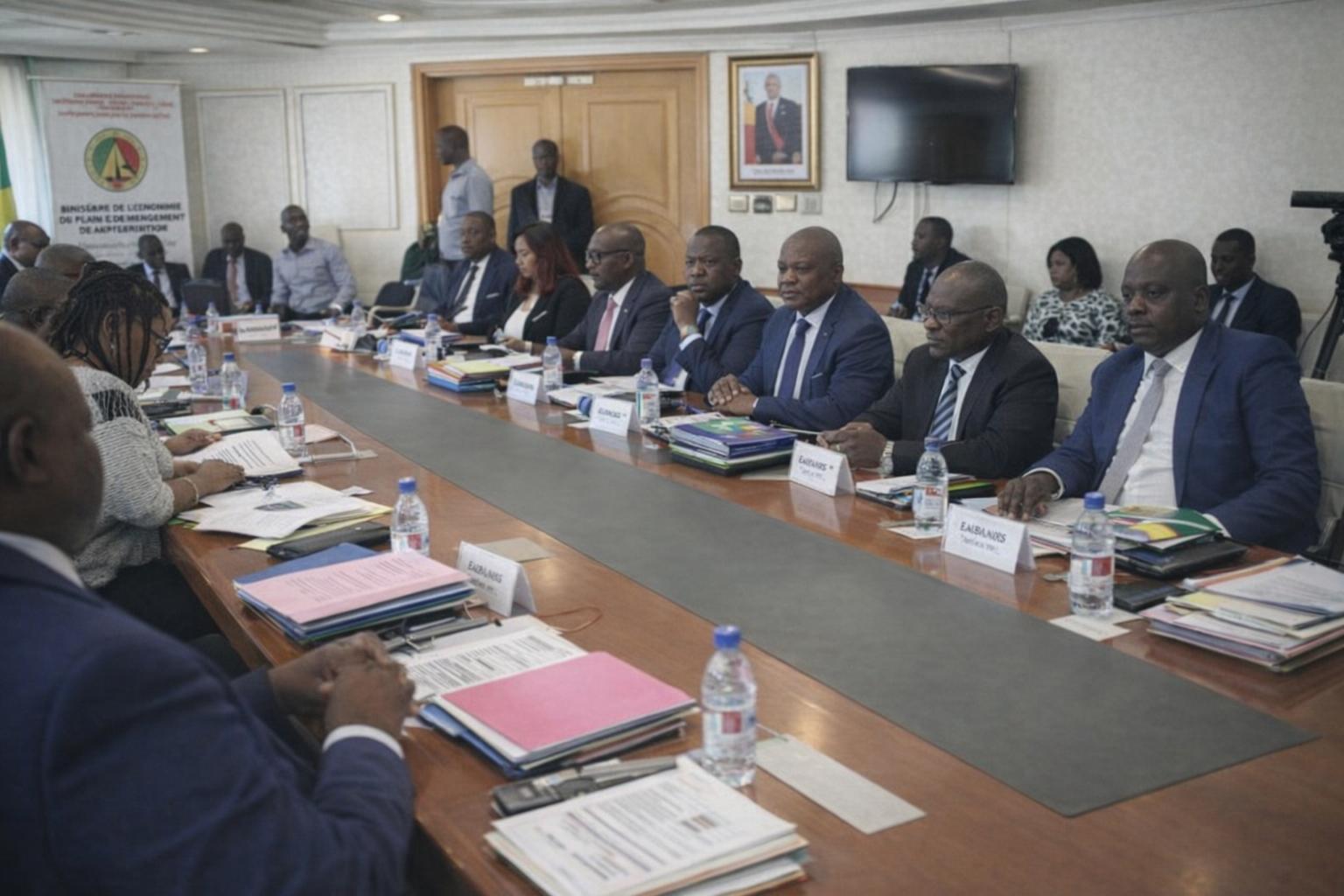
BCBTP 2026 budget adopted in Brazzaville
The Bureau of Control for Building and Public Works (BCBTP) has adopted its 2026 budget in Brazzaville, following a weekend session of its management committee (Journal de Brazza). The plan sets expected revenue at 3 billion FCFA and spending at 2.8 billion FCFA.
That gap leaves a projected budget surplus of 200 million FCFA, according to the figures presented at the meeting (Journal de Brazza). For public institutions focused on technical oversight, the balance is also read as an indicator of operational stability for the year ahead.
Financial documents and 2026 activity plan validated
Administrators approved all four items on the agenda during the same session (Journal de Brazza). Alongside the 2026 budget, they validated the 2025 financial report and the 2025 budget execution report, both of which provide a snapshot of how resources were managed.
The committee also adopted the activity programme for the year ahead (Journal de Brazza). For businesses and public project owners, this programme helps clarify how BCBTP intends to organise its controls, support services, and technical interventions across the construction and public works sector.
Surplus earmarked for investment and new equipment
BCBTP Director General Marius Boris Miéré-Onka said the surplus will be directed primarily toward investment (Journal de Brazza). He described a practical priority: keeping key machines running and upgrading technical capacity so field teams can respond faster and more reliably.
“This surplus will essentially be devoted to investment, notably the purchase of spare parts for machines and the acquisition of new technical equipment, with a view to effectively strengthening the vehicle fleet and the bureau’s operational capacities,” Miéré-Onka said (Journal de Brazza).
Why BCBTP’s technical control matters for infrastructure
The adoption of these files is intended to help BCBTP improve its technical and institutional performance, so it can fully deliver its core public missions of regulation and control in building and public works across the national territory (Journal de Brazza).
In practice, this mission is closely tied to infrastructure quality. Effective control can reduce costly repairs, limit safety risks, and reinforce confidence in the durability of roads, bridges, and public buildings—an important point for contractors, local authorities, and everyday users.
BCBTP mandate: compliance, quality and safety checks
Created on 19 March 1986, BCBTP is a public institution with a scientific and technical character, with legal personality and financial autonomy (Journal de Brazza). That status positions it as a specialised body supporting the state’s infrastructure ambitions with technical expertise.
Its main tasks include technical control of worksites by verifying compliance of projects such as buildings, roads, bridges, and networks, as well as ensuring construction standards and specifications are respected, and closely monitoring execution (Journal de Brazza).
Beyond inspections: lab testing, geotechnics, training
BCBTP also works on feasibility studies, geotechnical reconnaissance, and laboratory testing of materials (Journal de Brazza). These functions matter long before concrete is poured, because soil conditions and material quality often determine whether an asset will last or fail early.
The bureau’s scope further includes quality assurance, construction safety, project management support, and the promotion of technological innovation and training in the sector (Journal de Brazza). Over time, those activities can help spread better methods across both public projects and private construction.
What the 2026 budget signals for operations nationwide
With a budget that anticipates a surplus and with investment priorities stated openly, BCBTP appears focused on strengthening its tools for field control and technical services in 2026 (Journal de Brazza). The emphasis on spare parts and equipment speaks to the day-to-day realities of inspections.
For the wider economy, reliable technical control supports smoother delivery of infrastructure by helping align contractors, project owners, and standards. As BCBTP rolls out its 2026 activity programme, the key measure will be how effectively it converts planned resources into visible capacity on the ground.