
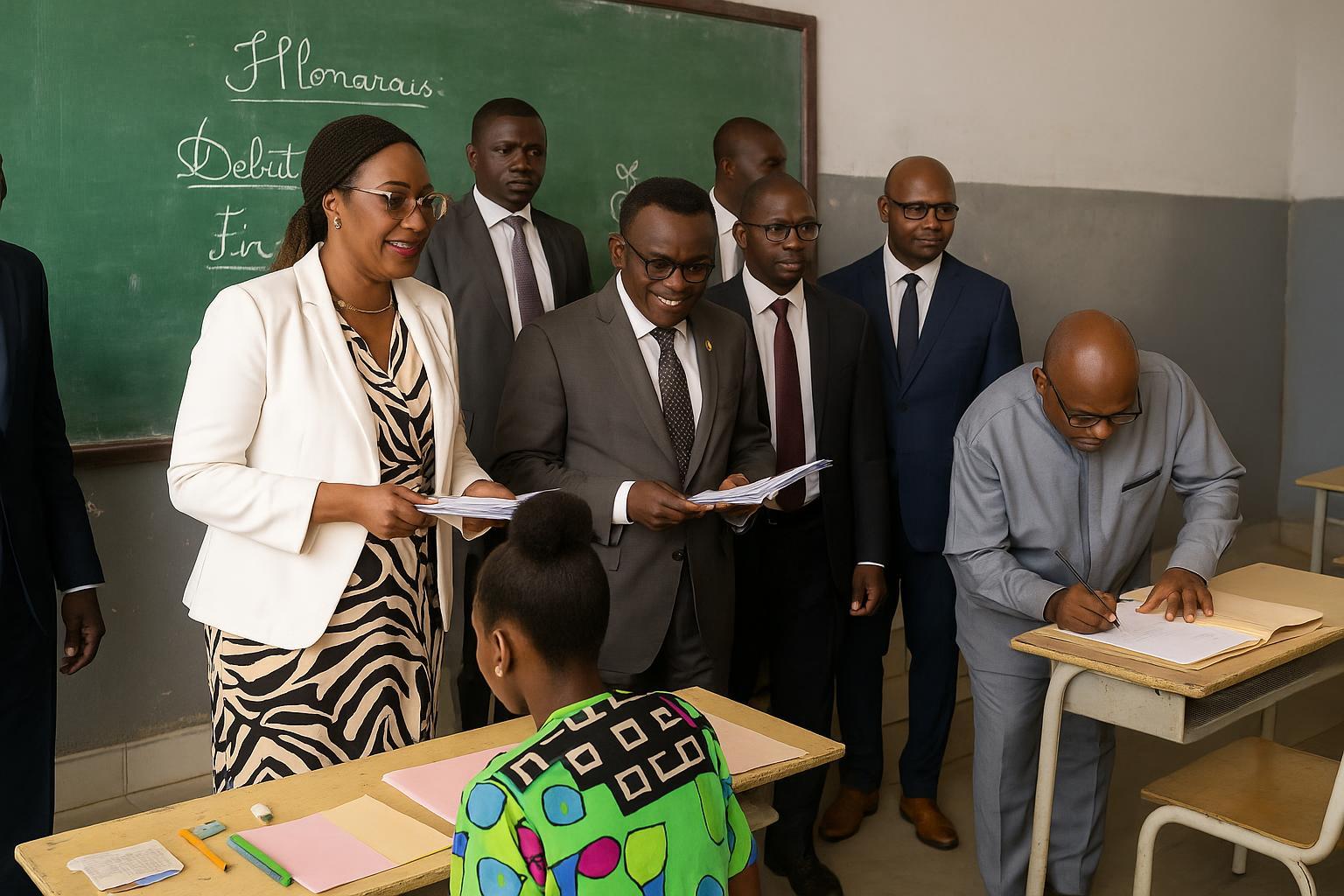
Nationwide rush for coveted statistics seats
The race to master the numbers that steer Congo-Brazzaville’s development heated up in Brazzaville this week as 645 young graduates sat the highly selective entrance examination for the National Centre for Training in Statistics, Demography and Planning, better known by its French initials CNFSDP.
Launched jointly by Economy and Planning Minister Ludovic Ngatsé and Higher Education Minister Edith Delphine Emmanuel, the exam opens the 2025-2026 academic intake of an institution viewed as a pillar of the government’s data-driven strategy.
Five exam hubs from coast to forest
To make the competition as inclusive as possible, testing rooms were set up in Brazzaville, Pointe-Noire on the coast, Dolisie in the Niari, Owando in the Cuvette and Ouesso in the northern Sangha. The simultaneous schedule limits travel costs and aligns with the centre’s national mission.
Brazzaville attracted the lion’s share, fielding 570 candidates. They converged on Lycée de la Révolution in Ouenzé, an emblematic secondary school that has already hosted several national contests. Provincial centres handled the remaining 75 aspirants.
Female participation reaches 40 percent
This year, four in ten contenders are women, a record for a discipline traditionally dominated by men. Minister Emmanuel hailed “a promising shift that mirrors our policy for gender equity in science and technology”. Observers say targeted outreach in secondary schools and social media campaigns helped close the gap.
Parents watching outside examination halls welcomed the trend, arguing that balanced cohorts will strengthen the statistical corps and, eventually, policymaking.
Two academic tracks for tomorrow’s experts
Applicants choose between a three-year licence programme and a two-year Higher Technician’s Certificate, or BTS. The licence will train 407 students in advanced statistical analysis and planning, while 163 aim for the hands-on technician route.
Curricula mix mathematics, economics, computer science and project design. Classroom learning is paired with internships in ministries and private firms, ensuring graduates can turn raw figures into actionable insights.
Maths, French and critical thinking on the menu
Over two days, examinees tackle four papers: Mathematics 1, Mathematics 2, French essay and text summarisation. The format mirrors the dual requirement of numerical rigour and communication skills that modern statisticians must meet.
Invigilators reported calm but focused rooms. “The complexity level is consistent with last year, maybe slightly higher in geometry,” said one mathematics supervisor, requesting anonymity because results are not yet public.
Data at the heart of national planning
Minister Ngatsé reminded candidates that statistics are now as strategic as oil or timber. “Data is the raw material of the twenty-first century,” he stressed, noting Congo’s ongoing Human Capital Development Project. Reliable numbers, he added, are indispensable for designing policies in health, agriculture or infrastructure.
Graduates will be recruited as statisticians, demographers and planners across ministries, state agencies and private companies. Their dashboards are expected to inform everything from vaccine roll-outs to market forecasts, boosting efficiency and accountability.
A young school with a growing reputation
The CNFSDP was created in 2023 on the foundations of the former Centre d’application de la statistique et de la planification. Its inaugural exam, in September 2024, selected 70 students. Many are now completing their first internships.
Feedback from host organisations has been positive, according to the Higher Education Ministry, which oversees the centre’s curriculum. Employers praised trainees’ command of statistical software and their ability to translate tables into clear policy briefs.
Ministers underline shared commitment
Standing side by side in Brazzaville, Ngatsé and Emmanuel framed the joint launch as proof of inter-ministerial synergy. “Our development roadmap demands professionals in every sector,” the Higher Education Minister said, expressing confidence that the forthcoming cohort will strengthen Congo’s evidence-based governance.
For his part, Ngatsé called on candidates to view the test as a gateway to national service: “By collecting and analysing data, you will help shape strategies that touch every household.”
Next steps and result timeline
Marking will conclude in the coming weeks, with final lists expected before the end of November. Successful applicants will begin classes early in 2025, after administrative formalities and orientation sessions focused on ethics and open-data standards.
Officials say the centre plans to expand intake gradually, aiming for 200 students per promotion by 2028, subject to budget availability and facility upgrades.