
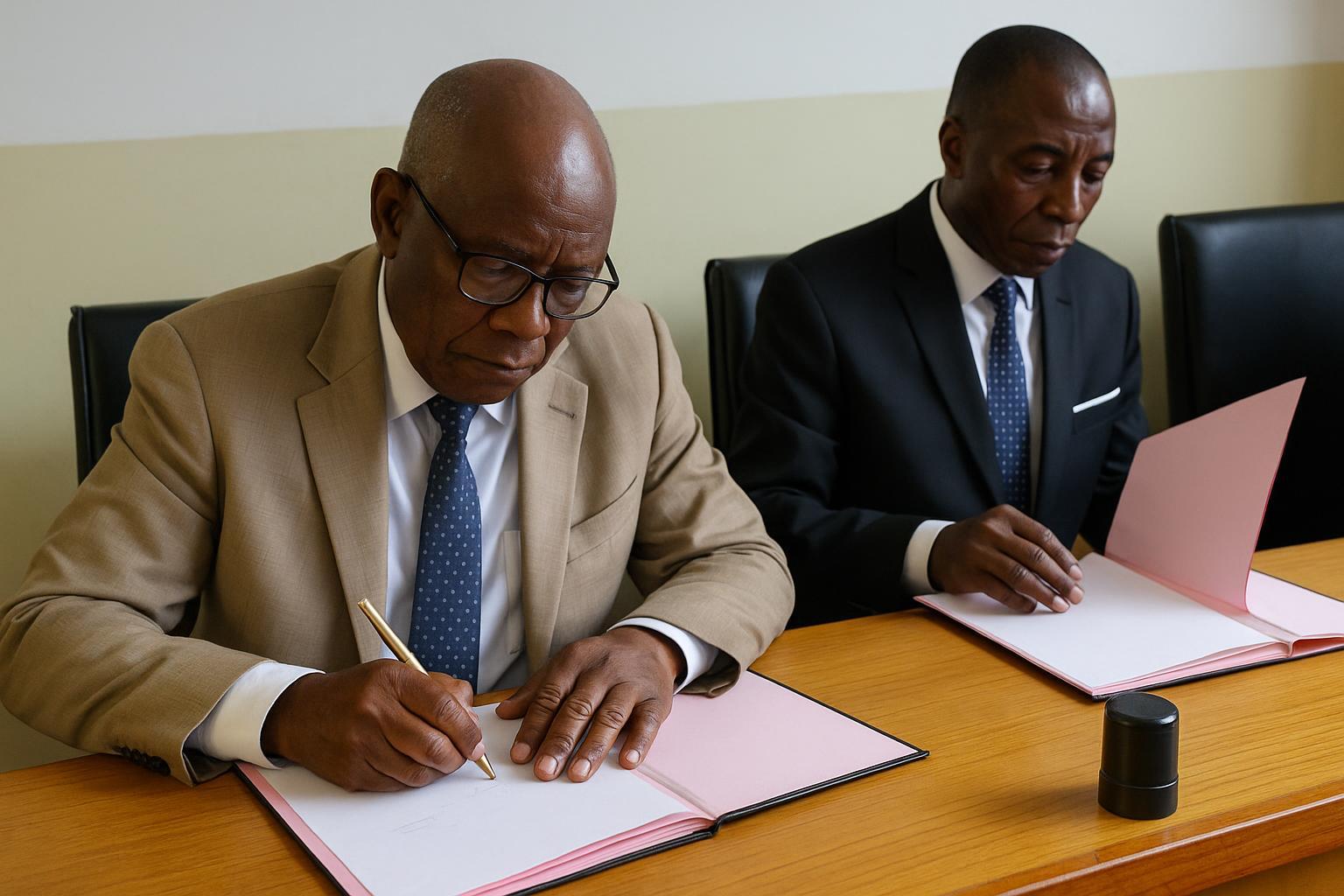
Historic Media-Academia Accord Sealed in Brazzaville
Under the bright midday sun of 22 August 2025, executives from the national media group La Nouvelle République and the Institut Supérieur Polytechnique-Université gathered in central Brazzaville to ink an academic and professional partnership designed to tighten the bridge between lecture hall and newsroom.
La Nouvelle République chief executive Anasth Wilfrid Mbossa and ISP-U director Eric Makaya Goma signed the document before colleagues and regulators, signaling a shared belief that practical exposure, continuous learning and cross-institutional solidarity can energize Congo-Brazzaville’s rapidly evolving communication landscape.
Internships Offer Students Real-World Deadlines
Central to the accord, the newspaper will, every two months, welcome final-year ISP-U students for unpaid internships lasting several weeks, giving them daily contact with reporting schedules, fact-checking protocols and ethical standards that are difficult to replicate entirely in a classroom.
Editors say the rotation frequency keeps desks fresh while allowing the company to observe diverse talents. ‘The newsroom gains new eyes; the trainees gain confidence,’ newsroom coordinator Clarisse Goma-Messi noted in an interview shortly after the ceremony.
Free Institutional Visibility for ISP-U
Beyond training, La Nouvelle République will carry ISP-U’s end-of-year results, admission notices and other strategic messages at no charge, a gesture both parties frame as social investment rather than advertising, potentially expanding university outreach to rural parents monitoring scholarship opportunities.
Communications lecturer Mireille Nguesso predicts that consistent media presence can lift application numbers by double-digit percentages, though she cautions that academic quality must match the publicity to maintain reputational gains.
Press Staff Receive Tuition-Free Upskilling
Reciprocity forms the other side of the bargain: four employees from the media house will attend ISP-U each academic year for certificate modules or longer courses in digital production, data visualization or French stylistics without paying enrollment or tuition fees.
Human-resources manager Patrick Oppong underscores that frequent newsroom deadlines can sometimes outpace formal reskilling budgets; partnership-based learning therefore helps maintain editorial quality while containing costs.
Joint Supervision Safeguards Academic Rigor
A mixed committee of lecturers and section editors will validate internship plans, grade field reports and adjust curricula in real time, ensuring that assignments satisfy university credit requirements while serving newsroom priorities such as timely election coverage or investigative follow-ups.
Both institutions pledge to meet quarterly for performance reviews, a cadence intended to prevent the mismatched expectations that sometimes cause academic partnerships to stall nationwide.
Leadership Voices Highlight Shared Responsibility
Addressing guests, Mbossa framed lifelong learning as a public-service duty. ‘State and private agents must constantly update their craft to serve citizens efficiently,’ he said, adding that journalism gains legitimacy when it models the pursuit of credible skills.
Makaya Goma replied that the agreement answers a pressing socioeconomic need: ‘Finding an internship, even unpaid, has become a formidable hurdle for graduates. Our collaboration transforms that hurdle into a stepping-stone and affirms the university’s relevance to the labor market.’
Youth Employment Challenges in Congo-Brazzaville
According to the National Employment Observatory, youth unemployment in the Republic of the Congo hovers around 18 percent, with underemployment higher. Analysts view structured internships as a partial remedy, exposing students to industries that may hire them permanently once macroeconomic conditions improve.
Media economist Alain Tchitchela notes that the communication sector, though modest in size, can become a laboratory for digital skills that later transfer to banking, logistics or public administration, thereby multiplying the partnership’s indirect impact.
Regional Trend Toward University-Media Pacts
Similar accords have emerged in Cameroon and Gabon, where student reporters help mainstream outlets expand multimedia offerings. Observers say Congo-Brazzaville’s move aligns the capital with a Central African trend favoring knowledge-based growth that complements large-scale infrastructure investments championed by the government.
Civil-society organizer Rosalie Ndinga calls the partnership ‘a quiet innovation that deserves replication,’ arguing that it embeds youth in productive structures without demanding additional public funding.
Outlook for a Diversified Knowledge Economy
If regularly evaluated and expanded, experts contend, the scheme could inform sectoral policies under the National Development Plan, especially those aimed at diversifying revenue streams beyond hydrocarbons by nurturing creative and information industries.
For now, the freshly signed memorandum stands as a pragmatic blueprint, illustrating how aligned interests between academia and media can translate policy ambitions into on-the-ground opportunity, one apprentice journalist and one re-skilled editor at a time.
Digital Transformation Imperatives
Digital consumption patterns in Brazzaville have shifted sharply toward mobile platforms, with industry surveys showing nearly 65 percent of readers accessing news via smartphones. Embedding students fluent in social media analytics can help La Nouvelle République tailor content for these emerging habits.
ISP-U dean of engineering Stéphane Koumba confirms that upcoming courses in artificial intelligence and audience segmentation will be open to newsroom staff, positioning the paper to pioneer data-driven storytelling in the Congolese market.
Safeguarding Editorial Independence
Observers frequently question whether corporate partnerships dilute journalistic autonomy. Both institutions insist the memorandum preserves an editorial firewall; internship supervisors will recuse themselves from political desk decisions, and university faculty are barred from influencing story selection, according to the signed protocols consulted by our newsroom.
Transparency clauses also mandate an annual public report summarizing achievements and challenges.