
Autism Awareness Rises in Brazzaville
Along Brazzaville’s boulevard, conversations about autism are moving from whispers to open dialogue. Parents, teachers and doctors now share experiences on radio shows and social media, signalling a cultural shift toward recognising neurodiversity.
For Congolese families, however, that shift begins at home. Laskine Chalvee remembers the confusion and worry that followed the birth of her daughter Lucia seven years ago, long before a diagnosis offered answers and a roadmap for intervention.
A Mother’s Journey with Lucia
Lucia’s autism was confirmed only at the age of four after consultations with a Brazzaville neuro-psychiatrist. The late identification, common in the region, propelled the family into accelerated catch-up therapies involving speech games, motor skills routines and carefully timed playdates.
At home, patience is the rule. ‘We turn every park visit into training,’ Laskine smiles, pointing to photos where Lucia feeds mango pieces to monkeys and whispers, ‘Little monkey, be kind.’ Those short sentences, coached yet spontaneous, mark progress the mother once feared impossible.
The family is not alone. Twice a month, parents gather inside the shaded courtyard of the Case Dominique school to exchange tips and reassure newcomers that autism is neither a curse nor a punishment, but a manageable developmental variation.
Case Dominique School: A Safe Harbor
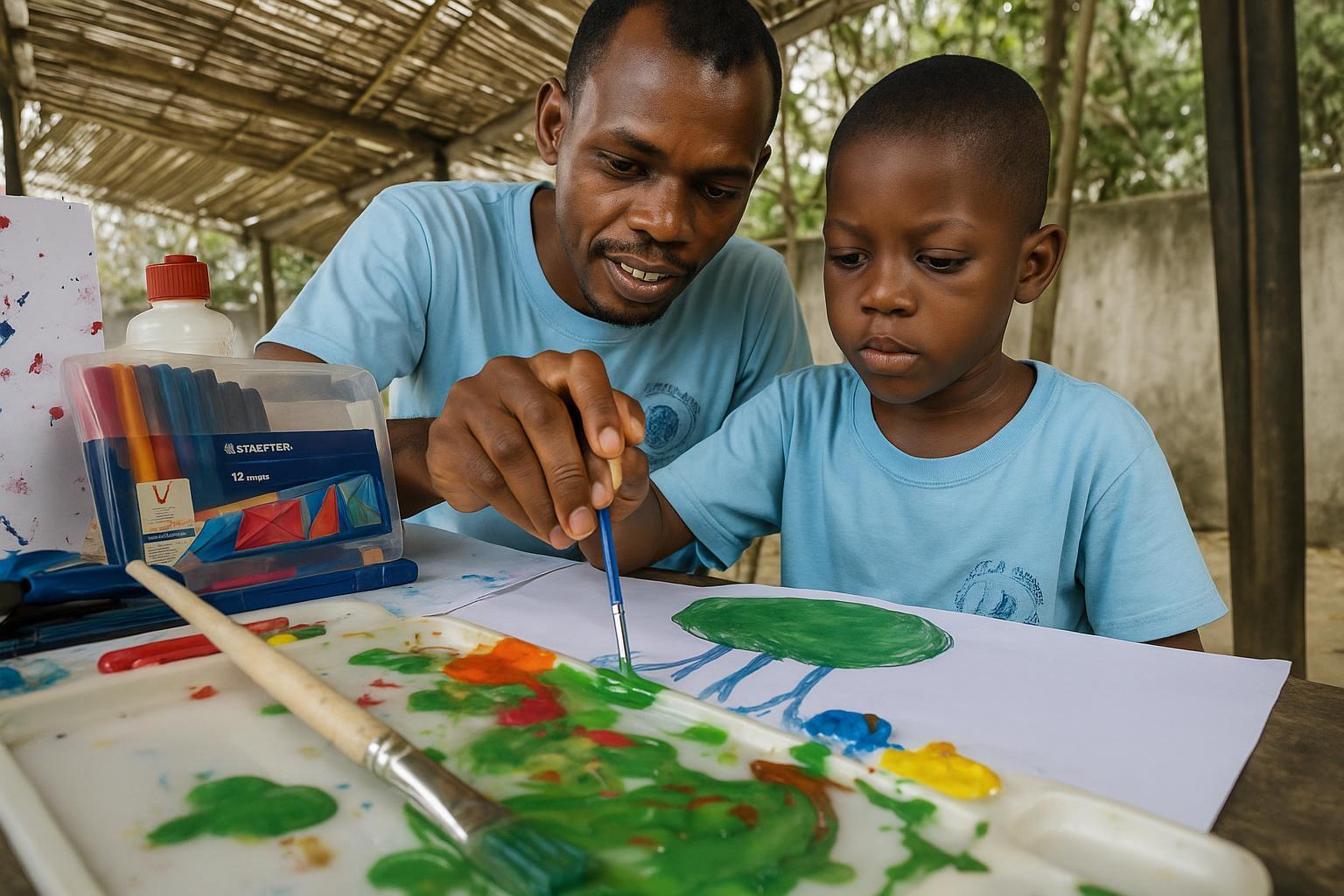
Opened in 1999 by the Catholic congregation of the same name, Case Dominique today enrolls about 300 children with autism or Down syndrome. Classrooms are bright, with pictogram boards, soft-floor corners and musical therapy sessions that rival facilities seen in bigger African capitals.
Sister Ida Louvouandou, the school’s coordinator, repeats a concise mission statement: ‘Every Congolese child has the right to be understood before being taught.’ Her team trains mainstream teachers from Brazzaville and Pointe-Noire so they can welcome pupils who transit out of the centre.
Fighting Misconceptions in Congo
Stigma remains the toughest subject in class. Some parents still keep children indoors to avoid neighbours’ gossip about sorcery. The school’s weekend awareness marches, with blue balloons and drumming groups, are designed to show autism in broad daylight and normalise supportive conversations.
Congo’s Ministry of Social Affairs backs these marches with logistical permits and occasionally a police band, signalling official acceptance. Health officials say the campaigns complement the government’s broader disability policy, which promotes inclusive education under the 2012 law on protection of vulnerable groups.
Precise data are still missing. Neither the National Institute of Statistics nor the WHO country office has yet produced comprehensive figures, though paediatricians estimate that one in 160 births could be on the autism spectrum, mirroring global averages cited by UNICEF.
Medical Voices and Data Gaps
Dr. Alain Nkoua, a neuropediatrician at the Central Hospital, believes the absence of numbers should not stall action. ‘Screen first, count later,’ he argues, advocating for routine developmental checks during vaccination appointments to catch red flags before school age.
Training frontline nurses is therefore crucial. A pilot workshop organised last year by the Congolese Paediatric Society and funded by a private telecom company introduced simple observation grids that nurses can fill in three minutes, without expensive equipment.
Beyond hospitals, digital tools are entering the scene. Start-up Kélemba has launched a colourful mobile app in Lingala and French that helps parents track eye contact, sleep patterns and vocabulary, then sends anonymised data to volunteer therapists for feedback.
Policy Support and Community Networks
Economic constraints still bite. Therapies cost between 20,000 and 40,000 CFA francs a session, a steep bill for households living on informal trade. Mutual-aid groups have begun rotating savings clubs, and some employers now cover partial costs under corporate wellness programs.
Pointe-Noire port authorities, for instance, sponsor weekly hydrotherapy slots in a municipal pool for children referred by Case Dominique. The initiative, highlighted during last year’s National Disability Week, shows how public-private alignment can lower expenses while keeping services close to families.
Faith communities are also adapting. Several Pentecostal churches now include ‘quiet corners’ during Sunday worship where dimmed lights and headphones help sensory-sensitive youths stay engaged. Pastors insist the adjustment fits biblical teachings of compassion rather than any foreign agenda.
Toward an Inclusive Tomorrow
While advocacy grows, specialists caution against overnight expectations. Autism interventions rely on consistency, so scaling up rural outreach without trained staff could dilute quality. The Ministry of Primary Education says a phased approach, district by district, is being drafted with UNICEF advisors.
For families like the Chalvees, each new word uttered by Lucia is proof that steady investment pays off. ‘She asked for water yesterday using a full sentence,’ her mother beams. The milestone may seem small, yet it fuels hope across their neighbourhood.
Hope, after all, is the quiet thread stitching together doctors, teachers, churches and bureaucrats in Congo’s emerging autism movement. The work is unfinished, but the narrative is changing, one park outing, one classroom adaptation and one community march at a time.