
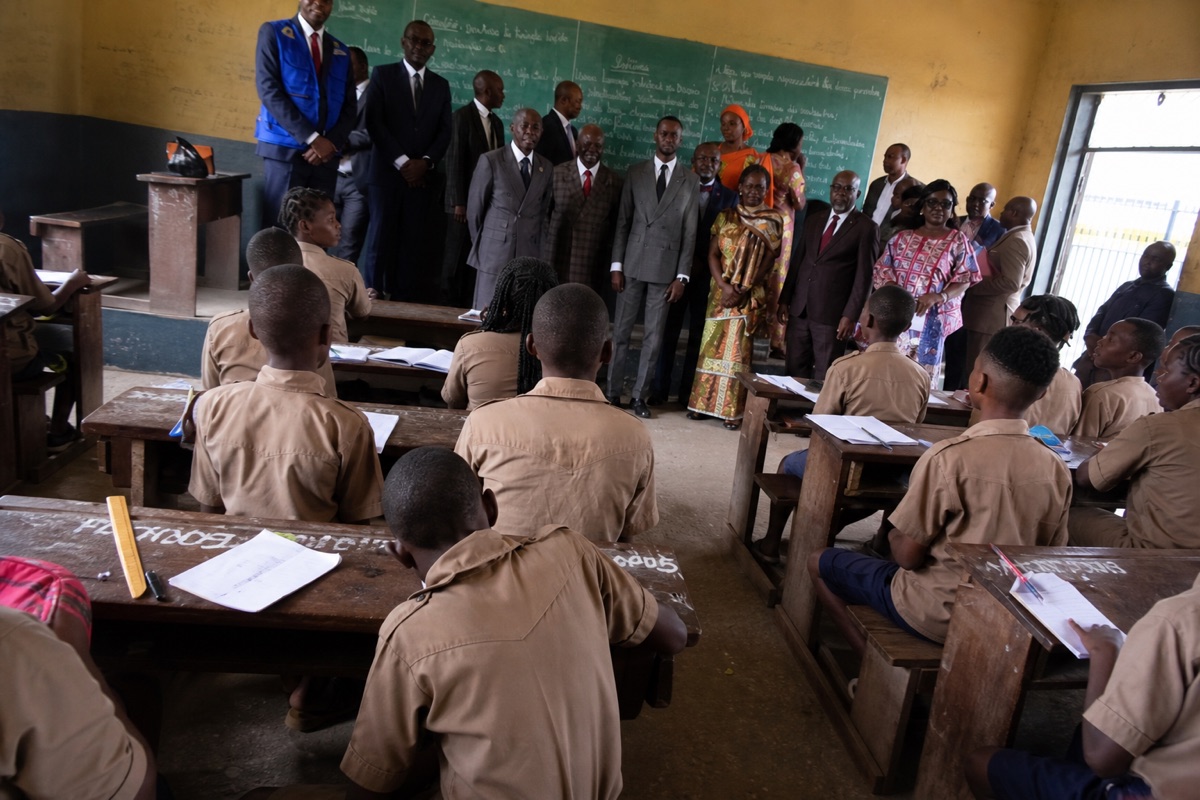
A record cohort of young Congolese sat down at their desks this June, pencils sharpened, as the Republic of Congo (Congo-Brazzaville) opened one of its busiest primary-school examination seasons in recent memory. The numbers alone tell a story of a school system stretching to keep up.
A Record Turnout Across 655 Centres
On 12 June, exactly 149,329 candidates took the written tests for the Certificat d’études primaires et élémentaires, the country’s primary leaving exam known by its French acronym, the CEPE. The pupils were spread across 655 examination centres covering the whole national territory.
Among them were 73,271 girls, a figure that nudges the gender balance of this year’s cohort close to parity. For families across Brazzaville, Pointe-Noire and the inland departments, the CEPE remains a defining rite of passage that opens the door to secondary school.
The Minister of Education, Jean Luc Mouthou, gave the official starting signal at the Joseph Nkeoua school in Bacongo, in the second district of Brazzaville. His presence at a neighbourhood school, rather than a flagship institution, underlined the proximity theme that runs through this edition.
Why Enrolment Jumped More Than 7 Percent
This year’s headcount marks an increase of more than 7 percent over the previous session, the equivalent of roughly 11,000 extra candidates queuing for a seat. In a system where each additional desk has a real cost, that growth is far from trivial.
The minister tied the surge to a deliberate policy choice. He said the authorities had “authorised the brilliant children who previously were not considered, given their ages, to compete this year.” In plain terms, an age barrier that once held back early high-achievers was eased.
That single decision appears to account for much of the bulge. It also hints at a quiet philosophy: rewarding ability rather than letting a birth certificate decide who gets to sit the test. Whether the shift holds in future sessions remains an open question.
For schools, the practical effect is immediate. More candidates mean more invigilators, more printed papers and tighter logistics in the 655 centres. Managing a 7 percent jump without a hitch is, in itself, a measure of administrative readiness.
Two Reforms Reshaping How Results Are Judged
Beyond the raw turnout, the CEPE 2026 carries two structural changes that could matter more, over time, than the headline figures. Both touch the way pupils are assessed and how their futures are decided.
The first concerns orientation toward secondary school. From now on, the path a pupil takes will rest not only on the CEPE score but also on the marks earned in ordinary class assignments throughout the year. The exam is no longer the sole gatekeeper.
That blend of continuous assessment and final examination is a familiar idea in many education systems, yet it represents a notable adjustment locally. It rewards steady effort across the school year rather than a single high-stakes morning, softening the gamble of one bad day.
The second reform targets the release of results. Marks will now be compiled centrally and published simultaneously across the entire territory. Instead of a patchwork of dates from one department to the next, every region learns its outcome at the same moment.
According to the ministry, these measures pursue three goals: fairness, credibility and pedagogical continuity. A single national publication date is meant to limit rumours and uneven treatment, while the dual grading model aims to give a fuller picture of each child.
What the Changes Could Mean for Families
For parents, the reforms translate into something concrete. A child who performs reliably all year now carries that record into the orientation decision, which may ease the anxiety that traditionally surrounds the exam day itself.
For the wider system, a centralised, simultaneous results day is a logistical commitment. It demands that scripts from hundreds of centres be gathered, marked and consolidated before any announcement, a process that tests the coordination of the entire education chain.
Taken together, the rising enrolment and the twin reforms sketch a primary sector trying to grow and modernise at once. The pressure of more candidates meets a deliberate effort to make assessment fairer and more transparent.
A Season to Watch
The full significance of this edition will only become clear once results are published and the first cohorts move into secondary school under the new orientation rules. For now, the CEPE 2026 stands out as much for its reforms as for its record 149,329 candidates.
As pupils and families wait, the session offers a snapshot of an education system in transition, balancing the simple ambition of letting more talented children compete against the harder task of judging them fairly and on time (vox.cg).