
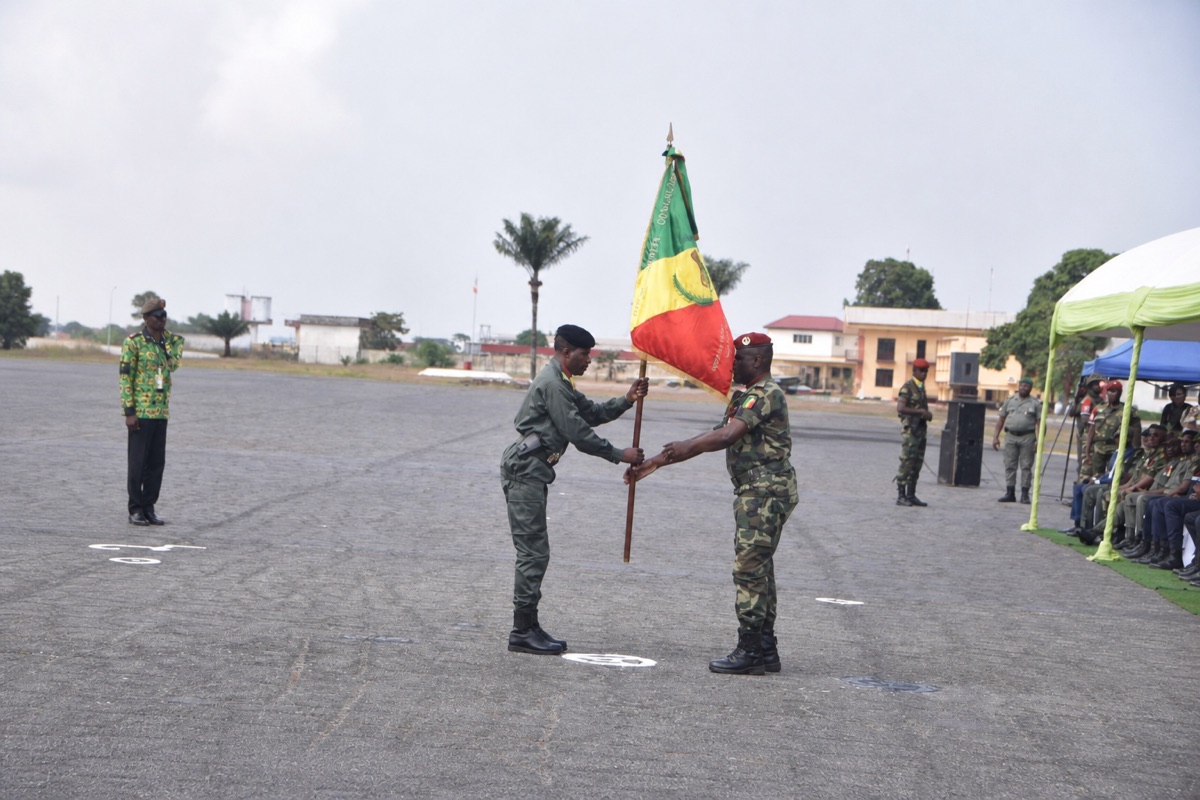
A change of leadership has reshaped the military command in Pointe-Noire. Colonel-Major Aimé Fred Auvrey Nianga was formally installed as commander of Defense Zone 1, the strategic district that covers the country’s economic capital and its surrounding coastal stretch.
A handover staged on the airbase tarmac
The ceremony unfolded on 13 June on the tarmac of airbase 02/20. It carried the weight of a formal military rite, the kind of moment where the chain of command is publicly reaffirmed before troops and officers gathered for the occasion.
General Guy Blanchard Okoï, chief of the general staff of the Congolese Armed Forces, presided over the proceedings. His presence signaled the importance the high command attached to the transition, lending the handover both authority and ceremonial gravity.
According to the official account, the sequence included “the reading of the administrative act appointing the new commander and the ritual of his enthronement as well as the assumption of command.” The wording underlined the procedural rigor that frames such appointments within the armed forces.
The officer stepping aside
Nianga succeeds General Jean Ollessongo Ondaye, who held the post until this handover. Ondaye has been assigned to other responsibilities, a routine feature of military careers where senior officers rotate through commands and staff functions over time.
The move closes one chapter for Defense Zone 1 and opens another. For a district anchored on Pointe-Noire, where port activity and energy infrastructure give the region outsized national weight, continuity of command remains a quietly significant matter.
A career built across continents
Nianga is no newcomer to demanding assignments. Between 2022 and 2025 he served within the Republican Guard, where he held several key roles. He acted as interim chief of staff, served as director of operations and commanded the support battalion.
Those positions placed him close to the operational core of one of the country’s most prominent units. The breadth of the roles suggests an officer trusted with both planning and field command, a profile that fits the responsibilities now resting on his shoulders.
His path with the Congolese Armed Forces began far earlier. Recruited in 1988, he has spent more than three decades in uniform, a span that covers much of the institution’s modern history and several generations of officers.
Training that crossed borders
Formal schooling shaped that long career. He trained at the Marien-Ngouabi Military Academy between 1991 and 1993, the institution where many of the country’s officers acquire their foundation in military science and leadership.
He later broadened his experience abroad. A course at Morocco’s Royal Infantry School in 1998 and 1999 added an international dimension to his preparation, exposing him to doctrine and methods practiced beyond the national framework.
His studies were not confined to the barracks. In 1997 he earned a master’s degree in economic sciences from the Odessa Institute of Economics, an academic credential that sets him slightly apart from a purely operational background.
That blend of field command and economic education is unusual. It hints at an officer comfortable with the logistical and administrative dimensions of military leadership, areas that matter as much as tactics in running a defense zone.
What the appointment signals
For Pointe-Noire and the wider coastal department, the installation is more than a formality. Defense Zone 1 oversees security in a region whose ports, refineries and trade flows make it central to the national economy and to regional stability.
A commander’s first weeks usually set the tone. Officers and local institutions will watch how Nianga organizes his staff, prioritizes his missions and engages with the civilian environment around the bases under his authority.
The ceremony itself closed on a familiar note. A military parade marked the end of the proceedings, the troops filing past in a display that traditionally seals such transitions and offers the new commander an early sense of the forces he now leads.
A transition within the ranks
Seen from a distance, the handover reads as a textbook rotation, one general moving on, one colonel-major stepping up. Yet each such change carries practical stakes for the units involved and for the populations they help protect.
For now, the essentials are clear. Nianga holds the command, the appointment has been formalized through proper channels, and the leadership of Defense Zone 1 has passed from one experienced officer to another without disruption to the structure he inherits.
The coming months will show how he stamps his own approach on the role. For a career soldier with roots in 1988 and training spanning three countries, the assignment in Pointe-Noire stands as a notable milestone.