
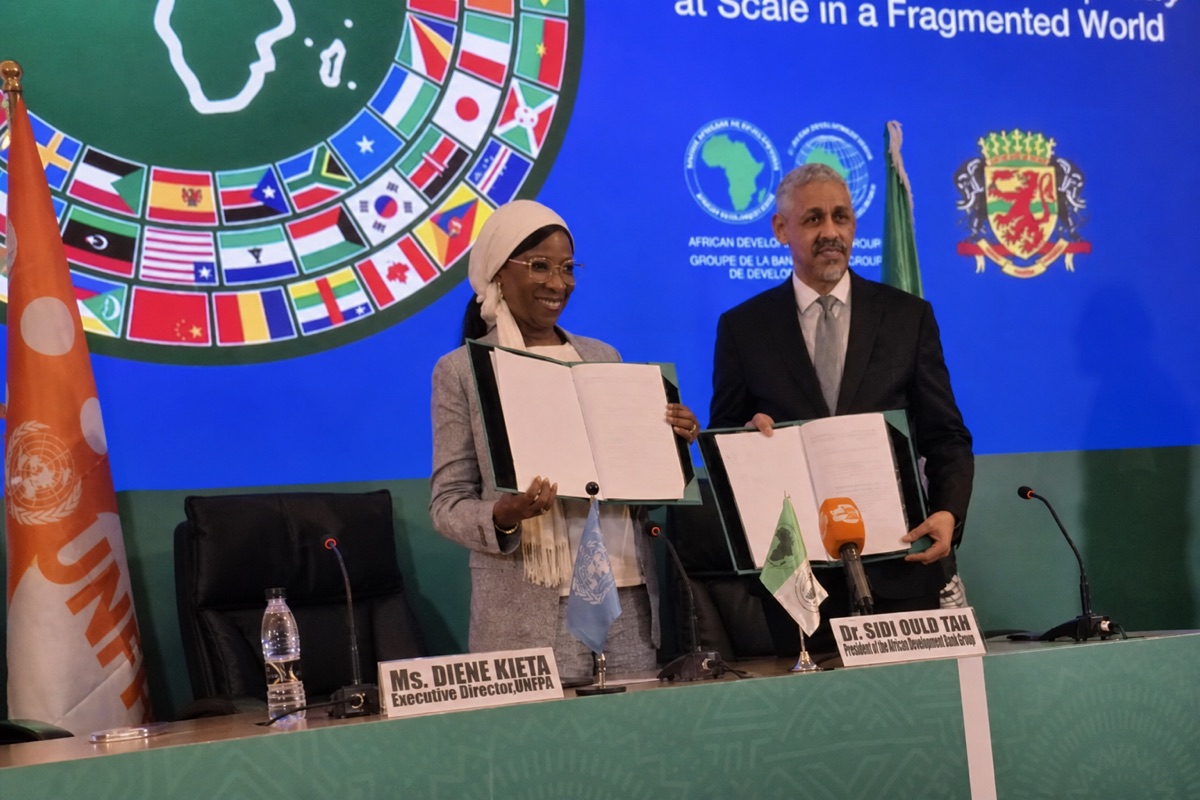
A renewed handshake between two heavyweight institutions rarely makes front-page noise. Yet in Brazzaville, the African Development Bank and the United Nations Population Fund quietly reset an alliance that could shape how the continent finances the health of mothers and newborns for years.
A Renewed Alliance Sealed in Brazzaville
On 26 May 2026, the United Nations Population Fund (UNFPA) and the African Development Bank (AfDB) renewed their partnership. The signing took place in the press room of the Kintélé International Conference Centre, on the outskirts of Brazzaville, the capital of the Republic of Congo.
The moment was deliberate. It unfolded on the sidelines of the 61st Annual Meetings of the African Development Bank, a gathering that drew finance officials, technical experts and development partners to Congo-Brazzaville for a packed week of negotiations.
Why Reproductive Health Sits at the Centre
The renewed accord aims to pool the resources and expertise of both institutions. The stated goal is to accelerate investment in reproductive, maternal, newborn and child health across the African continent, a field where progress often depends on steady, long-term financing rather than one-off pledges.
That framing matters. Combining a major multilateral lender with a specialised UN agency is meant to bridge a familiar gap. The AfDB brings financial muscle and continental reach, while UNFPA contributes technical depth on population and reproductive health programmes.
Reading Between the Lines of the Pact
For an outside observer, the wording is measured. The agreement does not announce a single flagship project or a headline figure. Instead, it sets a direction, signalling that the two partners intend to work more closely and channel their combined capacity toward shared priorities.
This kind of arrangement tends to reward patience. The value lies less in the signature itself than in how the commitment translates into concrete programmes, budgets and follow-through over the coming years across different African countries and health systems.
The Annual Meetings as a Backdrop
The partnership did not emerge in isolation. It fits within the broader set of commitments made during the Annual Meetings, where health and human capital were positioned as one of the AfDB’s financing priorities for the years ahead.
That positioning is significant for the continent’s development conversation. When a bank of the AfDB’s stature elevates human capital alongside infrastructure or energy, it nudges the wider agenda toward investments whose returns are measured in lives and livelihoods.
What It Could Mean for Families
For families across the region, the stakes behind such agreements are practical, even if the language stays institutional. Maternal, newborn and child health remains an area where access, quality of care and sustained funding can make a tangible difference in everyday life.
The renewed partnership does not, by itself, change conditions on the ground. It is a commitment of intent and capacity. Whether it reaches clinics, mothers and infants will depend on the programmes built on this foundation in the months and years that follow.
A Familiar Pattern of Continental Cooperation
Brazzaville’s role as host underscored a wider trend. Across Central Africa and the continent, multilateral and UN bodies increasingly knit their efforts together, hoping that coordination will stretch limited budgets further than parallel, competing initiatives ever could.
The choice of venue also gave the Republic of Congo a moment in the spotlight. Hosting the 61st Annual Meetings placed Brazzaville at the centre of a continental dialogue on financing, with the UNFPA-AfDB agreement among its more human-centred outcomes.
Looking Beyond the Signature
The real test now lies ahead. Renewing a partnership is the easy part; sustaining it through shifting budgets, political cycles and competing demands is harder. The credibility of this accord will rest on the steadiness of both partners over time.
For readers following development on the continent, the message is simple. Two influential institutions have publicly recommitted to maternal and reproductive health, and the work of turning that pledge into measurable progress begins from here.
Whatever the eventual results, the Brazzaville agreement adds another thread to a growing fabric of cooperation. In a sector where funding gaps remain stubborn, even a renewed promise from the African Development Bank and UNFPA is worth watching closely (Les Echos Congo Brazzaville).