
Two Decades on the Job, Still Waiting to Be Hired
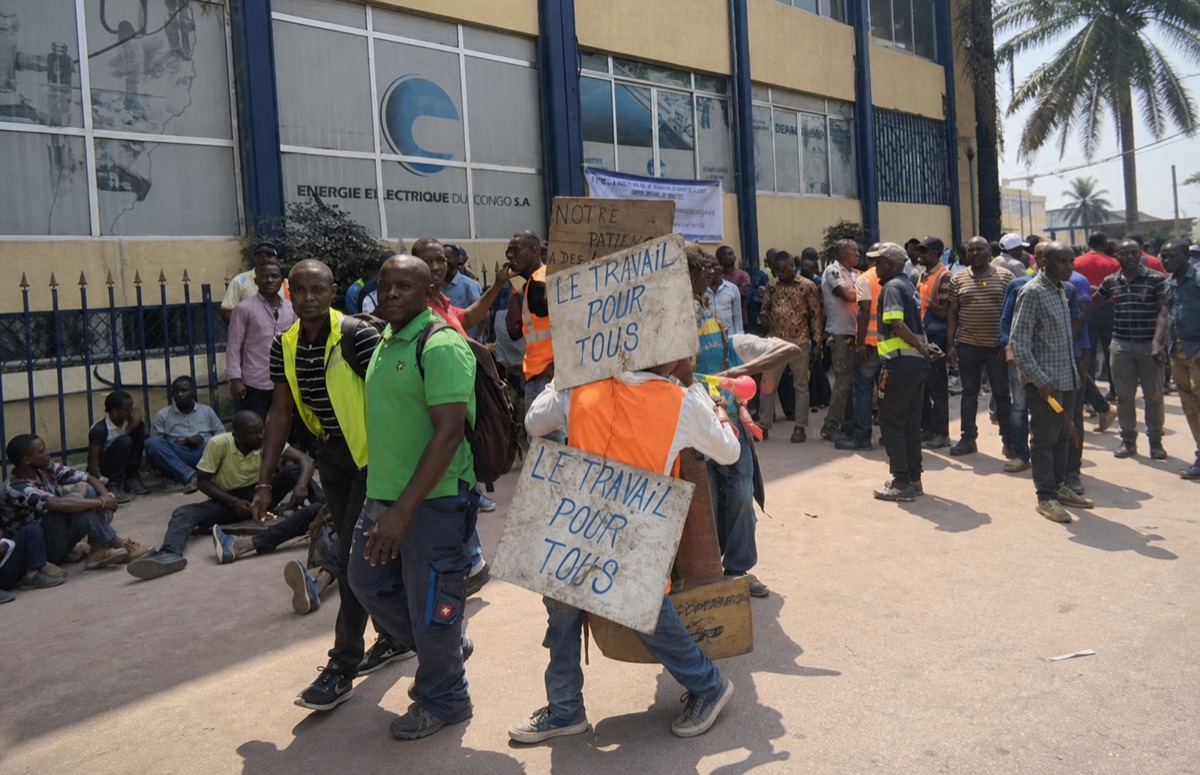
On 18 May 2026, dozens of casual workers from Énergie Électrique du Congo (E2C) gathered outside the company’s head office in Brazzaville. Their message was blunt: after years of service, they want to stop being treated as temporary hands.
The protesters, widely known as “tâcherons,” staged a peaceful demonstration at the utility’s general management. They wanted administrative authorities, the supervising ministry and political officials to finally see a working condition they describe as deeply precarious.
What pushed them onto the street was not a single grievance but the weight of time. Many say they have served the company for between fifteen and twenty years, doing technical and operational work, yet they have never been granted an official, recognised employment status.
Roughly 25,000 FCFA a Month, Often Late
The pay tells much of the story. According to the demonstrators, monthly earnings hover around 25,000 FCFA, a sum they consider far below the responsibilities they shoulder every day. Worse, they say, the money frequently arrives late.
“We have been working for 15 to 20 years without being hired. We are practically doing volunteer work, non-stop,” some protesters declared, visibly worn down by the absence of any lasting solution to their situation.
That sentiment captures the heart of the dispute. These are not newcomers asking for favours. They are long-serving hands who feel they have already proven themselves, only to remain outside the formal payroll year after year.
Promises Made, Promises Unkept
Beyond the wages, the workers pointed to a familiar pattern: recruitment pledges that never turned into contracts. Over time, they argue, such promises have hardened into a recurring disappointment rather than a path toward stability.
They also criticised what they see as a selective and unfair integration system. In their view, hiring decisions have not followed clear rules, leaving some workers absorbed while others, with equal or longer service, stay in limbo.
Their core demand is therefore procedural as much as financial. They are calling for a transparent, equitable process that would regularise every agent who has given the company long years of labour, rather than a handful chosen case by case.
A Wider Mood of Workplace Frustration
The E2C protest did not emerge in isolation. It lands in a social climate marked by growing demands over jobs and working conditions across several of the country’s public enterprises in the Republic of the Congo.
For the utility’s day labourers, the patience that once accompanied each promise appears to have run out. As they framed it, the moment calls not for more assurances but for concrete decisions capable of ending a precarity they now describe as unbearable.
That shift in tone matters. When workers stop asking for reassurance and start asking for action, the issue moves from an internal grievance to a public test of how the company and its overseers manage their workforce.
What the Workers Are Asking For Next
As the gathering wound down, the protesters issued a clear appeal to the relevant authorities. They want a dialogue opened as quickly as possible, one that examines their claims seriously and seeks a favourable way out of the standoff.
The request is, in essence, an invitation to negotiate before frustration deepens. The workers are not declaring a rupture; they are signalling that a structured conversation is overdue and that the cost of further silence is rising.
For now, the central questions remain open. Will E2C and its supervising ministry respond with a defined timetable, or will the demonstration join the long list of unanswered calls? The workers say they have waited long enough to find out.
Why This Dispute Resonates Beyond E2C
The case touches a nerve that extends past one company. Electricity is a service citizens depend on daily, and the people who keep that system running are, by their own account, among the least secure in the chain. The contrast is hard to ignore.
It also raises a broader governance question about public utilities and how they treat staff hired informally over many years. A clear, published integration policy would not only ease this conflict but could reduce the risk of similar standoffs elsewhere.
For the tâcherons of E2C, however, the immediate horizon is narrower and more personal. After up to two decades of service, recognition, a fair wage and a contract are what they came to demand, and what they say they intend to keep demanding until something changes.