
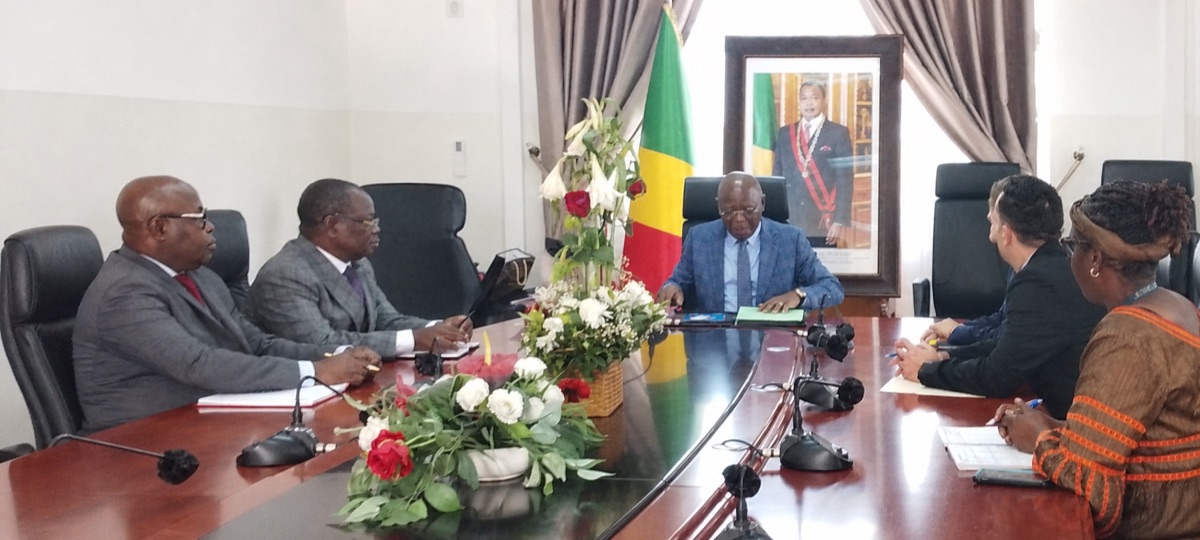
The Republic of Congo and the United States edged closer on defence this month, as a fresh round of high-level talks signalled that a quiet but steady military partnership is gaining shape between Brazzaville and Washington.
A Working Meeting Built on Shared Security Goals
On 18 May 2026, Amanda S. Jacobsen, charge d’affaires at the US embassy, sat down with Raymond Zephyrin Mboulou, Congo’s Minister of National Defence. Their conversation centred on strengthening bilateral military ties between the two nations.
The meeting was less about ceremony and more about substance. According to the account from Les Echos du Congo-Brazzaville, both sides used the encounter to map out where cooperation already works and where it could realistically grow over the coming period.
Why Obangame Express Sits at the Centre
Much of the discussion focused on “Obangame Express”, a maritime security exercise designed to sharpen coordination among African states confronting threats at sea. The drill targets piracy and broader insecurity across the Gulf of Guinea, a stretch of water long viewed as vulnerable.
For coastal nations, the stakes are practical. Shipping lanes, fishing grounds and offshore activity all depend on stability. By taking part in such exercises, Congo signals that securing its maritime approaches is a national priority, not a distant abstraction.
The emphasis on Obangame Express also tells a wider story. It shows that Brazzaville and Washington increasingly frame their relationship around regional security, treating the Gulf of Guinea as a shared concern rather than a problem for any single country to shoulder alone.
From Protocol to Practical Cooperation
The talks reached beyond strictly military matters. The two officials addressed the participation of an American band in the festivities marking the 65th anniversary of Congolese independence, a gesture read in diplomatic circles as a sign of warmer, deeper relations.
Yet the partnership is clearly moving past symbolism. The reported agenda points to technical training, assistance and the strengthening of operational capacity within the Congolese armed forces, turning goodwill into concrete programmes that could outlast any single ceremony.
That shift matters. Capacity building tends to leave a lasting footprint, because skills and procedures stay long after a visit ends. For Congo, the appeal lies in modernising its forces; for the US, it lies in working with a partner invested in regional order.
Reading the Wider Geopolitical Backdrop
The encounter unfolds against a familiar pattern: major powers sharpening their presence across Central Africa. In that competition, relationships are rarely accidental, and each meeting carries weight beyond its immediate agenda.
For Washington, Congo stands out as a strategic partner for regional stability, a country positioned along a sensitive maritime corridor. The calculation is straightforward, since a steadier Gulf of Guinea serves interests that stretch well past the region itself.
For Brazzaville, the logic runs in parallel. The government is working to modernise its defence systems, and ties with an established military power offer access to training and expertise that are difficult to build from scratch alone.
What the Meeting Signals Going Forward
Read together, the threads of this meeting suggest a partnership that is maturing rather than merely being announced. Maritime security, military training and a shared reading of regional risks now form a recognisable framework guiding the relationship.
None of this guarantees rapid results. Defence cooperation moves at its own pace, shaped by budgets, priorities and the slow grind of institution building. Still, the direction described in the talks points toward continuity instead of a one-off photo opportunity.
What stands out most is the tone. The exchange between Jacobsen and Mboulou read as businesslike, focused on durable cooperation rather than headline announcements, the kind of groundwork that often shapes how a partnership actually performs.
For readers watching Central Africa, the takeaway is measured but real. A military relationship that once leaned on protocol is gradually acquiring operational substance, and the Gulf of Guinea may well remain its anchor in the months ahead.