
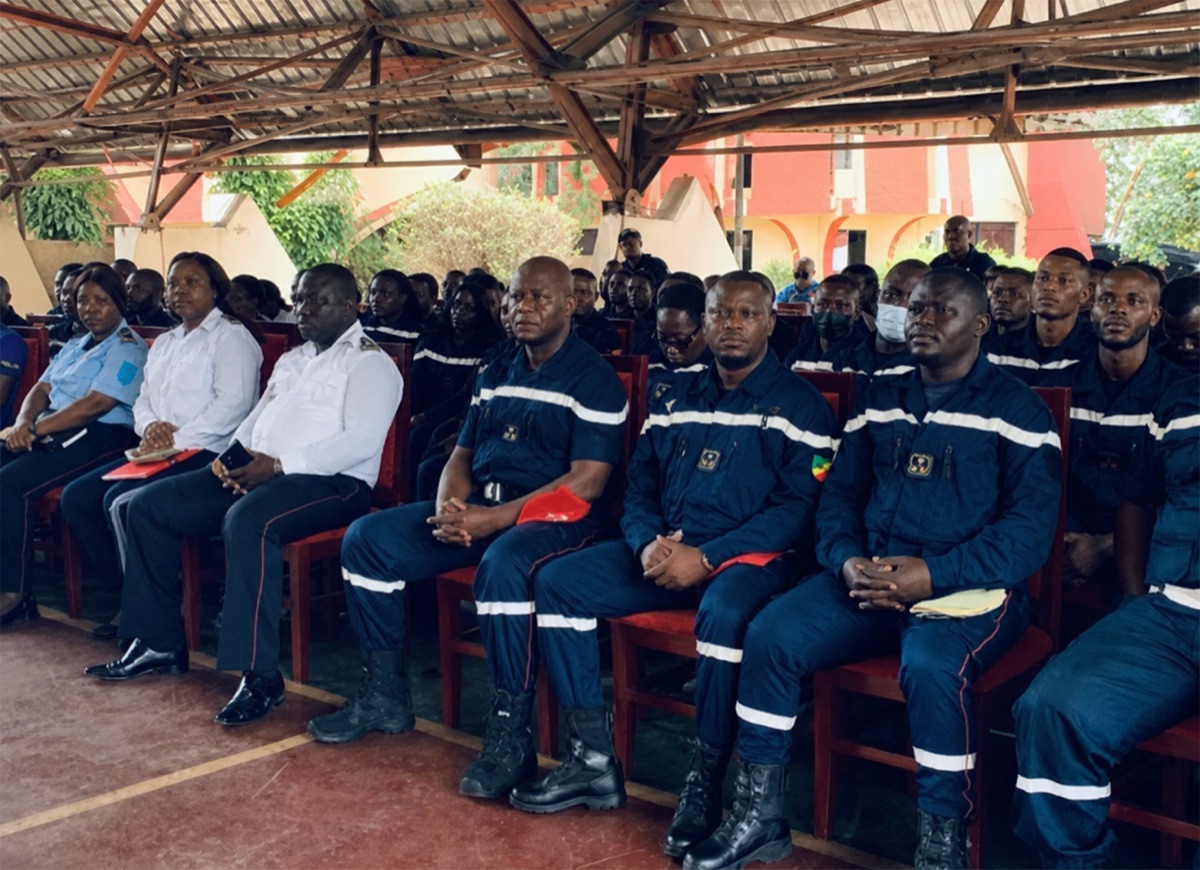
Congo-Brazzaville’s emergency responders are busier than they have ever been. The figures presented in Brazzaville read like a portrait of a young service straining to keep pace with a country that increasingly dials for help.
A record year for Congo’s first responders
The Civil Security Command unveiled its 2025 operational report on 8 May 2026 in Brazzaville. Deputy commander Colonel-Major Serge Pépin Itoua Poto laid out the results alongside General Albert Ngoto, who heads the Civil Security service.
The headline number is hard to miss. Across the year, units recorded 28,725 interventions, averaging close to 80 every single day. It marks the highest annual total the service has ever reported.
Inside the 28,725 operations of 2025
Most of that workload came from people in distress. The report breaks the total into 27,610 rescues to persons, 975 road accidents, 507 miscellaneous operations and five technological risks. The pattern points clearly toward human emergencies over industrial ones.
Within the rescue-to-persons category, the service counted 26,914 interventions. On-the-spot care dominated, accounting for 86.3 percent of those calls, while sudden illnesses and faintings made up another 12.9 percent. The numbers sketch a service answering everyday medical crises.
Why state exams shaped the rescue figures
A striking share of the activity tied directly to the school calendar. Of those rescue interventions, 21,627 involved health coverage for state examinations, a quieter but vital duty that rarely makes headlines yet absorbs much of the teams’ time and attention.
The exam season carried real weight. Coverage of the BEPC accounted for 36.6 percent of that effort, while the Baccalauréat represented 29.3 percent. Standing by at examination centres, responders effectively became part of the machinery that keeps the academic year running.
Assistance, fires and road accidents
Beyond rescues, assistance missions reached 696 interventions. The overwhelming majority, some 95 percent, were medical transports, with 62.2 percent of patients carried to hospital. It is the kind of unglamorous logistics that families rarely think about until they need it.
Fires told their own story about domestic risk. Household blazes made up 42 percent of all fire-related calls, a reminder that danger often begins at home rather than in factories or warehouses across the country’s towns and neighbourhoods.
Road accidents, by contrast, stayed comparatively contained in number. Of 97 such interventions, 95 percent occurred on public roads, underscoring how the open highway remains the principal setting for vehicle emergencies that the teams are called to manage.
Nine years of relentless growth
The longer view is what makes the 2025 report remarkable. Between 2017 and 2025, the volume of interventions multiplied more than twenty-fold. A service that once handled a modest caseload now operates at a scale few would have predicted nine years ago.
The acceleration sharpened recently. The year 2024 already signalled a turning point with 26,839 interventions, a figure that pushed the service into new territory. The following year extended the climb to 28,725, setting the record that now frames the entire report.
Such growth raises an obvious question about capacity. A force expanding its activity this quickly must either be reaching more of the population, responding to genuinely rising need, or both at once. The report itself leans toward demand that keeps outpacing resources.
Pressure mounts on logistics and staffing
That tension surfaced plainly in the closing message from the leadership. Officials called for reinforced logistical, medical and human resources, framing the appeal as a direct response to the steadily climbing demand for interventions documented across the year.
The wording matters. When a service celebrates a record while simultaneously asking for more support, it is signalling that success and strain are arriving together. Each additional rescue stretches vehicles, equipment and personnel a little thinner than before.
For ordinary residents, the takeaway is reassuring and sobering at once. The Civil Security service is clearly reaching people, from exam halls to roadsides to homes touched by fire, yet its own figures suggest the system is running close to its limits.
The 2025 report, presented by Itoua Poto and Ngoto, ultimately reads as both a milestone and a warning. The numbers prove the service has grown into a central pillar of public safety. They also make the case, in plain arithmetic, that the next chapter will depend on the means the country is willing to provide.
What began as a relatively small operation has become a daily fixture in Congolese life, answering roughly 80 calls a day. Whether that pace can hold without fresh investment is the unspoken thread running through every figure in this year’s tally.