
When the Sports Minister stepped onto the grounds of the Alima Academy in Oyo, he found a project that had outpaced its own timeline. Two years after opening, the facility now styles itself as the spearhead of Congo-Brazzaville’s effort to shape a new generation of footballers.
A Northern Campus Built for International Ambitions
Located 425 kilometres north of Brazzaville, in the Cuvette department, the academy has changed shape at remarkable speed. Hugues Ngouelondélé, Minister of Sports, Youth and Civic Education, travelled there to take stock of the work and weigh how far the venture had come.
What he saw was a complex deliberately calibrated to international standards. The minister described an evolution that, in his words, reflected both agility and professionalism, the kind of momentum that turns a young institution into a credible training ground rather than a hopeful experiment.
A New Two-Storey Building Anchors the Complex
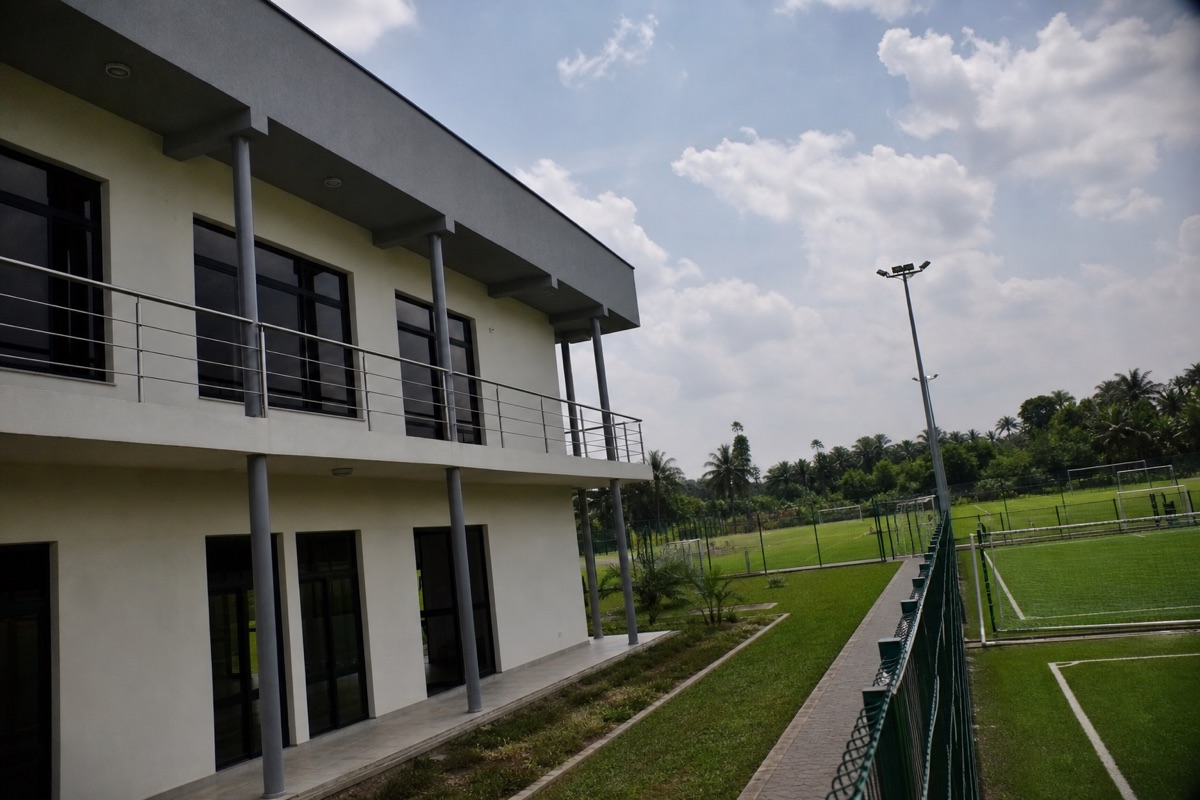
The campus has gained a fresh, two-level structure that sits beside the football pitches. Officials present it as a building that ties together comfort, design and practical use, signalling a wish to give future players a genuinely professional setting.
That choice matters in a country where sporting infrastructure has long lagged behind ambition. By placing the new building so close to the playing surfaces, the academy keeps daily life, training and recovery within a single, compact footprint rather than scattering them across the site.
The Minister’s Reading of the Project
Standing before the pilot intake, a group of boarders dressed entirely in blue, Ngouelondélé spoke of a spectacular rise. For him, the structure does more than coach players. It prepares an elite capable of meeting serious challenges, sustained by discipline and a steady commitment.
The framing is telling. Rather than presenting the academy as a feel-good showcase, the minister tied its value to results and rigour. That emphasis on demanding standards hints at how the authorities want the project judged, by what its graduates eventually achieve abroad and at home.
Twenty-Four Boarders Bound for France
The clearest test of that ambition is already booked. A delegation of twenty-four boarders is due to leave for France in the night of 17 to 18 May, carrying the academy’s reputation onto unfamiliar ground far from the Cuvette.
The purpose is direct: to measure young Congolese talent against Europe’s established youth systems. The trip is built around matches that include a fixture against the under-14 side of Paris Saint-Germain, alongside encounters with other clubs of reference cited as part of the programme.
Why the PSG Test Carries Weight
Facing a Paris Saint-Germain youth team is no small benchmark. The club’s academy belongs to a continental tier that Congolese football rarely meets at this age group, which makes the encounter a useful gauge of where the Oyo project truly stands.
For a structure only two years old, the willingness to seek out such opposition reads as confidence as much as exposure. The boarders will return either reassured by their level or sharply aware of the gap, and both outcomes feed the academy’s stated pursuit of excellence.
A Wider Bet on Homegrown Talent
The visit also fits a broader logic visible across the project. By concentrating coaching, housing and competition in one northern campus, Congo-Brazzaville signals that it wants to retain and develop young players locally before the wider football market draws them away.
The pilot promotion, in its blue kit, embodies that wager. These are the first names the academy is willing to send abroad as ambassadors, and their performance in France will inevitably shape how the model is perceived back home.
What the Oyo Trip Could Signal Next
Much will depend on how the squad fares against PSG’s U14s and the other sides on the schedule. A competitive showing would validate the heavy investment in infrastructure and the standards the minister insists upon.
For now, the academy occupies a hopeful but unproven position. It has the buildings, the backing and a pilot group ready to travel. The coming fixtures in France will begin to answer whether the Oyo experiment can turn promising foundations into lasting footballing returns (Adiac Congo).