
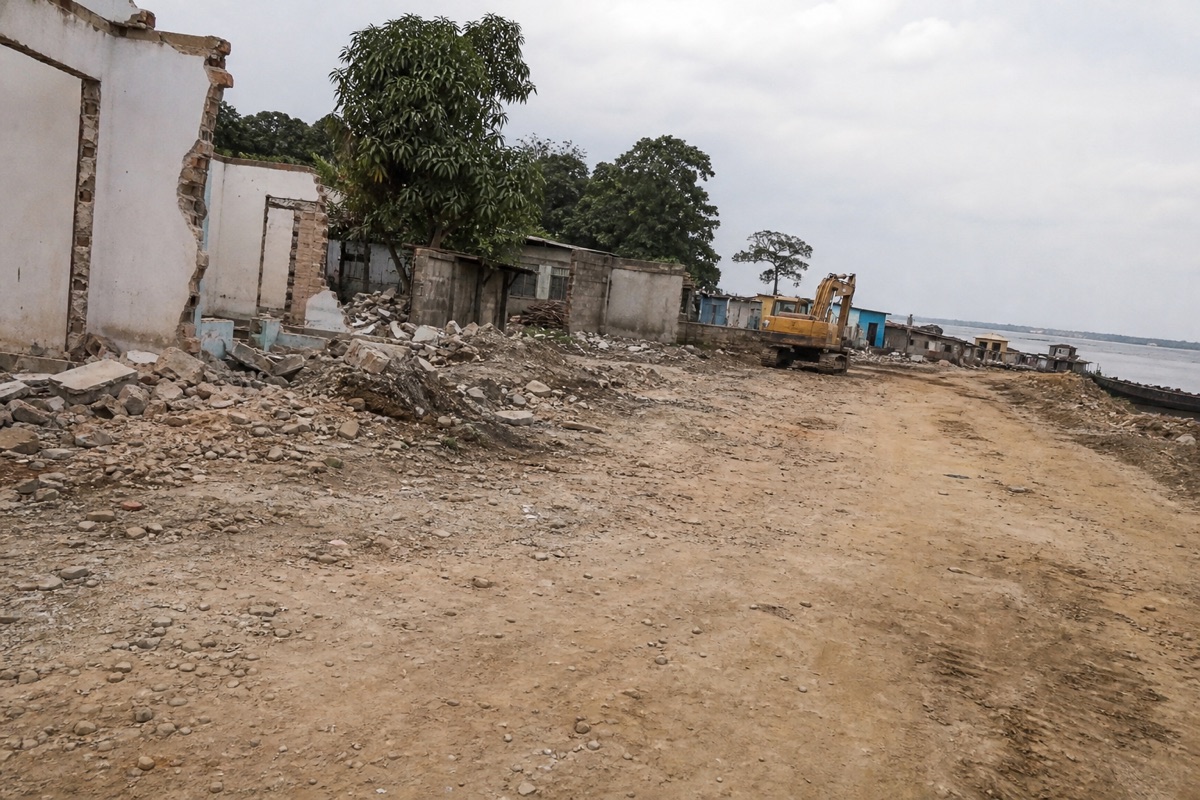
Heavy machinery rolled into Mpila on Wednesday, 13 May 2026, as Congolese authorities began clearing homes in the sixth district of Talangaï. The operation displaced 420 families and reopened a familiar debate in Brazzaville: how far public works may go.
Why the Yoro port road triggered mass evictions
The clearance ties directly to the widening of the access route serving the secondary port of Yoro, located in Mpila. To make room, several roadside plots were declared of public utility and placed under an expropriation procedure (Journal de Brazza).
Government officials frame the project as strategic. They argue the wider road will ease urban congestion and modernise the capital’s port infrastructure. Yoro, in their view, is set to anchor a growing share of Brazzaville’s logistics and commercial traffic in the years ahead.
Compensation paid, but deadlines ignored
According to the authorities, affected residents had already received financial compensation under the legal provisions in force. Those payments were meant to let families vacate within the deadlines set by the administration, clearing the way for construction to start on schedule.
Reality proved messier. Despite the payments and repeated formal notices, many households stayed put once the deadlines lapsed. The standoff left officials weighing the project timetable against the visible reluctance of residents to abandon homes they had long occupied.
State turns to force after the standoff
Faced with that resistance, the State chose to enforce its administrative decisions through public force. Security units were requisitioned by the government to remove the occupants who remained inside the project’s footprint, a step officials presented as a last resort rather than a first choice.
On the morning of 13 May, those forces moved in with heavy equipment to carry out the forced clearance of the houses still standing on the right-of-way. The operation unfolded under tight security across several zones of Mpila, signalling the State’s intent to see it through.
A public-utility argument under scrutiny
The authorities insist the operation answered a strictly public-utility goal. They tie it to the broader modernisation drive meant to support Brazzaville’s urban and economic growth, positioning the road widening as one piece of a larger infrastructure programme (Journal de Brazza).
That framing matters because expropriation in Congo-Brazzaville rests on the public-utility test. Once plots are declared of public interest, the administration gains the legal footing to compel departure. The contested part is rarely the principle; it is the execution, the timing, and the human cost.
Mpila’s heavy memory of disruption
Mpila is not a neutral backdrop. The neighbourhood already carries a heavy place in Brazzaville’s recent history, and any large-scale operation there lands on residents with particular weight. For many families, the access road works mean uprooting from a quarter they know intimately.
The source material does not detail where the 420 households went next, nor how they judged the compensation they received. On those points the record stays open, and it would be premature to assume either smooth resettlement or lasting grievance without firmer information.
What the project promises for the capital
Supporters of the plan point to the everyday stakes. Brazzaville’s traffic strains its main arteries, and a functional secondary port could redistribute freight that currently clogs the city. A wider, smoother access road is the physical link making that ambition workable on the ground.
For commuters, small traders, and local institutions, the calculation cuts both ways. Better port access and lighter congestion could lower costs and shorten journeys over time. Yet those gains arrive only after the disruption that families on the right-of-way are absorbing right now.
Balancing development and the people it moves
The Yoro episode distils a tension running through fast-growing capitals. Cities need modern infrastructure, and ports anchor regional trade across Central Africa. Delivering them, though, often requires moving people, and the fairness of that process shapes whether the works are remembered as progress or grievance.
The official line is consistent: compensation paid, notices served, deadlines set, and force used only after refusals. Residents’ own accounts of that sequence are not captured in the available record, leaving one side of the story documented and the other still to be heard.
For now, the bulldozers have done their work in Mpila, and the road to Yoro inches closer to its planned width. Whether the modernisation it serves justifies the upheaval of 420 households will be measured less in blueprints than in how those families rebuild.