
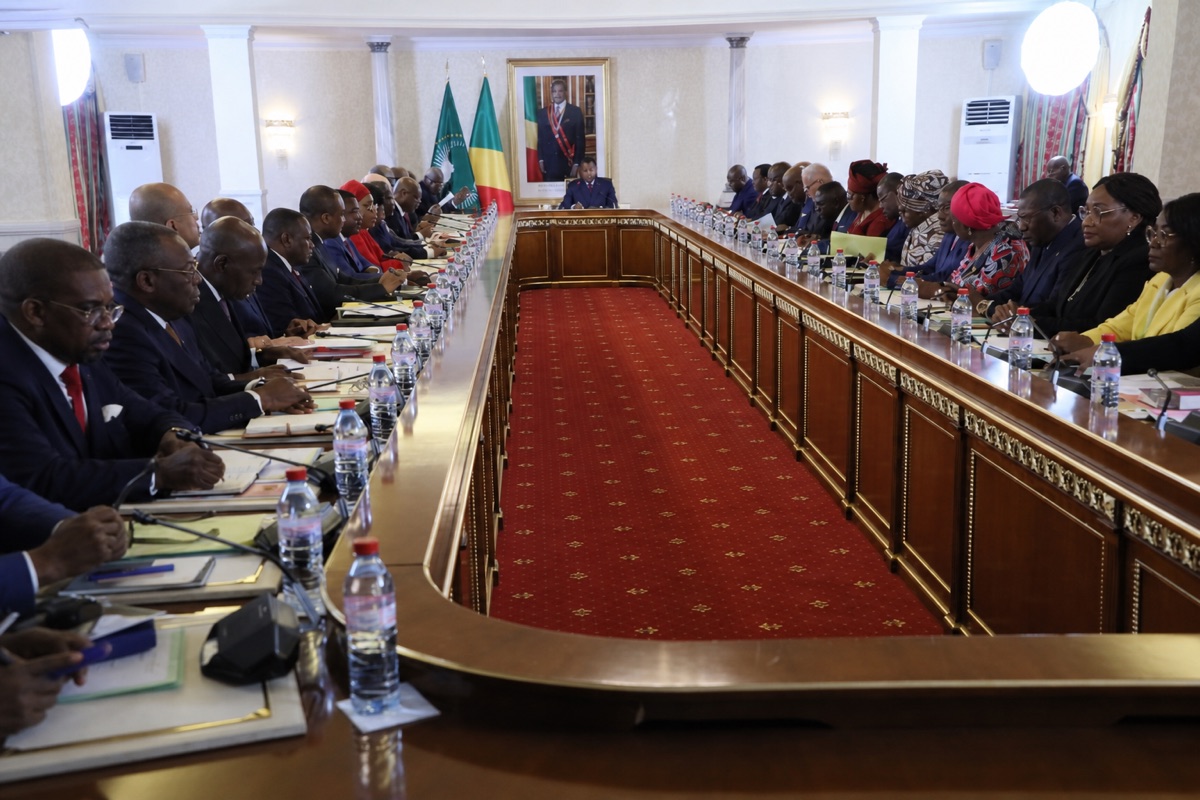
President Denis Sassou N’Guesso has placed the digital overhaul of Congo-Brazzaville’s public offices at the heart of the government’s agenda. The decision, taken at the first Council of Ministers on 6 May, frames modernisation as a matter of national urgency.
Why A Digital Task Force Tops The Agenda
The head of state called for a dedicated “task force” to drive the rapid digital transformation of state administrations. He singled out the bodies that collect tax revenue, signalling that faster, cleaner systems are expected to reshape how the state handles public money.
The choice is telling. Revenue agencies sit at the crossroads of citizen frustration and state efficiency. Long queues, paper files and opaque procedures have long defined the experience of dealing with public offices across Brazzaville, Pointe-Noire and the wider departments.
By naming digitisation a priority rather than a long-term ambition, the presidency is betting that visible service improvements can rebuild day-to-day trust. The message to ministers was direct: results, not intentions, will measure the government’s early performance.
Rail And Roads Return To The Spotlight
Beyond screens and software, the president tied the country’s future to its physical arteries. He pressed for the rehabilitation of the Congo Ocean Railway, the historic line linking the Atlantic coast to the interior and a long-running symbol of national infrastructure.
He also pushed for better roads connecting Congo-Brazzaville to its neighbours. In a region where Central African trade depends on reliable corridors, cross-border links carry weight far beyond domestic commuting and local logistics.
The pairing of digital and physical infrastructure reflects a wider calculation. A modern administration means little if goods, workers and commuters cannot move. The government appears to want both fronts advancing together rather than in isolation.
Power Supply Gets A Heavy-Voltage Promise
Electricity featured prominently among the stated priorities. The president urged work to strengthen supply by upgrading the very high-voltage line between Pointe-Noire and Brazzaville, the backbone connecting the country’s two largest cities.
Reliable power underpins almost everything else on the list. Digital tax systems, functioning offices and active businesses all depend on a grid that does not falter. For households and small firms alike, steadier electricity remains a daily concern rather than an abstract policy line.
Framing the high-voltage line as a strategic asset places energy alongside transport and digitisation as a single connected effort. The implication is that no priority can succeed while the others lag behind.
Clean Water Named An Immediate Concern
Access to drinking water was described as another pressing emergency. The president pointed to the implementation of the Mattei Plan for Africa and the renovation of rural water installations as channels for progress on this front.
Water sits closest to everyday life. In rural areas in particular, the reliability of installations shapes health, time and household routines. By linking the issue to a continental framework, the government signals that local needs are being tied to broader partnerships.
The emphasis on rural facilities suggests an effort to spread attention beyond the major cities. Proximity to citizens, especially outside the urban centres, runs as a quiet thread through the full set of announced priorities.
A Call For Collective Resolve
Closing the meeting, Sassou N’Guesso urged his government to show a shared “determination” focused on meeting public expectations. He reminded ministers that citizens had done their part by placing their confidence in the authorities.
The framing turns the agenda into a question of accountability. By invoking the trust voters have extended, the president sets a standard against which ministers will be judged in the months ahead. Expectation, he suggested, now has to be matched by delivery.
Taken together, the priorities sketch a government trying to connect the visible and the invisible: faster offices, steadier power, moving trains and running taps. Whether the task force and the broader plan translate into felt change will be the real test for citizens watching from Brazzaville to the smallest department.
The early signal is one of urgency over patience. For a public used to slow administrative routines, the promise of digital, connected and better-resourced services lands as both an ambition and a demand for proof.