
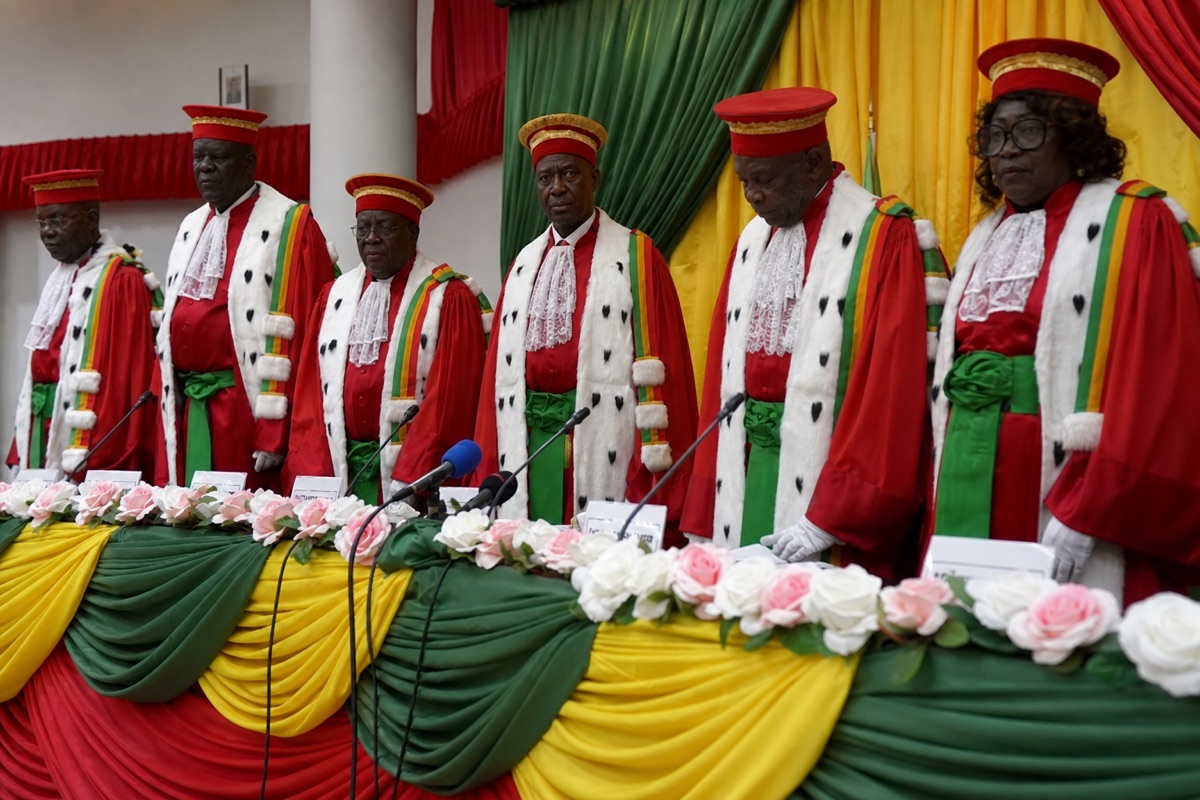
Brazzaville closed the book on its presidential contest on March 28, 2026, when the Constitutional Court read out the final tally. The verdict was emphatic: incumbent Denis Sassou Nguesso had been returned to office in the first round.
A first-round result settled in a single decision
The numbers anchor the outcome. Sassou Nguesso gathered 2,509,456 votes, equal to 94.90% of valid ballots cast in the two-stage polling held on March 12 and 15, 2026. No serious challenge approached that margin.
The runner-up trailed far behind, registering only 1.40% of the expressed vote. The gap left little room for interpretation, and the court treated the spread as decisive once it had reviewed the certified returns from across the country.
Court president Auguste Iloki framed the conclusion in plain legal terms. Because the incumbent had secured more than an absolute majority of valid votes in the first round, the magistrate declared him elected President of the Republic without need for a second ballot.
Turnout the court leaned on
Participation gave the proclamation added weight. Of 3,155,751 registered voters in Congo-Brazzaville, some 2,681,921 took part. That works out to a turnout of 84.99%, a figure officials presented as a sign of broad engagement with the process.
For a country where voter mobilization often shapes the post-election conversation, the participation rate became a talking point in its own right. It allowed the authorities to cast the result as both lopsided and widely backed at the polling stations.
The decision itself carried a formal reference, numbered 003/DCC/EL/PR and dated March 28, 2026. That document set out the final results and closed the legal sequence that began when the first ballots were counted earlier in the month.
What the formal ruling actually says
Court rulings of this kind do more than announce a winner. They convert provisional counts into definitive ones, foreclosing the ordinary avenues for contesting the figures. In this case, the proclamation was paired with a separate matter the judges had to weigh.
That matter was an appeal. The reading of the result and the handling of the challenge arrived together, giving the session a dual character: confirmation on one side, adjudication of a dispute on the other.
By treating both items in the same sitting, the court signaled that the electoral file was, from its standpoint, complete. The outcome and the objections to it were addressed before the same bench on the same day.
The Mafoula appeal and why it failed
The challenge came from candidate Uphrem Dave Mafoula, who had filed a request to annul the vote. His petition put the alleged conduct of the election before the judges, asking them to set the results aside.
The court was not persuaded. It found that the irregularities Mafoula described were not established, pointing to the absence of direct and decisive evidence to support the claims. On that basis, the request was dismissed.
The reasoning followed a familiar judicial standard. Allegations, however pointed, require proof the bench can act on. Without that proof, the judges declined to disturb a result that the certified figures already supported by a wide margin.
The ruling did not end with a verbal announcement. It was formally notified to the parties involved and then published in the Journal officiel, the step that gives such decisions their full legal force and public record.
A familiar fixture returns to office
For readers tracking Congolese politics, the proclamation extends a long-running chapter rather than opening a new one. Sassou Nguesso has been a defining figure in the country’s public life, and the March vote keeps him at its center.
The court’s language was deliberately procedural, stripping the moment of drama. Iloki’s statement rested on arithmetic and law: an absolute majority in the first round, and therefore a presidency confirmed under the rules as the judges read them.
What happens next moves beyond the courtroom. With the legal questions resolved and the figures gazetted, attention shifts to governance, to the priorities of a renewed mandate, and to how citizens experience the years that follow this decision.
For now, the documented facts stand on their own. A first-round win recorded at 94.90%, a turnout of 84.99%, an appeal rejected for want of evidence, and a ruling published for the record (Vox Congo). Together they define the official close of Congo-Brazzaville’s 2026 presidential election.