
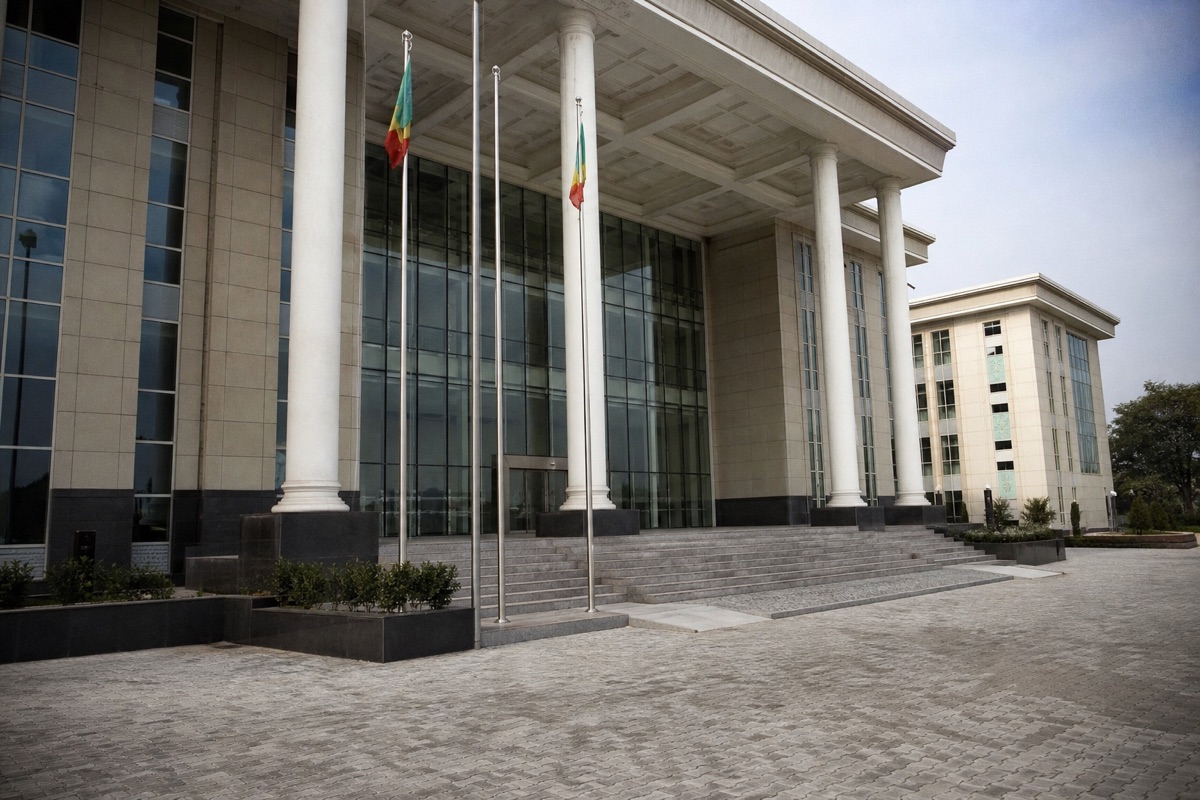
Congo-Brazzaville’s Constitutional Court has drawn a firm line under the country’s presidential election. The judges rejected the annulment request filed by independent candidate Uphrem Dave Mafoula, clearing the final legal hurdle to the official results.
The ruling, handed down on 28 March, confirms the re-election of President Denis Sassou N’Guesso. It also closes the most visible challenge to a vote whose outcome had drawn pointed questions from one of the trailing contenders.
Who Brought The Challenge
Mafoula ran under the banner of the party known as “Les Souverainistes.” He finished third in the contest, gathering 1.03 percent of the votes cast, well behind the front-runner.
Despite that modest score, he took his grievances to the country’s highest court. His petition sought nothing less than the cancellation of the entire presidential ballot, a step few candidates ever attempt seriously.
The Allegations On The Table
The candidate built his case around several claimed irregularities. He argued that voters had been moved between constituencies, a practice he said distorted the local balance of the electorate.
He further alleged that money had changed hands inside polling stations. According to his filing, cash was handed out in a bid to sway how ballots were marked on election day.
Mafoula also said his own representatives had been blocked from doing their work. He claimed delegates loyal to his campaign were prevented from entering certain voting sites to observe proceedings.
Rounding out the complaint, he accused organisers of stuffing ballot boxes. Taken together, the candidate framed these points as proof that the official tally could not stand.
Why The Judges Said No
The Constitutional Court was unconvinced. In its decision, the bench found the material submitted to be “neither serious nor credible” enough to alter the result of the vote.
The judges set out a clear standard for such cases. Irregularities, they noted, must rest on concrete documents, including signed minutes from polling stations and sworn testimony from credible witnesses.
Beyond that, the court stressed a question of scale. Even proven faults, it reasoned, must be wide enough to actually flip the final outcome before they can justify cancelling a national election.
Measured against that test, Mafoula’s file fell short. The ruling held that the documents lacked “any probative value or force” and showed no obvious link to the irregularities the candidate had described.
What The Decision Settles
With the petition dismissed, the court moved to proclaim the definitive results. That step gives the figures their final legal standing, leaving no further ordinary avenue of appeal inside the country.
Those results confirm Denis Sassou N’Guesso as the winner. According to the proclamation, he secured 94.90 percent of the votes that were validly expressed in the presidential contest.
The gap between that figure and Mafoula’s 1.03 percent underlines the distance the challenge had to cover. To succeed, the petition needed to show fraud large enough to bridge a margin of more than ninety points.
The Stakes For The Process
For ordinary readers, the ruling carries a practical message about how disputes are meant to be settled here. Complaints alone are not enough; the court has signalled that paperwork and proof carry the weight.
That insistence on signed records and sworn statements sets a marker for any future contender. It tells campaigns that observation, documentation and method matter as much as public accusation after polls close.
The decision also lowers the legal temperature around the result. By ruling on the substance rather than sidestepping it, the court has tried to leave a written record of why the challenge did not hold.
For the parties involved, the outcome is now fixed in law. Mafoula’s bid has run its course through the institution designed to hear it, and the proclaimed result stands as the official close of the race.
What lingers is the wider conversation about trust in the count. The court’s reasoning offers a framework for that debate, even as it firmly declines to disturb the numbers placed before it.
In the end, the episode reads as a study in thresholds. The line between a grievance and a winning legal case, the judges have made clear, runs through evidence that is both solid and large enough to matter (ADIAC Congo).