
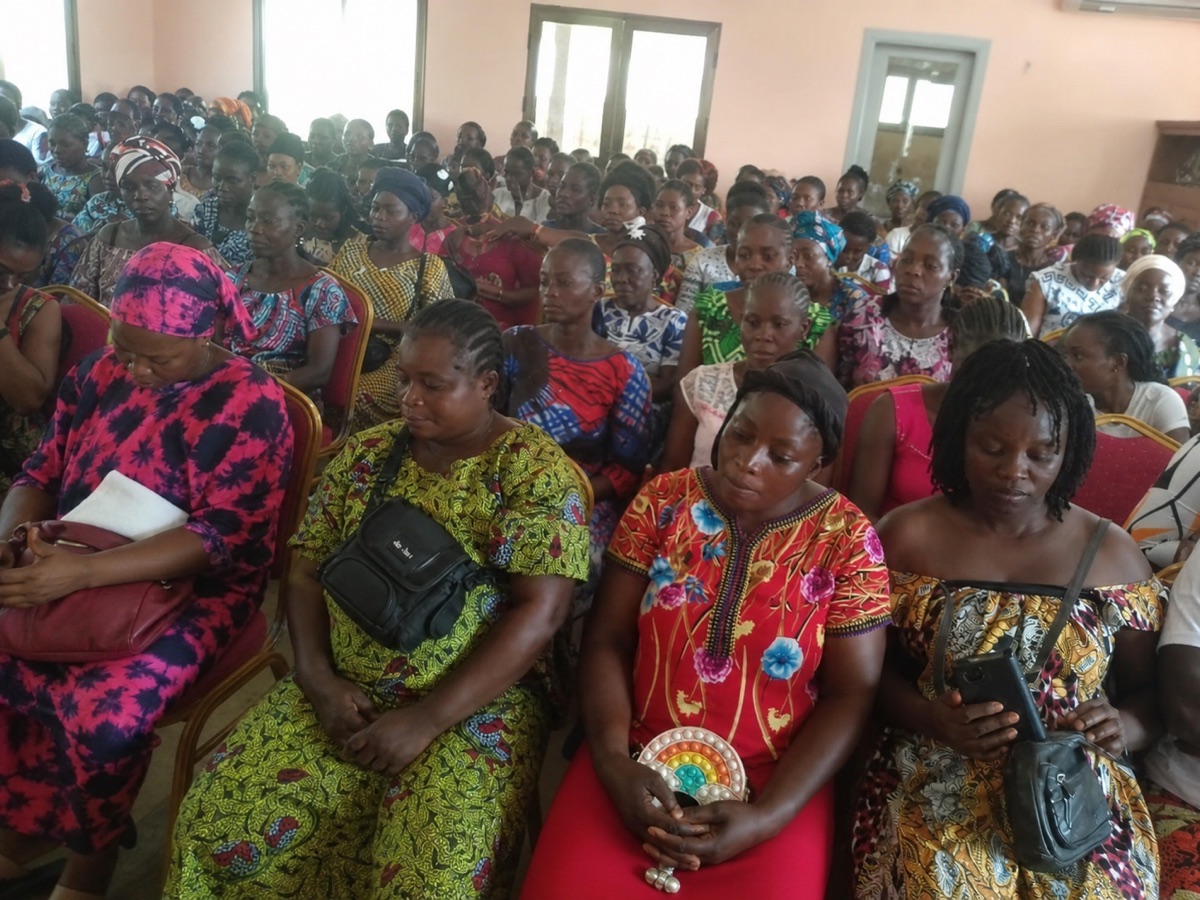
In the rolling hills of the Bouenza department, the story of Congo-Brazzaville’s latest presidential election is being told through a quieter lens. It is the story of village women who lined up to cast ballots in numbers that local officials describe as striking.
Following the provisional results of the presidential vote held on 12 and 15 March 2026, a senior voice from the Women’s Consultative Council travelled south to say thank you. The gesture was simple, but the message behind it carried weight for rural communities often left at the margins.
A council official returns to thank Bouenza’s women
Yennie Clara Mathurine Osseté Mberi Moukietou, executive secretary of the Women’s Consultative Council, made the journey on 22 March. Her itinerary took her through Soulou, Kolo and Mouyondzi, three localities where she had earlier campaigned for stronger female participation.
The visit closed a loop she had opened weeks before. During her awareness tours across Bouenza’s villages, she had urged women to step forward and vote. Returning afterwards to acknowledge their response gave the outreach a sense of follow-through rarely seen in rural politics.
What the turnout figures suggest
Osseté Mberi Moukietou praised what she called the responsible engagement of women throughout the electoral process. In her words, “the female vote experienced significant enthusiasm,” a phrasing that points to mobilisation rather than mere attendance at the polls.
For a region like Bouenza, where distance and daily labour can keep many away from voting stations, that enthusiasm is not a small detail. It signals that organising efforts reached households that national campaigns sometimes struggle to touch directly.
She also tied this participation to support for the incumbent. According to the council secretary, the women she met backed candidate Denis Sassou N’Guesso for a renewed five-year term, a point she stated openly during her stops across the department.
Why women’s mobilisation matters in rural Congo
Women form a substantial share of the rural electorate, yet their political voice is often described in general terms rather than measured locally. The Bouenza visit reframes that picture by placing village women at the centre of the post-election conversation.
The approach mirrors a wider trend in Congolese civic life, where consultative bodies attempt to bridge the gap between national institutions and the daily realities of departments far from Brazzaville. Direct contact, rather than abstract appeals, appears to be the working method.
By thanking voters in person, the council framed participation as a civic achievement worth celebrating. That framing can encourage future turnout, particularly among younger women watching how their elders’ involvement is received and recognised by public figures.
A symbolic gesture in Mouyondzi
The tour was not limited to speeches. In Mouyondzi, Osseté Mberi Moukietou handed an envelope of 300,000 FCFA to members of the Moukietou association, intended to help launch their first agricultural project.
The contribution linked political participation to tangible local development. By backing a farming initiative, the council signalled that civic engagement and economic opportunity can move together, especially for women’s groups seeking to build collective ventures from the ground up.
She encouraged the association’s members to redouble their efforts, framing the support as a starting point rather than a reward. The agricultural focus fits a region where farming remains a cornerstone of household income and community resilience.
Reading the wider message
For readers across Congo-Brazzaville, the Bouenza episode offers more than a courtesy visit. It illustrates how electoral participation, local organising and modest development support can be woven into a single narrative aimed at sustaining momentum.
Whether the enthusiasm described will translate into lasting civic habits remains an open question. What is clear is that the council chose to spotlight women’s turnout publicly, treating it as a result in its own right and not merely a statistic buried in tallies.
The visit also underlines a practical truth of Congolese politics. Proximity matters. Officials who return to the same villages they once canvassed build a form of trust that distant communication rarely achieves on its own.
As provisional results settle into the public record, the Bouenza tour stands as a reminder that elections are experienced locally, household by household. In Soulou, Kolo and Mouyondzi, women were told their participation counted, and that acknowledgement may prove its own kind of legacy.
For now, the department’s women carry both recognition and a small seed of investment. How that combination grows, in farming plots and at future polling stations alike, will be worth watching in the seasons ahead (Adiac Congo, Stanislas Okassou).