
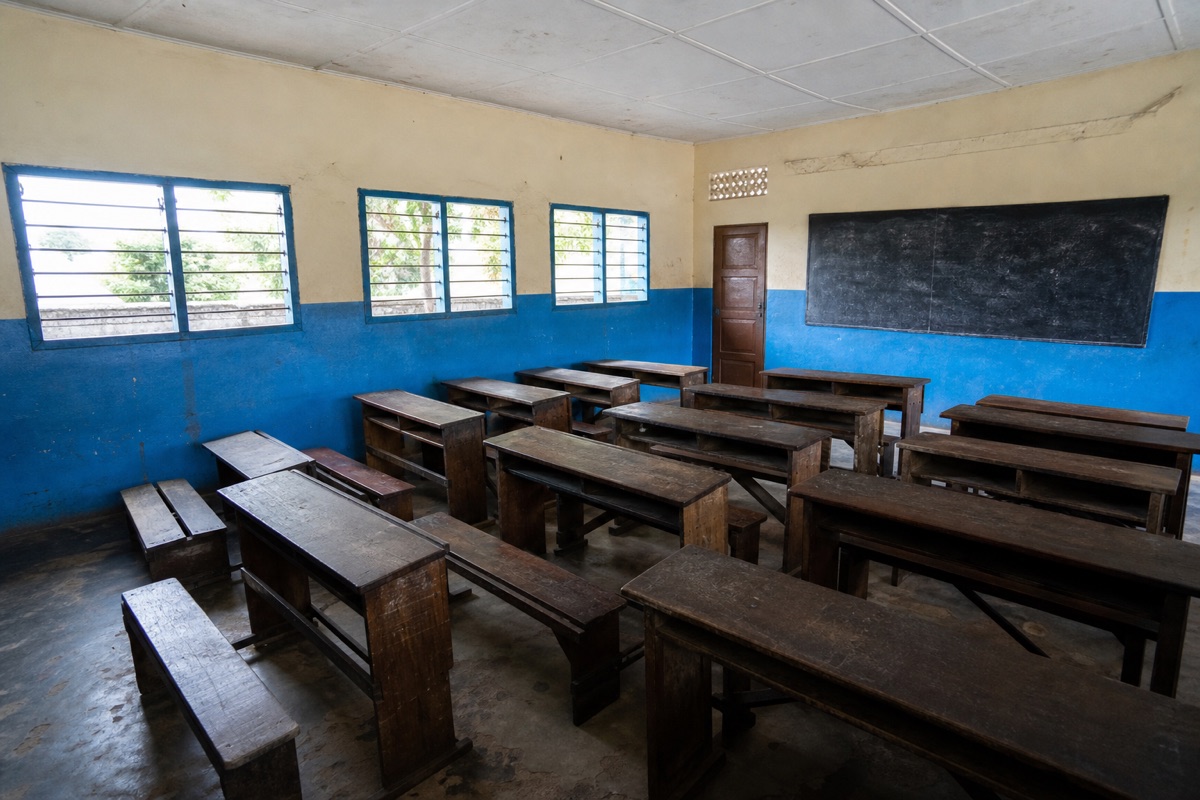
Community teachers across Congo-Brazzaville are bracing for a nationwide walkout. Their union says patience has run out after months without pay, and classrooms could fall silent at the start of April unless the government moves quickly.
A Strike Date Drawn in the Sand
The National Network of Community Teachers (RNEC) announced the action during a general assembly held on March 21 in Brazzaville. Members voted to begin an effective strike on April 4, framing the date as a final deadline for the authorities to respond.
The union’s message was blunt. Conditions, it said, have become “intolerable” for thousands of teachers spread across the country. The vote turned a long-simmering grievance into a concrete threat that now hangs over the public school calendar.
Nine Months of Missing Grants
At the heart of the dispute sits money that teachers say they earned but never received. The RNEC reports that grant payments have gone unpaid for nine months, leaving families to stretch household budgets to breaking point.
The immediate demand is narrower than the full sum. The union is calling for at least five of those nine months to be settled without delay. It presents the figure as a minimum gesture of good faith rather than a complete resolution.
For teachers working far from the capital, the arrears are more than an accounting line. They shape daily life, from rent to food to transport, and the union argues they erode the will to keep showing up for pupils.
Where the Union Points the Blame
The RNEC places responsibility squarely on the Ministry of Finance, the Budget and the Public Portfolio. According to the union, the repeated delays reflect what it describes as contempt toward community teachers, a charge that gives the standoff a sharp political edge.
That framing matters. The union is not only asking for back pay; it is challenging how the state treats a workforce it considers essential. By naming the ministry directly, the RNEC signals that it sees the problem as deliberate rather than merely bureaucratic.
The teachers in question often serve on the front line in rural and peri-urban areas. These are places where public schooling can hinge on a single committed instructor, and where an absent paycheck quickly becomes an absent classroom.
Questions Over Who Gets Hired
Beyond the unpaid grants, the union raises a second grievance about recruitment. The RNEC denounces what it calls an opaque handling of earlier hiring quotas, suggesting that the process has not always favored those who actually teach.
According to the union, some posts intended for teachers were instead handed to people outside the profession. It claims that certain positions even went to market traders, displacing the genuine beneficiaries the quotas were meant to protect.
If accurate, such allegations point to a credibility gap as much as a pay gap. The union appears to argue that fixing salaries alone will not restore trust unless the rules governing who joins the corps are applied fairly and transparently.
A Promise Teachers Want Honored
The RNEC also ties its demands to a commitment already on the books. Among its central claims is the effective implementation of President Denis Sassou N’Guesso’s social program, which provides for the regularization of 12,000 community teachers currently in service.
For the union, that pledge is leverage. By invoking an official promise rather than a fresh demand, the RNEC casts the strike less as a confrontation and more as a call to deliver on words the leadership has already spoken.
Regularization would change the status of those teachers, offering a path toward stability that monthly grants alone cannot guarantee. It is the kind of structural fix that, in the union’s view, would address the root of the recurring tension.
What April Could Bring
The stakes for the school system are immediate. Unless the authorities react quickly, community teachers could suspend lessons from April 4, and the union warns of repercussions for public schools throughout the country.
A walkout would ripple far beyond the teachers themselves. Pupils preparing for the rest of the academic year, and parents who rely on public schools, would feel the disruption first, particularly in the under-served areas where these instructors are concentrated.
For now, the calendar is the pressure point. The union has set its date, laid out its conditions, and left the next move to the government. Whether the gap narrows before April 4, or hardens into a full strike, will become clear in the days ahead.
The coming weeks will test how the state values a workforce it has promised to regularize. Teachers say they have waited long enough; the authorities have a short window to prove them wrong.