
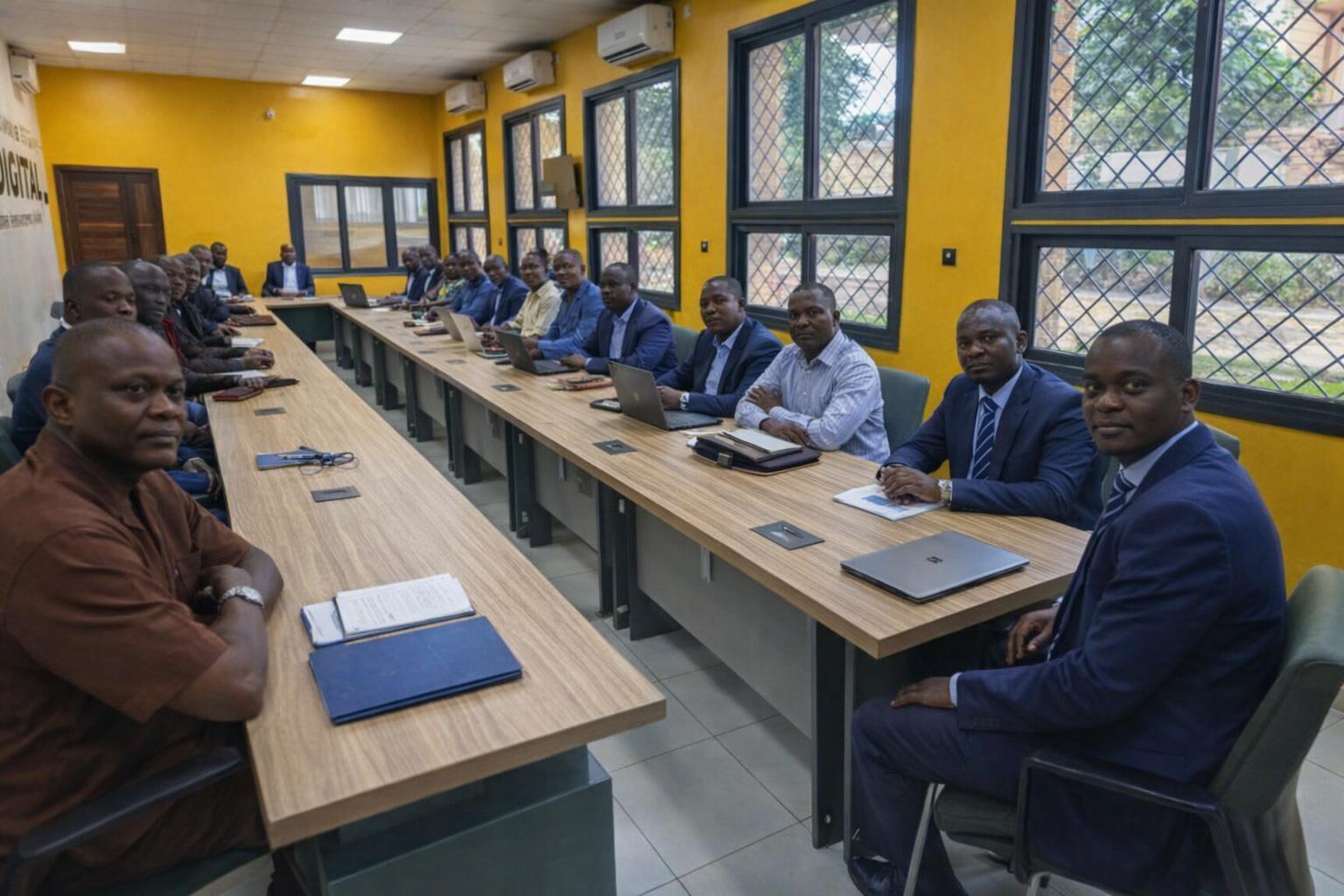
Brazzaville training focuses on e-document management
Executives and staff of the National Institute for Documentation and Scientific and Technological Information (Indist) have been meeting in Brazzaville since Jan. 28 for a training seminar on digital archiving and the management of multimedia rooms.
The workshop also brings together several executives and researchers from institutes under the Ministry of Scientific Research and Technological Innovation. The stated goal is to strengthen staff capacity across the department in electronic document management, according to organizers.
Ministry official says timing is key for researchers
Speaking at the opening session, Aimé Christian Kayath, director of the minister’s cabinet at the Ministry of Scientific Research and Technological Innovation, said the seminar comes at the right moment for the sector.
“This seminar comes at a timely moment, because it was important to be able to train researchers in digital archiving and everything related to a digital library,” Kayath said during the opening of the work session (Ministry of Scientific Research and Technological Innovation).
Participants are expected to focus on practical skills that help convert, organize, preserve and retrieve documents electronically, a shift that can reduce delays linked to paper files and improve the circulation of scientific information inside institutions, according to the seminar’s stated objectives.
Digital library and multimedia room move into service
Beyond training, the seminar is also set to support the operational launch of a multimedia room and a digital library that were recently inaugurated, according to the organizers.
The aim, officials said, is to allow agents, researchers and university users to consult documentation in more modern conditions, using tools designed for digital access and improved reading and research environments within the ministry’s network.
A push to align with digital standards
Kayath said the ministry now has the tools needed to align with digital norms, and that the priority is to put those tools to work in a practical way.
“Our ministry today has the necessary tools to align with digital standards. The question is to get down to work to make these tools count and allow research to immerse itself even more deeply in this area,” Kayath said (Indist).
In practice, this effort signals a drive to make digital documentation part of day-to-day research routines, by linking training, infrastructure and usage so that the new facilities are not only inaugurated, but actively used by the research community.
What this means for users and institutions
For researchers and students, digital archiving and a functioning digital library can mean faster access to scientific documents, more reliable preservation of institutional records, and better continuity for projects that depend on past publications and data.
For institutions, electronic document management can improve traceability and organization, while multimedia spaces can support consultation, collaboration and basic digital skills. Organizers presented the seminar as a concrete step toward modernizing public research support services in the Republic of the Congo.