
Fast-tracked HIV HQ opens in Brazzaville
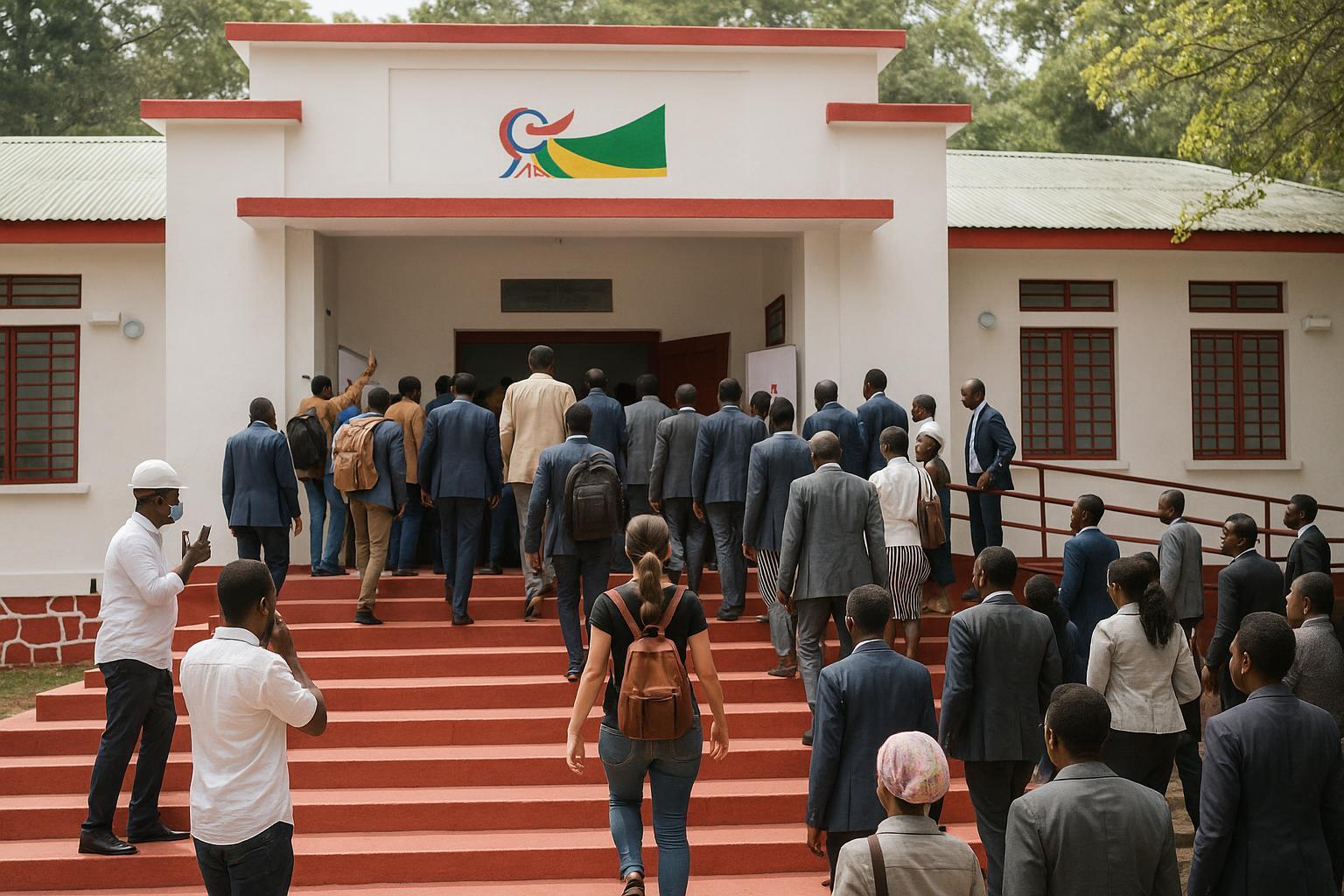
Under soft mid-December skies the blue-and-white façade standing on the Talangaï plateau became the newest symbol of Congo’s public-health drive. The government formally received the refurbished headquarters of the National HIV/AIDS Control Programme, a project completed in just five months with international partners.
The 400-square-metre building sits on a generous 10,000-square-metre state-granted plot, once home to the Lucienne Edouard childcare centre. Twenty-three purpose-built rooms now house offices, meeting halls, archive zones and a reprographics suite, designed to speed data flow and decision-making across the country’s 15 departments.
Cost-efficient build reflects tight timelines
Executed between early June and December, the rehabilitation cost 383.4 million CFA francs, roughly 586,000 euros at current rates. Officials from the Global Fund and the United Nations Development Programme highlighted the strict procurement controls that kept spending within budget despite volatile material prices.
Site engineers noted that solar-ready roofing, low-flow water fixtures and cross-ventilation were integrated to reduce utility bills. Those features align with national commitments under the Paris Agreement and respond to Brazzaville residents’ calls for greener public buildings.
Government sets performance targets
Health Minister Professor Rosaire Ibara used the handover ceremony to underline accountability. He told programme managers that every square metre must translate into concrete results, from higher testing rates to sharper epidemiological surveillance, saying the new HQ is ‘a platform for performance, innovation and transparency’.
A dashboard of indicators—monthly stock availability, turnaround times for viral-load tests and community outreach coverage—will be published on the ministry’s website. Civil-society groups welcomed the move, calling open data a powerful deterrent against medicine shortages.
Partnership roadmap to 2030 goal
UNDP Resident Representative Adama Dian-Barry reiterated that ending AIDS as a public-health threat by 2030, while ambitious, remains within reach if investments stay steady. She described the headquarters as ‘a beacon of hope’ built to host prevention drives, rapid testing and treatment-adherence coaching under one roof.
From 2026 the agency plans to extend similar refurbishments to district warehouses nationwide under World Health Organization coordination, ensuring the cold chain for antiretrovirals and other essential medicines reaches the most remote health zones.
Impact already visible in treatment numbers
PNLS Coordinator Mapaha Maikassissa reported that more than 48,000 people, including 3,000 children, were on antiretroviral therapy during 2024-2025. She credited recent training of 500 health workers in differentiated care models for improving retention and easing clinic congestion.
In maternal care, 143,744 pregnant women accepted HIV screening, an unprecedented uptake attributed to integration with prenatal visits and the availability of point-of-care tests. Health economists estimate each prevented mother-to-child transmission saves the state up to 120,000 CFA francs in future treatment costs.
Community groups see new space as rallying point
Outside the ribbon-cutting, activists from Positive Generation and local churches discussed using the conference rooms for peer-education sessions. ‘We need neutral, welcoming venues where young people can talk freely about prevention,’ explained volunteer counselor Mireille Okemba, adding that the new HQ could triple workshop capacity.
Digital advocacy groups intend to link the building’s fibre-optic connection with a public dashboard displaying regional testing campaigns in real time, a first for Congo-Brazzaville. Developers say the tool will cut duplication and allow rapid redeployment of mobile teams during outbreak alerts.
Health infrastructure and national development
Economists at the University of Marien-Ngouabi argue that sturdy health facilities help unlock wider economic gains. Reduced absenteeism, they say, means higher productivity in the emerging information-services corridor stretching from downtown Brazzaville to Kintélé’s special economic zone.
The building’s local supply chain also mattered: over 70 per cent of materials were sourced from Congolese firms, keeping cash cycles domestic and creating 120 short-term construction jobs for youth apprentices under the National Employment Policy.
Next steps: stronger supply lines and research
Looking ahead, the health ministry plans a satellite warehouse in Pointe-Noire to stabilise antiretroviral stocks for the coastal departments. Tender documents are expected in March, with an emphasis on climate-resilient design and last-mile delivery using solar-powered refrigeration units.
Officials also revealed that the new HQ will host a small operational research hub in partnership with the Congolese Foundation for Medical Sciences, analysing data from community clinics to fine-tune treatment protocols and fast-track approval of paediatric formulations.
A signal of sustained commitment
For many guests the short construction time signalled resolve at the highest level of state. As Dr. Aimé Bagamboula from WHO Congo summed up, ‘Concrete walls are important, but the real victory is the sustained commitment they represent for every citizen’s health.’
Residents welcome health hub to district
Neighbouring shopkeeper Armand Ngoma recalled that the old structure had been idle for years. ‘Seeing it flourish again tells our children that public assets can be revived,’ he said, predicting higher foot traffic would boost small businesses selling stationery, snacks and photocopy services to visiting health staff.
Local taxi unions are arranging a fixed fare from downtown to the compound to ease commute for patients. Municipal authorities, in turn, pledged to resurface the adjacent road section within the first quarter of 2025, complementing the health ministry’s efforts with improved urban mobility.