
Private Sector Invited to Light Up the Countryside
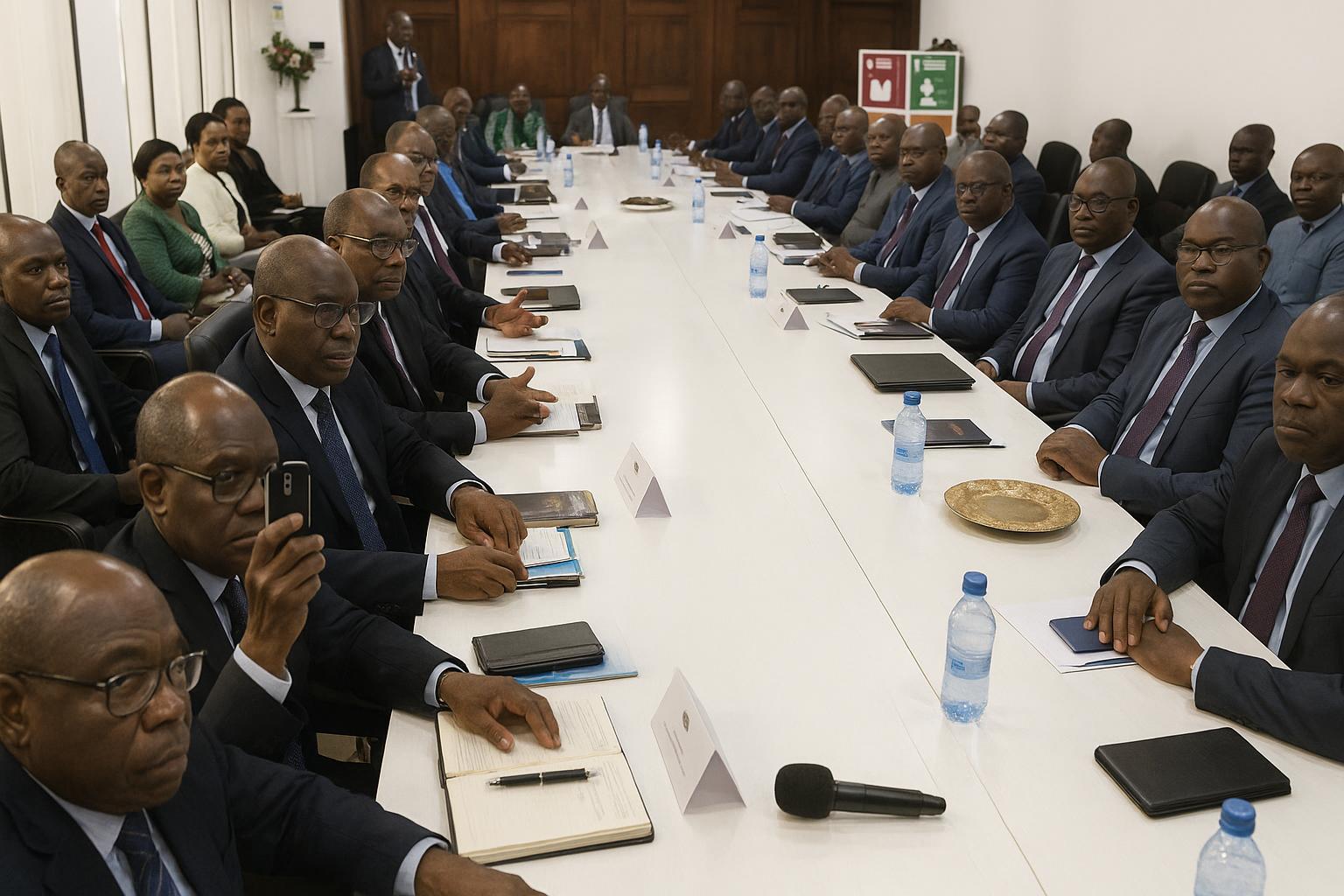
Business leaders enjoyed a working lunch in Brazzaville on 1 December as United Nations Development Programme resident representative Adama Dian Barry urged them to take a seat at the rural electrification table, describing the Programme for Electrification of Rural Zones, PEZOR, as “an investment first, a humanitarian act second.”
Her message was unambiguous: without Congolese entrepreneurs, manufacturers and financiers anchoring projects on the ground, the effort to extend reliable electricity beyond main cities will slow, keeping households and micro-industries dependent on costly alternatives and limiting the country’s vision for inclusive growth.
Barry reminded attendees that the state has mandated UNDP, in tandem with the Ministry of Energy and Hydraulics, to “create the right conditions so that power is available in sufficient quantity and quality for every user, from family kitchens to agro-processing lines.”
Some executives whispered that early engagement lets firms shape contracts instead of adapting later.
UNDP Outlines a Mini-Grid Road Map
PEZOR’s backbone will be a network of nineteen isolated mini-power stations strategically dotted across rural districts, Barry explained, enabling more than 200 inhabited localities to plug into stable grids tailored to local demand rather than the one-size-fits-all extensions that have proved cumbersome elsewhere.
That architecture, she added, offers an immediate commercial opportunity: each site can be developed, operated and maintained under public-private arrangements that let companies recover costs through transparent tariffs while communities benefit from cleaner, more predictable energy.
UNDP plans to provide technical assistance packages covering feasibility studies, environmental safeguards and tender design, ensuring projects reach bankability faster and align with national grid codes; concessional finance windows are also under discussion to soften upfront capital requirements.
Beyond household lighting, the mini-grids are designed to supply three-phase power adequate for cold storage, milling and digital connectivity, elements Barry described as “the seeds of rural entrepreneurship that keep young people from drifting to congested urban centres.”
Executives Demand Predictable Policies
Representing the country’s largest employers’ union, UNICONGO president Michel Dzombo welcomed the blueprint yet stressed that investors will only commit long-term capital once the legal and regulatory framework is “stable, readable and coherent.”
Dzombo pointed to the need for a transparent business model clarifying revenue sharing, licence durations, and eventual integration with the national utility, saying clarity will help boards quantify risk and secure financing in regional and international markets.
He also encouraged authorities to publish a single, universally accessible set of technical norms for mini-grids, arguing that scattered standards inflate costs and slow procurement, especially for small and medium-sized domestic firms hoping to enter the energy supply chain.
Several executives at the lunch cited case studies from neighboring economies where tariff adjustments lagged behind inflation, eroding returns. They urged policymakers to incorporate automatic indexation mechanisms so that operating costs such as diesel back-up or battery replacement are not borne solely by concessionaires.
Minister Ouosso Highlights Local Innovation
Energy and Hydraulics minister Émile Ouosso assured participants that his department is finalising draft regulations that will anchor the private sector’s role in generation and distribution, describing the forthcoming texts as “open to consultation because shared ownership begins with shared writing.”
Ouosso praised UNICONGO members for their engineering depth and for the innovative financing structures several firms have piloted in water and telecom projects, noting such creativity can be adapted to electrification without over-burdening public finances.
The minister reiterated government commitment to the national objective of universal access, emphasising that rural progress reinforces economic diversification efforts championed by President Denis Sassou Nguesso and complements ongoing grid reinforcement work in Brazzaville and Pointe-Noire.
Timeline for Further Consultations
UNDP and the ministry confirmed that technical workshops will be arranged early next year to refine site selection criteria, tariff methodologies and environmental safeguards, with initial invitations expected to reach companies before the end of this month.
Parallel discussions are planned with the Congolese Union of Banks to explore guarantee instruments that can de-risk loans to energy start-ups, while development finance institutions will be approached about co-lending windows linked to climate funding.
Industry observers note that the mere scheduling of these dialogues has already sparked informal consortium building. Engineering firms are pairing with solar suppliers, telecom tower operators with software start-ups, each exploring how to bundle services that could turn an isolated village mini-grid into a catalyst for e-commerce and remote learning.
A separate meeting held earlier with the National Oil Company, UNOC, and a Chinese consortium remains on the agenda, indicating that foreign industrial partners could also play a role once domestic regulations are clarified.
For now, private-sector eyes are fixed on the forthcoming rule book. If the promised clarity arrives, executives say PEZOR could move swiftly from concept to construction, bringing brighter nights to rural classrooms and longer production shifts to village workshops across the Republic of Congo.