
Land ceremony marks official green light
A bright morning on 8 November saw State Minister for Land Affairs Pierre Mabiala hand over a three-hectare title deed to the Bank of Central African States, sealing Dolisie’s status as host city for the institution’s next agency (Ministry of State Lands, 8 Nov).
Flanked by local administrators and BEAC executives, the minister called the gesture “a concrete sign of the government’s desire to bring quality banking services closer to the people.” Applause rippled across the small crowd gathered near the municipal garage where the modern complex will rise.
The Niari capital thus joins Brazzaville, Pointe-Noire, Ouesso and Oyo on the national BEAC map, underscoring the bank’s plan to cover every economic pole of the Republic of Congo.
Strategic push for balanced banking coverage
Central bankers say the south-western corridor generates growing flows of timber, agriculture and transit trade that require stronger cash logistics. A Dolisie hub will shorten delivery routes for notes and coins to local banks and micro-finance cooperatives (BEAC preliminary study, 2022).
Regional lenders currently rely on Pointe-Noire for liquidity, a 160-kilometre haul that can delay payments and raise transport costs. By cutting that distance, officials expect smoother treasury operations for public salaries and infrastructure projects.
The move aligns with CEMAC’s 2023-2025 strategy to boost financial density across member states, promoting not only economic security but also inclusion of smaller towns previously at the fringe of formal banking.
What Dolisie stands to gain
Nicknamed the “green gold city” for its vast forest resources, Dolisie has long acted as a crossroads between coast and hinterland. The BEAC agency is projected to create up to 120 direct jobs during construction and 60 permanent positions once operational, according to municipal estimates.
Local chamber of commerce president Irène Mouanga believes the presence of a high-level bank will “attract fresh capital, raise confidence and keep more savings at home instead of Brazzaville.”
Small transport companies plying the Mayoko iron corridor also look forward to faster access to credit lines, a step viewed as essential for scaling fleets and maintenance.
Designing a future-proof building
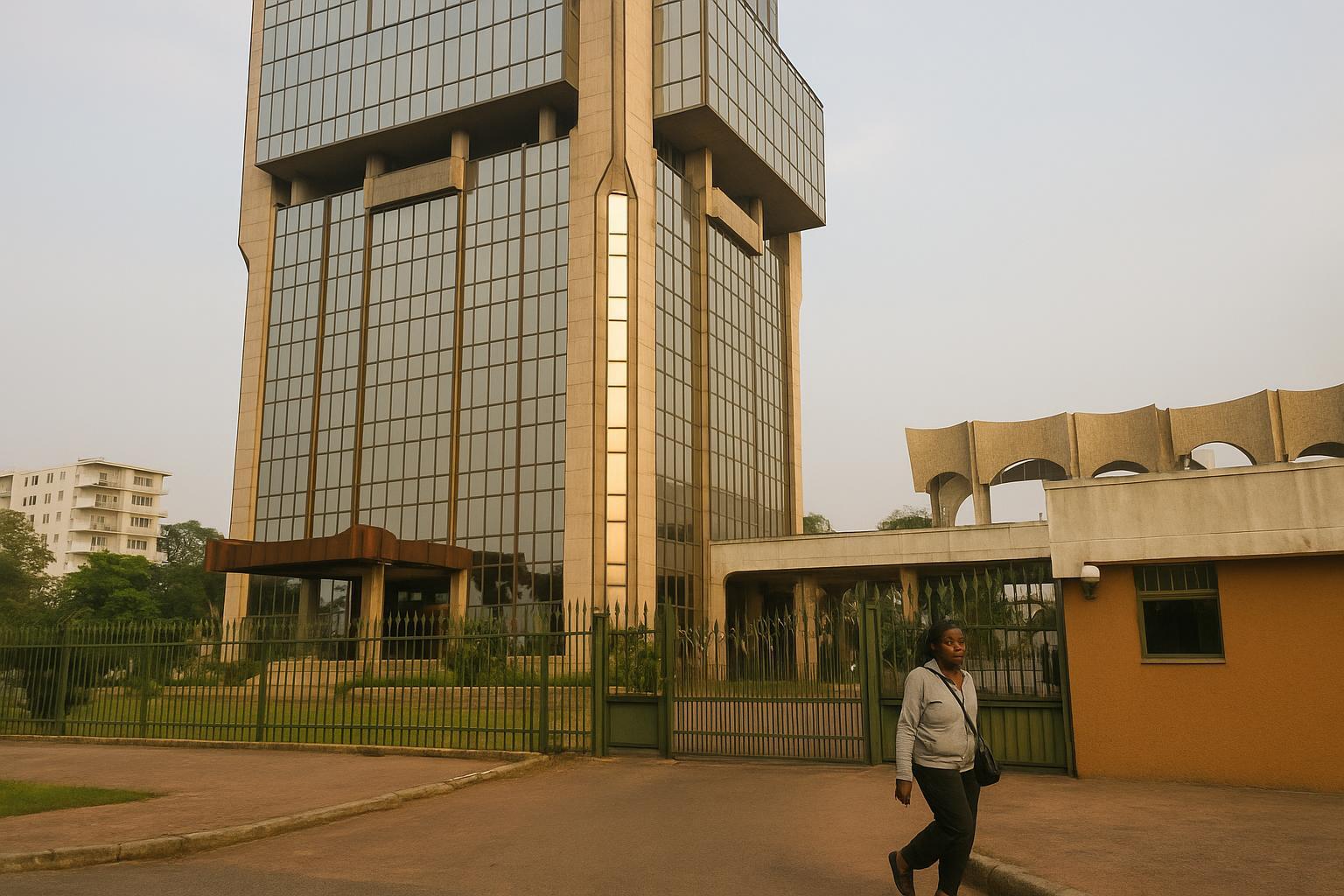
Pre-concept drawings show a four-storey glass-and-concrete block with anti-seismic foundations and green roof panels, matching recent BEAC standards in Yaoundé and Libreville. The blueprint includes open-plan offices, high-spec meeting rooms, a corporate restaurant and secure cash vaults.
Engineers plan to integrate solar arrays capable of covering 30 percent of annual electricity demand, easing strain on the local grid and aligning with Congo’s low-carbon commitments presented at COP27.
A tender for civil works is due early 2024, with the foundation stone targeted for the second quarter, subject to final board approval in Libreville headquarters, project managers said.
Voices from government and industry
Governor-prefect of Niari, Baron Frédéric Bouzock, praised President Denis Sassou Nguesso’s leadership for “ensuring that every department feels the pulse of national development through concrete investments.”
BEAC national director Bienvenu Sosthène Dingana highlighted that the Dolisie office will pilot digital-first counters, promoting mobile wallet interoperability and biometric identity checks for rapid account opening.
Civil society leader Louise Ikouélé welcomed the announcement but urged that “fees remain affordable so that rural women’s groups can truly benefit.” Bank officials responded that a pricing study is ongoing in partnership with the Ministry of Economy.
Next deadlines and regional outlook
If timelines hold, structural works should finish by late 2025, allowing test operations early 2026, a schedule considered realistic given similar builds in Cameroun and Gabon.
Observers see the project as a milestone in Congo’s decentralisation agenda, complementing planned road upgrades linking Dolisie to the Cabinda enclave and the deep-water port of Pointe-Noire, reinforcing Niari’s emergence as a vibrant trade gateway.