
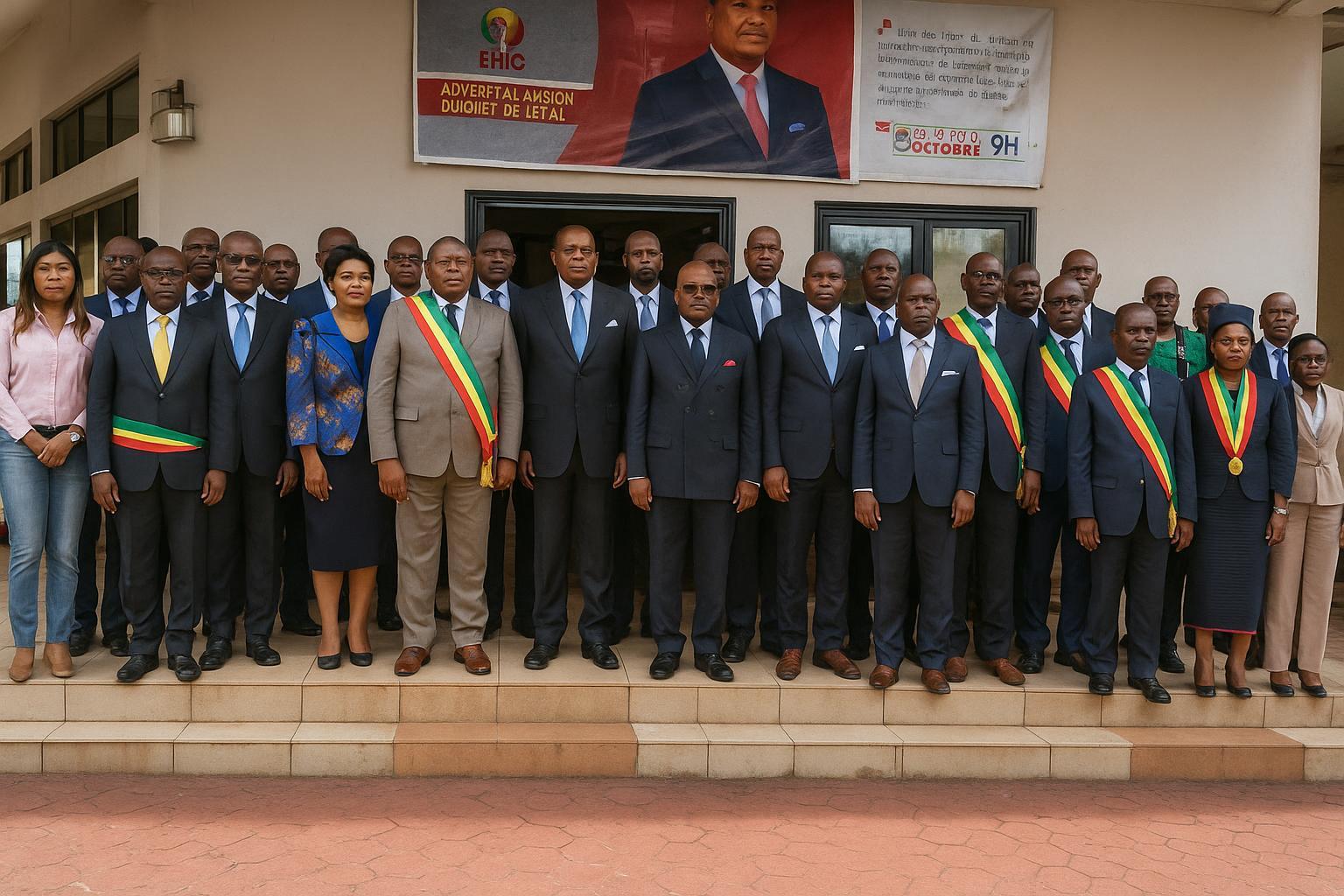
Sixth FHIC opens in Owando
The northern town of Owando vibrated with optimism on 28 October as the sixth Forum Horizon Initiative and Creativity, FHIC, rallied hundreds of young women and men eager to turn ideas into viable businesses, echoing the national push for inclusive growth.
Organized under the theme “Together for sustainable and solidarity-based entrepreneurship in the Cuvette, in line with President Denis Sassou Nguesso’s vision,” the gathering focused on practical skills that participants can apply immediately within their communities.
Minister Mabiala’s call for action
Acting as guest of honour, State Minister for Land Affairs and Public Domain Pierre Mabiala urged attendees to “fully own the knowledge shared by carefully selected experts,” insisting that entrepreneurship, coupled with peace, remains the safest path toward long-term prosperity.
He applauded FHIC’s progression from Brazzaville to Dolisie, Impfondo, Pointe-Noire and now Owando, describing the circuit as “a practical school that travels to the youth instead of waiting for the youth to travel to it.”
The minister reiterated President Sassou Nguesso’s commitment to public safety, noting recent operations against lawlessness. “Security is the oxygen of development,” he affirmed, encouraging participants to protect their communities while they build enterprises that add value locally.
FIGA outlines funding avenues
Brice Makaya Kokolo, deputy director-general of the Impulse, Guarantee and Support Fund, FIGA, reminded the audience that finance follows preparation. He cited the palm-oil cooperative Kolisa, backed by FIGA, as proof that disciplined planning unlocks credit and markets.
“Courage and determination are not optional; they are the capital you already possess,” Makaya Kokolo declared, inviting project holders to approach the fund’s Brazzaville and departmental desks for tailored coaching, feasibility studies and partial guarantees.
FHIC leadership nurtures networks
Executive president Aline France Etokabeka traced FHIC’s origin to 2023, stressing that the platform links trainers, financial institutions and market outlets in a single forum, shortening the distance between an idea on paper and a product on a shelf.
Her team handed the FHIC flag to Abel Joël Owassa Yaucka, MP for Owando and first quaestor of the National Assembly, who accepted the role of patron for this edition and pledged logistical support through his NGO “La Dynamique Owando Pluriel.”
“Entrepreneurship never lies,” Owassa Yaucka told the crowd, listing self-help projects his organisation has launched, from tailoring workshops to digital literacy hubs. He urged young residents to emulate these examples and “transform the Cuvette into a reservoir of start-ups.”
Field visits reveal agribusiness promise
To anchor theory in reality, the first day concluded with a tour of Makoua, where participants walked through cocoa plots, oil-palm stands and a small-scale palm-oil mill. Farmers explained how collective management reduces costs and attracts contracts from regional processors.
“Seeing the machines turn fresh fruit into bright red oil gave me confidence; I want to replicate this in my village,” said Pauline Ngouabi, a 24-year-old agronomy student from Okoyo, already drafting a micro-enterprise plan with classmates.
Multi-actor partnership gains traction
Alongside FIGA, public broadcaster Télé Congo, regional banks and the United Nations Development Programme provided technical sessions on bookkeeping, e-commerce logistics and environmental compliance, underscoring the multi-actor nature of the endeavour.
Organisers estimate that at least 60 percent of registered delegates come from rural districts where access to incubation centres is limited. By staging FHIC on their doorstep, they aim to reverse urban migration trends and keep value chains close to raw-material sources.
Local authorities have earmarked plots near Owando airport for an upcoming “entrepreneurial village” that will host co-working spaces, cold rooms and training halls. Construction designs, shared during the forum, highlight solar-powered equipment to cut operating bills.
Next steps and expected impact
Over the coming week, mentors will supervise business-model canvases, pitching sessions and prototype testing. Successful teams will secure follow-up visits from FIGA and sector ministries to fast-track administrative formalities such as patent registration and tax identification numbers.
Analysts from the Departmental Directorate of Economy predict that if only a quarter of drafted projects see daylight, the Cuvette could generate 800 new jobs within two years, mainly in agro-processing, digital services and eco-tourism.
For Pierre Mabiala, such prospects justify sustained public backing. “Our mission is to equip the youth so they thrive at home rather than seek uncertain fortunes elsewhere,” he concluded, drawing applause that echoed across the Owando cultural centre.
Voices from the diaspora
Several Congolese living abroad attended virtually through live-streamed sessions. Dieudonné Mavinga, a software engineer in Dakar, said the event helps him connect with local coders for outsourcing contracts, adding that remittances can be more impactful when tied to structured ventures.
Organisers said the interactive platform recorded connections from France, Canada and South Africa, illustrating how the forum’s reach now extends beyond national borders. Plans are underway to integrate a year-round digital academy where diaspora experts will tutor early-stage enterprises.
In the meantime, registration desks near the Owando stadium remain open for latecomers, with facilitators promising condensed refresher modules. “Nobody should feel left out,” Etokabeka stressed, noting that transportation stipends are available for participants from remote villages.