
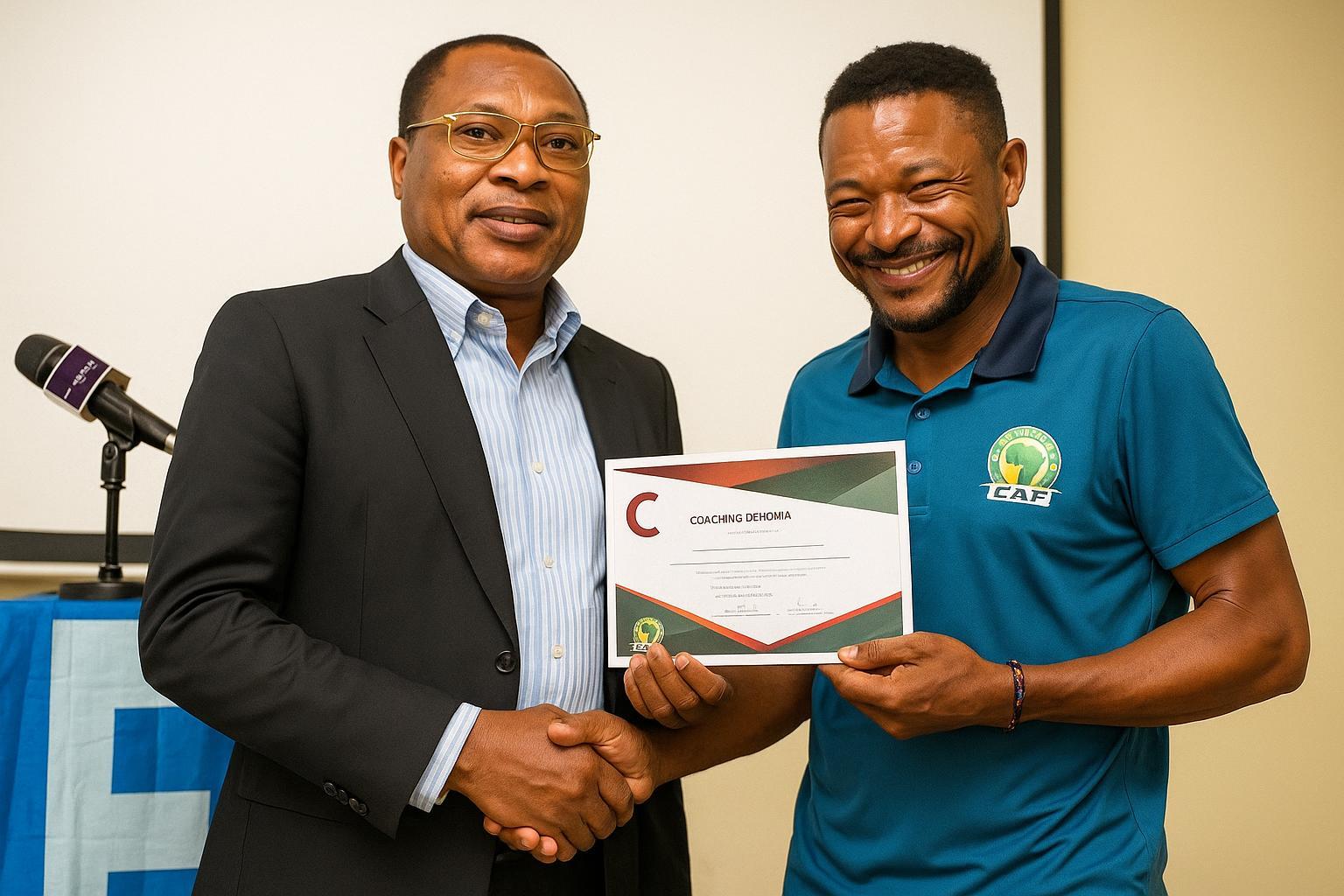
New CAF C Coaches Graduate in Brazzaville
Flashing smiles filled the Congolese Football Federation auditorium on 18 October as twenty-eight aspiring tacticians finally clasped the coveted CAF C coaching diploma, a document that unlocks the touchline for national league matches and youth competitions across Central Africa.
The graduation was presided over by federation president Jean-Guy Blaise Mayolas, whose brief but enthusiastic address underlined government-backed ambitions to professionalise every layer of the beautiful game, from grassroots centres to senior selection benches.
A brass band played the national anthem while relatives clicked phone cameras, giving the event a festive air that echoed similar ceremonies staged recently in Cameroon and Gabon, a regional trend fed by the Confederation of African Football’s stricter licensing grid introduced in 2022 (CAF circular 2022-11).
A Year-long Syllabus Tailored to Congolese Reality
Unlike the conventional eight-week module outlined in the CAF handbook, the Brazzaville cohort spread its lessons over twelve months, a choice made by National Technical Director Pascal Blin to accommodate participants who juggle club duties, family obligations and often long road trips from remote departments.
Weekly sessions mixed chalkboard theory with on-field drills at the Alphonse-Massamba-Débat annex, covering talent identification, injury prevention, video analysis and the emerging science of load management, an area Blin insisted was ‘no longer a luxury but a necessity for Congolese athletes targeting continental exposure’.
Course fees stood at 120,000 FCFA, roughly the price of a mid-range pair of boots, yet more than half the candidates benefited from subsidies channelled through the FIFA Forward programme, an arrangement Mayolas described as ‘evidence that solidarity funds reach the grassroots’.
External lecturers from the University of Brazzaville’s sports science department presented nutrition and psychology modules, a partnership the Federation hopes to formalise through a memorandum of understanding early next year, according to deputy technical director Prisca Ngombé, who helped coordinate classroom resources.
Why a CAF C License Matters on the Bench
Since the CAF Coaching Convention came into force, clubs entering interclub tournaments must register a technical staff holding recognised badges; failure to comply risks hefty fines and even ejection, as experienced by a Beninese side during last season’s Confederation Cup preliminary round.
In Congo-Brazzaville the directive already reshapes budget lines, with several Ligue 1 clubs allocating funds for staff education rather than last-minute player signings, a strategy sports economist Fabrice Moukouba describes as ‘investing in a playing philosophy instead of gambling on raw muscle’.
Domestic referees also attended certain tactical sessions, fostering a shared vocabulary with coaches. According to elite referee trainer Arnaud Okemba, this crossover ‘reduces confrontations on match day because we now understand the purpose behind pressing triggers or time-wasting interpretations’.
The CAF C level, though entry-grade, authorises holders to coach amateur senior squads and youth elite academies, making it a crucial rung for former internationals looking to transition from boots to clipboards without leaving the country for costly European courses.
Voices from the Field: Fresh Graduates Speak
Elisabeth Makosso, one of four women in the cohort, hailed the inclusive tone of the course, noting that mixed-gender coaching teams ‘mirror the diversity of changing dressing rooms and send a message to young girls that tactical expertise is not a male monopoly’.
Her classmate Junior Diawara, assistant at District club Etoile de Talangaï, believes the year-long rhythm allowed deeper assimilation. ‘We had time to test drills during weekend fixtures and come back Monday with concrete questions; that cycle simply isn’t possible in condensed eight-week workshops,’ he explained.
Both graduates intend to pursue the CAF B badge within two years, provided funding mechanisms announced by the Ministry of Sports materialise. A scholarship scheme is being drafted, ministry adviser Rodrigue Massamba confirmed, though final approval must await next quarter’s budget arbitration.
Pointe-Noire Ceremony Mirrors the Capital
A sister ceremony unfolded simultaneously at the Atlantic port city’s Félix-Éboué complex, granting fourteen coastal coaches their moment in the spotlight. The replication answers a long-standing plea for decentralisation, easing travel costs for clubs already contending with fluctuating fuel prices.
Local federation delegate Mathurin Ndinga underlined that future intakes may rotate between Dolisie, Owando and Ouesso, aligning with national cohesion policies promoted by President Denis Sassou Nguesso to ensure equal access to professional pathways across all twelve departments.
A brief exhibition match between graduates and a local U-17 selection concluded the Pointe-Noire gathering, giving spectators a taste of fresh methodologies such as rondo warm-ups and position-specific coaching, practices rarely seen in provincial stadia until now.
Next Steps: DTN’s Roadmap for Coach Development
Closing the Brazzaville event, Pascal Blin unveiled a three-tier roadmap: digital learning platforms by mid-2026, a refresher clinic for veterans every off-season, and an eventual CAF coaching centre of excellence to be integrated into the future Kintélé sports city project.
Funding discussions are ongoing with private sponsors and supranational partners such as the CEMAC Development Bank. ‘Our coaches shape our players, who in turn shape our national brand,’ Blin reminded attendees, urging the new graduates to act as ambassadors of modern, ethical, data-driven football.