
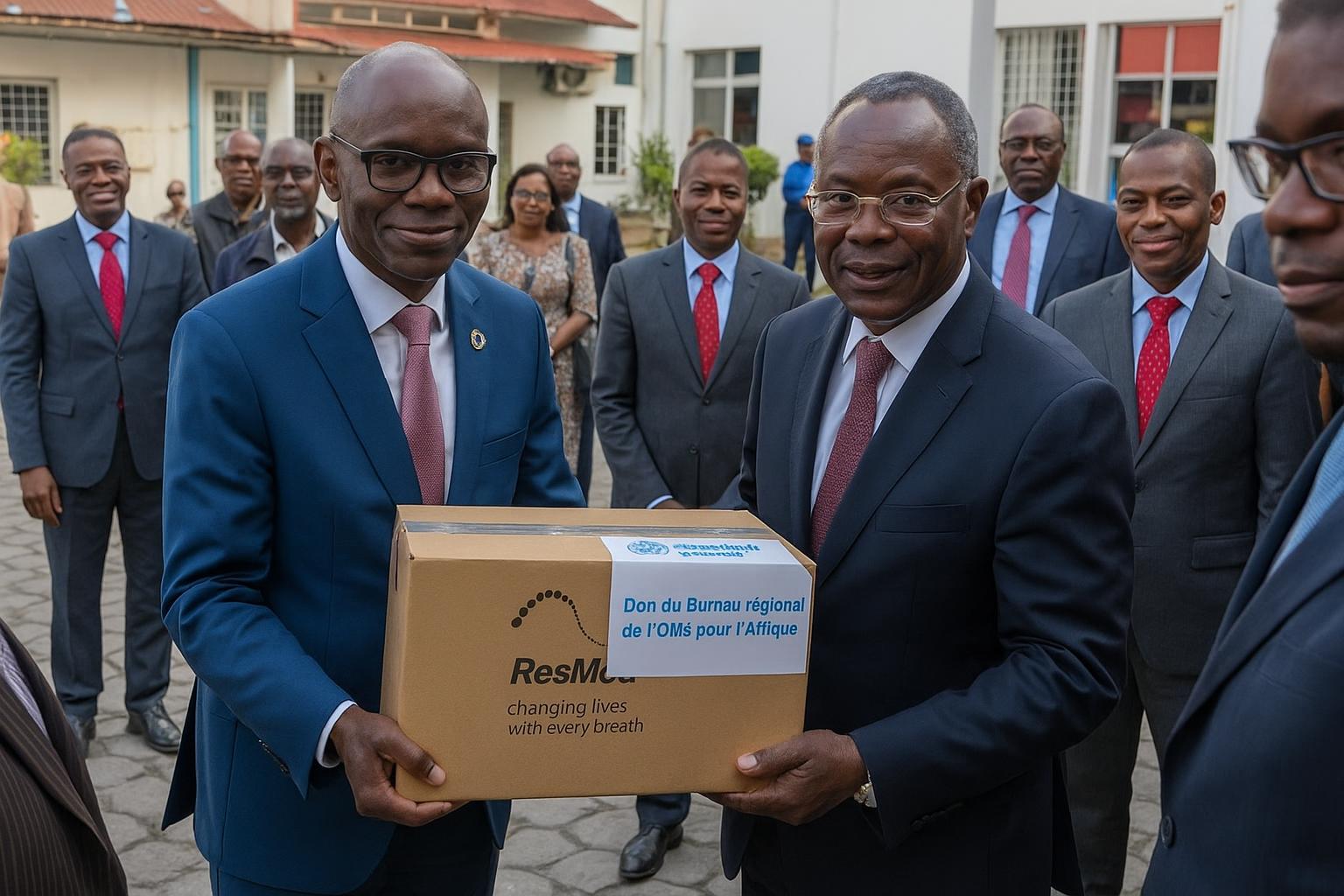
WHO shipment lands in Brazzaville
A convoy of white-labeled crates bearing the blue WHO emblem rolled through the gates of the Ministry of Health compound in Brazzaville on Friday, carrying what officials call the largest single batch of intensive-care supplies delivered to Congo since the pandemic.
The handover ceremony, held under a clear tropical sky, gathered senior health officials, United Nations staff and dozens of student nurses who erupted in applause as pallets of ventilators, oxygen concentrators and patient monitors were unwrapped for a first visual inspection on the ministry forecourt to loud cheers.
Inside the life-saving kit
According to the official manifest, the WHO donation includes thirty adult ventilators, twenty paediatric ventilators, forty oxygen concentrators, sixty multiparameter monitors, humidifiers, laryngoscopes, defibrillators and hundreds of single-use resuscitation kits, all calibrated to international standards and ready for immediate deployment in provincial facilities serving four million rural residents.
Technicians from the National Biomedical Service inspected every serial number alongside WHO engineers, ensuring warranty documents and maintenance schedules correspond to the ministry’s digital registry, a crucial step that health economists say can extend the lifespan of equipment in environments where spare parts once took months to source locally.
The bundle also contains infection-prevention material such as gloves, gowns and high-grade masks, items that proved indispensable during recent outbreaks of influenza and mpox in neighbouring states, offering a protective buffer should cross-border cases appear along the busy Pointe-Noire to Kinshasa corridor over the next months.
Strategic timing with new hospitals
Health Minister Professor Jean-Rosaire Ibara reminded guests that the country is days away from inaugurating two reference hospitals, one in the north near Oyo and another in the economic hub of Pointe-Noire, both designed with modern intensive-care wings now fully equipped for critical respiratory care needs.
By synchronising the shipment with the ribbon-cutting calendar, authorities hope to avoid the empty-ward syndrome that has plagued past infrastructure projects across the continent, where bricks went up before biomedical devices arrived, leaving shiny rooms idle and communities questioning the value of public investment in health service delivery.
Dr Mohamed Yakub Janabi, WHO Regional Director for Africa, called the timing ‘a textbook case of strategic alignment’, noting that the operational readiness assessments his team conducted last month highlighted human-resource gaps the donation now partially closes by supplying equipment that requires minimal retraining for experienced staff.
Voices from the wards
Inside Brazzaville’s Talangaï General Hospital, senior nurses watched televised coverage of the ceremony with evident relief, saying off-camera that improvised oxygen splitters will soon become a memory once the new concentrators are installed, reducing night-shift stress and improving the survival odds of premature newborns there.
Emergency physicians emphasise that ventilators alone cannot save lives without stable electricity; the Ministry therefore confirmed that backup generators and voltage regulators, financed through its own budget lines, are already in place, signalling a whole-of-system approach rather than a public-relations gesture toward resilient critical care service chains.
Medical students at Marien Ngouabi University argue the real test will be routine maintenance, yet they feel encouraged by the joint inspection teams announced during the event, a sign that preventive servicing schedules will be respected and spare parts stocked locally in regional repair hubs soon.
Steady march toward Universal Health Coverage
Congo’s latest National Health Development Plan sets the ambitious target of universal health coverage by 2030, and international observers often cite access to critical care as a key benchmark; the WHO shipment moves the dial by expanding functional ICU beds in both urban and hard-to-reach districts across territory.
The handover also dovetails with government incentives encouraging young doctors to serve outside major cities, offering housing and research grants in facilities newly equipped with world-class monitors, making rural postings more attractive and slowing the migration of talent to private clinics or neighbouring countries in coming years.
WHO officials stressed that the donation is only one pillar in a broader collaboration encompassing training modules, digital surveillance tools and joint outbreak simulations planned for early next year, each meant to strengthen national preparedness and build confidence among citizens seeking timely, affordable and quality health services nationwide.
What happens next on the ground
Over the next fortnight, a logistics task force will dispatch the equipment to fourteen departmental hospitals and three teaching institutions, using a barcode tracking system that feeds directly into the ministry’s public dashboard so citizens can monitor deliveries in real time from their smartphones and community kiosks.
Once installation teams sign off, biomedical trainers will conduct refresher sessions for nurses and respiratory therapists, ensuring every shift can troubleshoot alarms and calibrate oxygen flows; by mid-December, officials anticipate that the new gear will be fully integrated into national referral pathways, closing a critical preparedness gap for emergencies.