
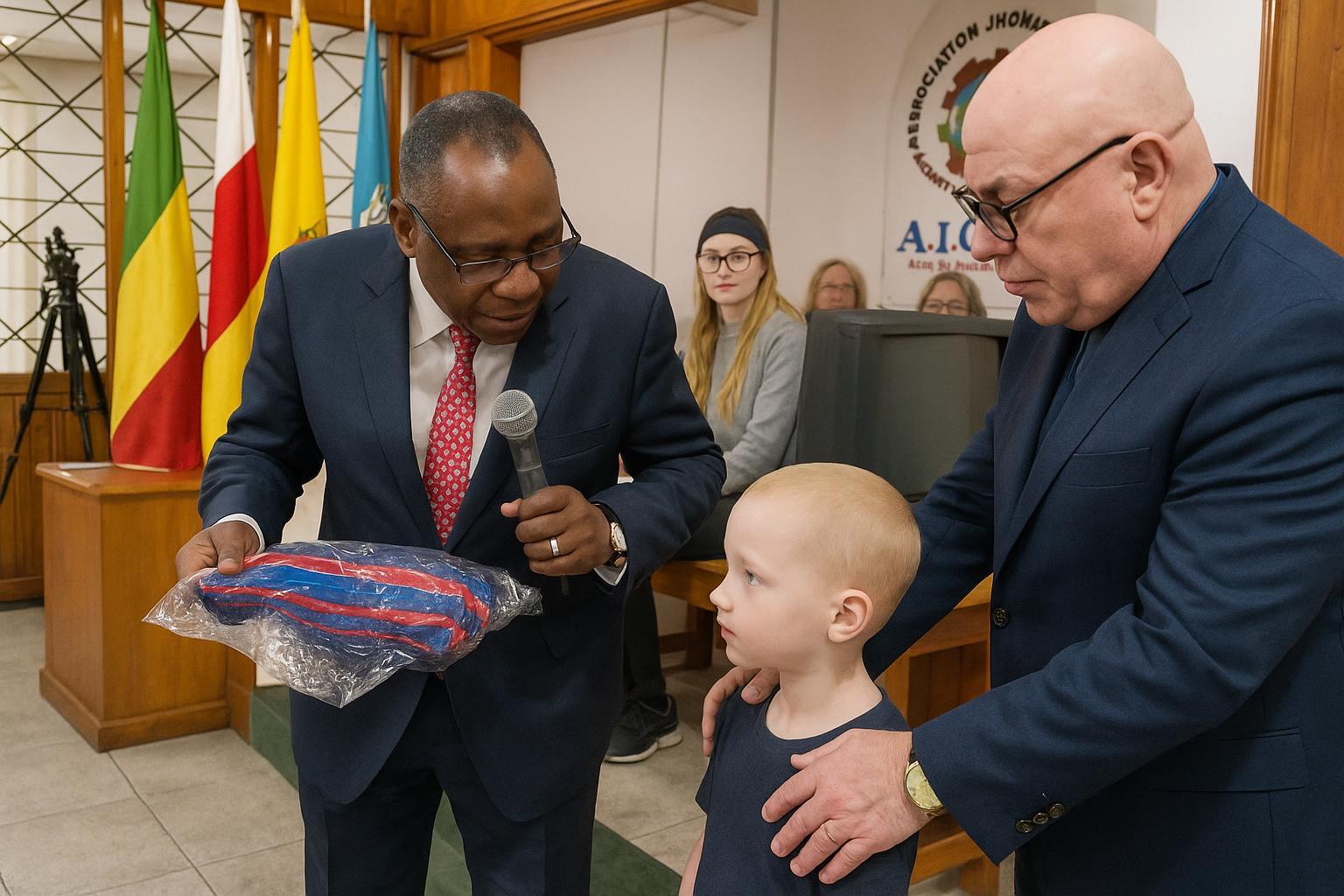
Community drive lights up Moungali
Saturday 11 October 2025 felt like a fresh start for roughly one hundred albino pupils streaming into Moungali.
In the courtyard of AJCA’s medical clinic, boxes brimmed with notebooks, pens, solar-rated creams and gentle cleansing soap.
Volunteers arranged the kits with the precision of pharmacists, conscious that every item could decide a child’s comfort in class.
The initiative sprang from a partnership between the Association Johny Chancel for Albinos and the charity Redonner le Sourire.
Their shared goal was simple yet ambitious: erase practical barriers so that skin sensitivity never sidelines academic dreams.
High-level backing signals priority
The presence of Minister Delegate Joseph-Luc Okio lent state gravitas, underscoring the administration’s pledge to leave no learner behind.
Standing beside him, a representative of the Russian embassy offered discreet applause, echoing earlier bilateral cooperation on health expertise.
Minister Okio handed a sealed envelope to organisers, calling it “a modest sign of our continuous solidarity with vulnerable compatriots.”
He reminded the audience that inclusive schooling aligns with the national reform roadmap championed by President Denis Sassou Nguesso.
“Education equips every child to contribute to peace and prosperity,” he noted, sparking cheers from parents gathered under colourful tents.
Education and sunscreen: inseparable duo
AJCA spokeswoman Sylvia Okandza took the microphone, her voice carrying the conviction of years spent battling stereotypes.
She stressed that sending albino children to school is not charity but an investment in Congo’s collective intellect.
Research shows uninterrupted education raises earnings and health outcomes; for albino pupils, sunscreen becomes as fundamental as exercise books.
Network president Johny Chancel Ngamouana illustrated the point by displaying a cream bottle next to a mathematics textbook.
“We cannot solve equations if painful burns keep us home,” he declared, prompting knowing nods from teenagers in matching uniforms.
Each kit therefore contained high-protection factor lotion suitable for tropical midday recess, together with gentle cleansers to prevent irritation.
Medical volunteers offered brief demonstrations on proper application, ensuring supplies would stretch until next term’s harmattan season.
A clinic born from persistence
The Moungali clinic itself stands as proof of what local initiative can achieve when matched with strategic partnerships.
Founded in 2017 by Ngamouana, the centre delivers free dermatological consultations and, when necessary, coordinates regional evacuations.
Specialists from Mali, Uganda, Belgium and Russia routinely share expertise, a model that impressed several visiting WHO observers last year.
The clinic’s pastel hallways feature motivational murals painted by young albino artists who once arrived as timid patients.
“Health feeds confidence, and confidence feeds learning,” murmured paediatric nurse Mireille Abamba while adjusting a child’s new straw hat.
AJCA finances the facility through small donations, craft sales and occasional corporate sponsorships, illustrating community resilience amid financial constraints.
Families embrace brighter horizon
Outside the clinic gate, mother of three, Jacqueline Banzou, clutched exercise books with relief etched on her face.
She explained that sunscreen alone can consume half a modest household’s monthly income when available.
“Now my twins will focus on grammar instead of counting blisters,” she said, wiping perspiration from her brow.
Nearby, fourteen-year-old Rodrigue Mikangou admired his first scientific calculator, describing plans to become a civil engineer.
“Bridges shade everyone,” he smiled, hinting at a future where inclusion shapes infrastructure as much as policy.
Teachers present at the event promised follow-up visits to ensure creams are applied correctly and supplies remain stocked.
They argued that sustained mentorship—not one-off giveaways—turns gifts into measurable academic performance.
Looking ahead to 2025-2026 term
With the new school year approaching, AJCA has scheduled quarterly check-ups and intends to expand coverage to rural districts.
Logistics remain challenging, yet organisers believe digital fundraising platforms can mobilise diaspora support for transportation costs.
Ministry officials hinted at potential integration of photoprotection measures within wider public-health programs, pending budget discussions.
For the students cheering under Brazzaville’s sun, policy debates felt distant; what mattered was stepping into classrooms with confidence.
As the ceremony closed, a chorus of primary voices sang the national anthem, reminding onlookers that inclusion ultimately uplifts the entire Republic.
Experts call for data driven inclusion
Epidemiologist Dr. Armand Mpassi, who studies sun-related skin cancers, cautioned that precise statistics on albinism remain scarce nationwide.
He urged schools to document absenteeism linked to dermatological issues, arguing that evidence can unlock targeted budget lines.
“Data transforms goodwill into systemic protection,” he said, praising AJCA for already compiling patient-school attendance correlations.
Sociologist Clémentine Lengolo added that public awareness campaigns must highlight success stories to replace pity with respect.
She recommended integrating albinism education into civic classes, a proposal Minister Okio promised to study during forthcoming curriculum reviews.
Both experts agreed that the Brazzaville ceremony signals more than charity; it showcases a replicable model of shared responsibility.
As twilight settled, organisers packed leftover supplies earmarked for Pointe-Noire, extending the ripple of solidarity beyond the capital’s paved avenues and into classrooms bordering dense forests.