
A solemn state tribute in Brazzaville
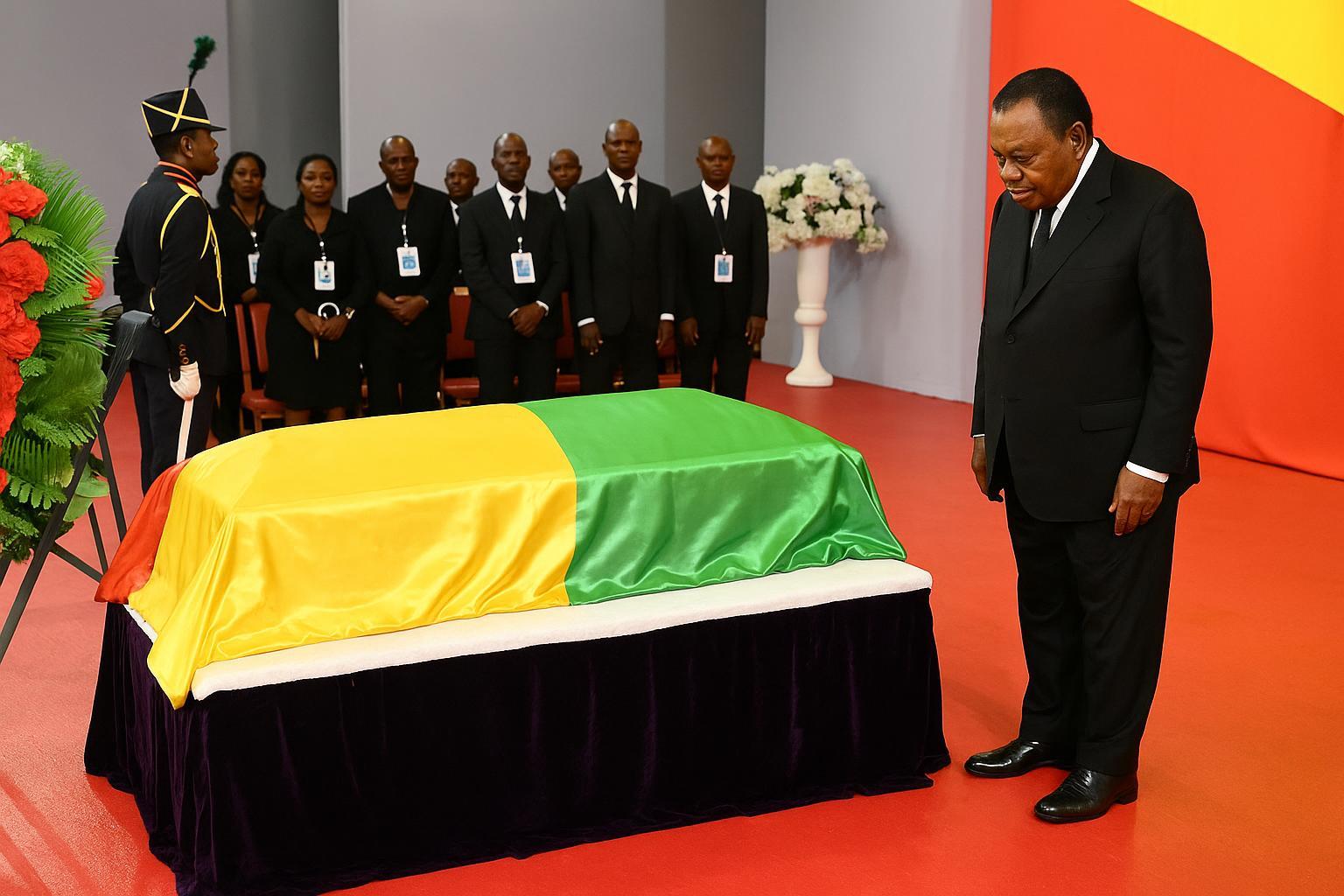
The Brazzaville Congress Palace fell silent on 13 October as the flag-draped coffin of André Georges Mouyabi entered under an escort from the Republican Guard. The national anthem echoed through the hall, setting the tone for a ceremony broadcast live by Télé Congo.
President Denis Sassou Nguesso walked forward, placed a white-rose wreath on the catafalque, and bowed in a moment of reflection. His gesture, shown repeatedly on public screens, captured the measured respect the State wished to convey to a man who had served five successive administrations.
Government members, diplomatic envoys and representatives of the four main religious denominations joined lawmakers in paying their respects. According to Les Dépêches de Brazzaville, every seat in the 1 400-place auditorium was taken by 8 a.m., testimony to Mouyabi’s cross-generational appeal.
Life of service from Bouenza to Paris
Born in 1935 in Ditadi, Loudima district, Bouenza, André Georges Mouyabi attended the modern college of Dolisie, then the regional administrative school. Friends from those years recall a diligent student who travelled to class on foot from the family farm, carrying exercise books wrapped in palm leaves.
He entered public life at thirty, elected deputy for Madingou during the early years of the Republic of Congo. Commenting on that period, historian Albert Sita notes that rural deputies shaped the first Assembly by voicing local concerns on cocoa prices and feeder roads.
Mouyabi’s last days unfolded in Paris, where he had gone for a routine check-up. Relatives told the Congolese Press Agency he succumbed on 18 September 2025 to a brief illness, “still reading parliamentary notes and asking about harvest figures” right until the final evening.
Key milestones in national leadership
Appointed government commissioner, or prefect, of Dolisie in March 1965, Mouyabi gained a reputation for defusing land disputes through night-long dialogues that ended only when farmers shook hands. He left the post thirteen months later to become president of the National Assembly.
His speakership, ending with the 1 August 1968 dissolution, overlapped a turbulent era. Yet analysts agree that Assembly archives show record attendance rates and the passage of thirty-two bills under his gavel, including the landmark mining code that still informs present policy.
Successive portfolios followed: Industry and Mines, Urbanism and Housing, then Civil Service. Former civil servants remember that his ministry introduced the first computerised payroll in 1985, boosting transparency. “He treated every memo as if the Republic depended on it,” said retired director Paulette Ngoma during Monday’s vigil.
Service to different administrations
Mouyabi’s ability to serve under varying political climates drew notice. In 1996, President Pascal Lissouba appointed him special adviser for institutional reform. That role, though brief because of the 1997 hostilities, allowed him to draft guidelines later used in the post-conflict civil service overhaul.
Political scientist Rodrigue Mabiala points out that Mouyabi’s methods were “quiet, never confrontational, but firm on constitutional principles”. Mabiala argues that such tact helped maintain administrative continuity, a trait valued by today’s leadership. The observation earned nods from several MPs during Tuesday’s media scrum.
An example for the youth
First secretary of the Assembly, Fernand Sabaye, delivered the main eulogy. His voice occasionally trembled as he called the departed “a laborious and discreet statesman whose humility lit every corridor he crossed”. Young parliamentary interns listened from the gallery, phones lowered out of respect.
Campus Radio Brazzaville interviewed some of those interns. “His life shows we can rise from village classrooms to the national stage without losing our values,” said law student Ornella Madzou. That message, repeatedly highlighted on social networks, may broaden Mouyabi’s posthumous influence.
The Ministry of Youth announced that the next civic-education module will include a case study on Mouyabi’s negotiation style, emphasising patience, data gathering and clarity. Officials believe the material will supplement existing lessons on national symbols and the Constitution.
Family and final journey home
Behind the protocol, the human dimension remained palpable. Mouyabi leaves ten children and many grandchildren. Eldest son Gilbert, visibly moved, thanked the Head of State “for treating our father as a son of the Nation” and promised to uphold the values instilled at family dinners.
After the Brazzaville honors, the coffin departed for Loukoko Air Base, then boarded a military aircraft bound for Madingou. Along the route, residents gathered at roadside checkpoints waving tricolour flags. Local radio Bouenza FM reported spontaneous choruses of the hymn “Nkolo Nzambi”.
Burial will occur in the family compound, shaded by mango trees he planted decades ago. Customary chiefs plan to perform a libation ritual before the final blessing from the bishop of Nkayi, blending tradition and faith, two pillars Mouyabi cherished throughout his ninety years.
Looking forward with gratitude
As dusk settled over the capital, the giant screens outside the Congress Palace replayed key moments of Mouyabi’s career: speeches on industrial diversification, his smile during village visits, the firm handshake with workers at Pointe-Noire port. Each image invited citizens to consider their own role in nation-building.
Prime Minister Anatole Collinet Makosso summed up the sentiment in a brief statement: “Our Republic grows stronger when it remembers its builders.” For many observers, the ceremony not only honored a past figure but also reaffirmed the continuity and unity that define Congo-Brazzaville today.
The State protocol office confirmed that an annual lecture on parliamentary history will bear Mouyabi’s name. Its inaugural edition, scheduled next September, will coincide with the first anniversary of his passing, ensuring that his meticulous approach to public duty remains a living reference.