
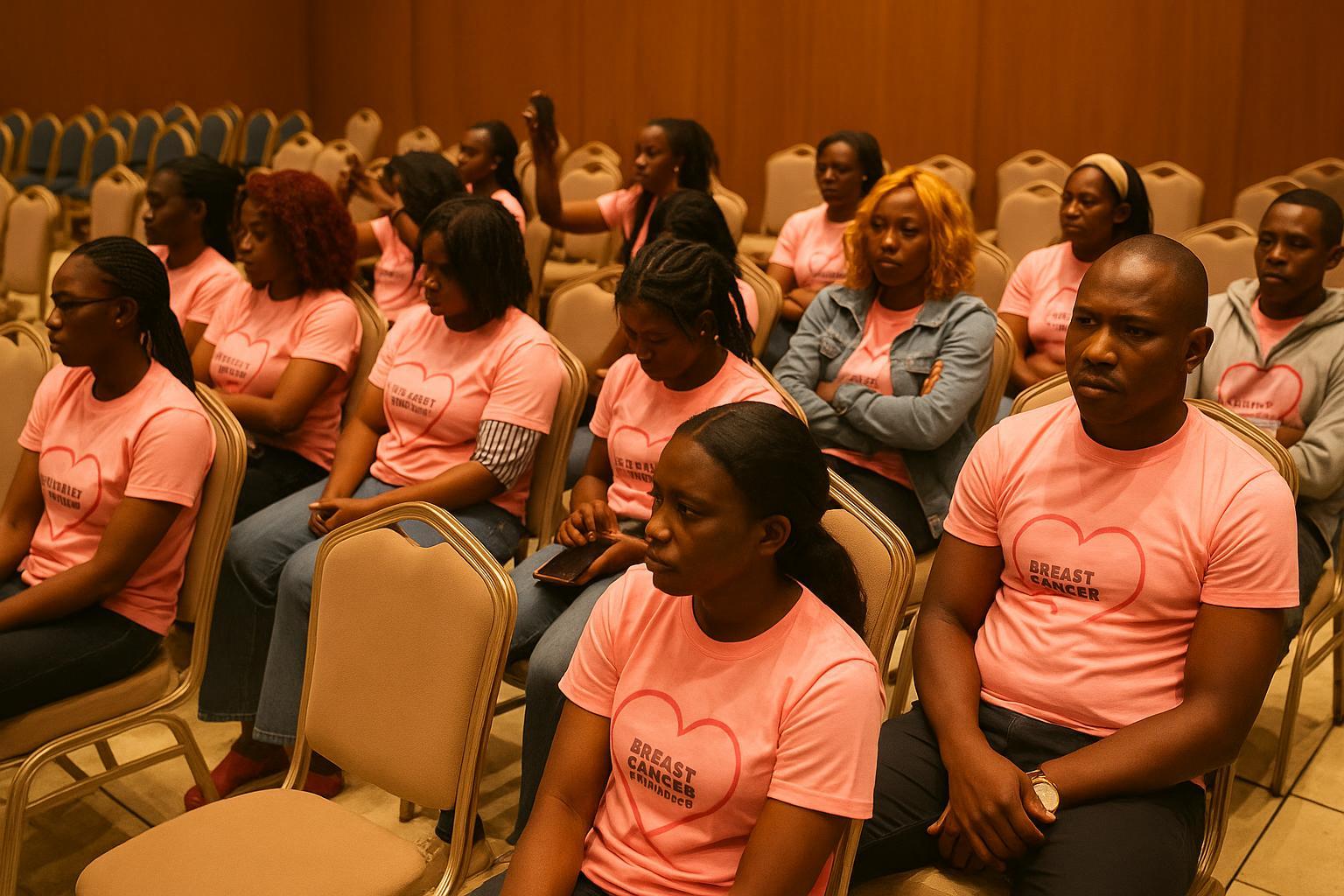
Brazzaville ceremony signals nationwide mobilisation
A burst of pink and blue banners coloured the Radisson Blu ballroom in Brazzaville on 2 October as Health and Population Minister Prof Jean-Rosaire Ibrara launched the 2025 “Octobre rose & Novembre bleu” campaign before officials, clinicians and civil-society leaders.
From the podium, the minister insisted the slogan “All united against cancer” carries a practical meaning this year, promising visible action in every department. The World Health Organization’s new Africa chief, Prof Mohamed Yakub Janabi, applauded the initiative, pledging continued technical support (WHO Africa statement).
Breast and prostate: leading local threats
Breast cancer remains the number-one malignancy among Congolese women, with close to 5 000 new cases a year, or roughly one in three female cancers, according to ministry surveillance figures published in July.
Men face a quieter but deadly enemy: prostate cancer accounts for an estimated 22 % of male cancers nationally, a proportion confirmed in the latest Brazzaville University Teaching Hospital registry report (2024). Both diseases respond better when caught early, reinforcing the push for routine checks.
Seven strategic pillars guide the 2025 drive
Prof Ibrara listed seven priorities: community awareness through churches, markets and social media; cost-free mass screening caravans; strengthened diagnostic and treatment capacity; intensive training for doctors and nurses; local epidemiological research; psychosocial and economic support networks; and tight coordination between departmental health teams.
The ministry has already dispatched 36 portable ultrasound units and 20 prostate-specific-antigen analysers to semi-urban districts, funded through a partnership with the African Development Bank and CEMAC Health. A hotline (3434) will connect citizens to the nearest free screening point.
Experts underline urgency and feasibility
“We cannot stay indifferent; every delay costs lives,” Prof Janabi told reporters, adding that Congo’s strategy aligns with the WHO Global Breast Cancer Initiative targets for 60 % survival by 2030.
Dr Claudine Mavouenzela, head oncologist at Pointe-Noire General Hospital, notes that 70 % of her breast-cancer patients still arrive at stage III or IV. “If rural women feel welcomed at district clinics this month, that statistic can drop,” she argues.
Economist Jérôme Nkouka estimates early detection could save up to 4 billion CFA francs annually in advanced treatment costs, freeing resources for paediatric services (Ministry of Finance working paper).
Faces behind the statistics
Thérèse Makaya, 42, a market gardener from Dolisie, travelled six hours to share her survival story. “A mobile unit found my lump in 2023. Surgery was fast and free; now I’m back in my field,” she smiled, encouraging women “not to fear the exam.”
On the men’s side, retired teacher Martin Ngandzi recalls ignoring urinary symptoms. “When the Blue volunteers visited my parish last November, I finally got tested. Starting treatment early kept me in the classroom as a mentor,” he said, urging peers to seize the new screenings.
Practical calendar and services for citizens
Throughout October, pink-clad nurses will operate weekend mammography sessions at Brazzaville’s Makélékélé sports complex, while weekday slots rotate through community clinics in Ouesso, Oyo and Sibiti.
In November, urology teams plan free prostate-specific-antigen tests at railway stations to reach commuters. The National Social Security Fund confirmed it will reimburse 80 % of follow-up biopsies for registered workers.
Daily updates on locations, waiting times and weather are available via the ministry’s Telegram channel and on Radio Congo’s 6 a.m. service bulletin.
Training and research boost sustainable impact
The University of Brazzaville Medical Faculty, backed by the Congolese Society of Pathology, will host a three-day workshop on artificial-intelligence-assisted histology in mid-October.
Separate sessions in November will upgrade 120 general practitioners on hormone-therapy protocols, using curricula validated by the Société d’Urologie du Congo. Preliminary results from a multi-centre study on genetic risk factors in Central Africa are also slated for release, enriching regional science.
Beyond two months: building a year-round safety net
Authorities emphasise that the campaign is a starting point, not a finale. By January, every departmental hospital should pilot a one-stop breast clinic model to cut diagnosis time to seven days, mirroring benchmarks set in Morocco and Rwanda.
The ministry is negotiating with pharmaceutical partners to secure price cuts on essential oncology drugs, a move praised by patient associations for easing household budgets in 2026.
“Long treatments break families financially; subsidised medicines are a life anchor,” stresses Carine Okombi, coordinator of the Pink Ribbon Network.
Digital and diaspora engagement expand reach
A #PinkBlueCongo hashtag already trends on TikTok and Facebook, driven by local influencers and sports stars recording self-exam tutorials. Diaspora doctors in Paris and Montréal will host bilingual webinars answering viewer questions live.
Mobile-money platforms MTN MoMo and Airtel Money have integrated a micro-donation option, letting commuters round up fares to fund chemotherapy for low-income patients, adding a civic layer to daily transactions.
Optimism tempered by realistic challenges
Health planners acknowledge obstacles: shortages of oncology nurses, intermittent electricity for radiotherapy in interior regions, and cultural stigma that sometimes delays care.
Yet stakeholders maintain momentum is on their side. “Every October the wave grows larger; 2025 could mark the tipping point where early detection becomes the norm,” predicts Dr Mavouenzela.
With government commitment, partner backing and community energy, Congo-Brazzaville aims to turn the twin colours of pink and blue into permanent symbols of hope rather than seasonal reminders.