
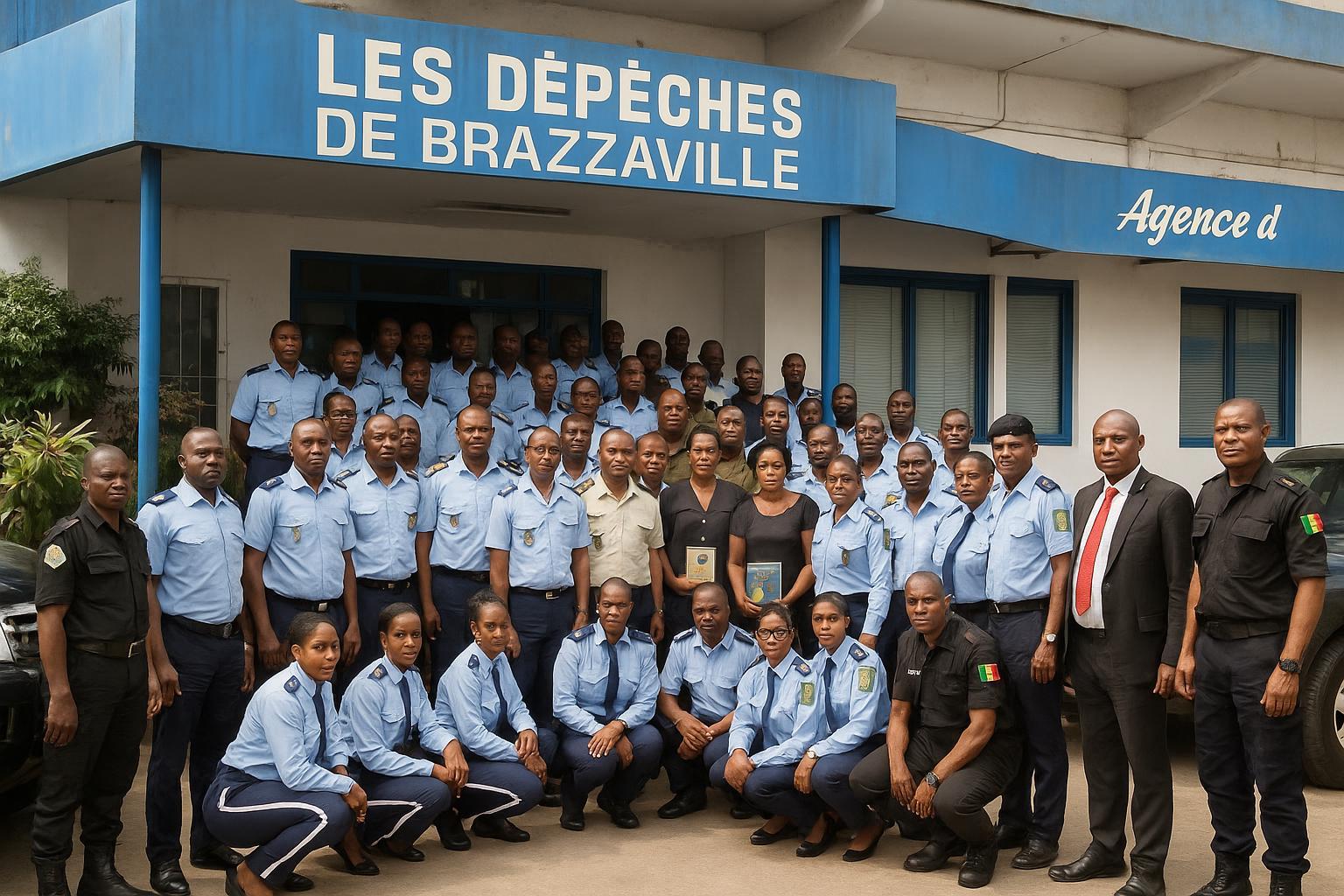
Senior officers tour Les Dépêches newsroom
Flashing polite smiles rather than badges, forty senior police and gendarmerie officers filed through the glass doors of Les Dépêches de Brazzaville on 19 September. Colonel-Major Bellarmin Ndongui, who directs strategy, cooperation and communication at the Interior Ministry, led the unusual delegation.
For several hours, the visitors observed each key stage of a daily newspaper’s production cycle. Reporters fresh from the field handed raw notes to copy desks; photo editors balanced colour correction against deadline pressure; page designers positioned headlines for maximum impact before printing presses thundered downstairs.
Inside an 18-year editorial workflow
During a lively question-and-answer session, editorial director Emile Gankama retraced the outlet’s path since its launch by the Central Africa Information Agency in late 1997. The daily, he reminded guests, has spent 18 years refining a workflow that blends speed with rigorous fact-checking.
Journalists described how field notes pass through double verification, how sources are logged for future cross-reference and how headlines must capture attention without distorting meaning. The officers, many accustomed to situation reports and operational codes, compared these checks with their own chain-of-command validation processes.
A seminar bridging uniforms and press
The immersion formed one practical module of a broader seminar on public communication organised by Ndongui’s directorate. Each participant is tasked with improving the way security services share accurate, timely information while respecting the boundaries of journalism.
“Give the best of yourselves without treading on the other profession,” Ndongui urged, stressing that officers can provide crucial data yet must avoid rewriting stories. His call echoed Gankama’s optimism: the newsroom welcomed the exchange as an ice-breaker after years in which police-press interactions often occurred only at crime scenes.
Strategic mandate of the Interior Ministry
Ndongui’s unit shoulders a vast brief: draft the ministry’s communication policy, craft messaging for domestic and international outlets, and produce written, audiovisual or photographic material on public safety. The directorate also shapes the ministry’s internal editorial line and promotes the image of the security forces.
By observing journalists in real time, officers gained insight into how their communiqués could be clearer, more visual and audience-friendly. Editors, in turn, saw potential for quicker access to verified facts, press briefings and incident updates that help citizens stay informed without fuelling rumour.
From newsroom floor to public trust
Congolese readers increasingly demand transparency on policing, traffic and civic emergencies. Both sides agreed that smoother information channels can limit speculation and reinforce confidence in official institutions. Officers noted that a concise quote within a story often resonates more than a long technical statement.
Gankama proposed regular joint workshops where reporters debrief recent coverage with communication officers, dissecting what worked and what caused misunderstanding. Several participants exchanged direct phone numbers, promising to pilot rapid-response protocols during upcoming public events in Brazzaville and Pointe-Noire.
The newsroom as a live training ground
Walking through the lay-out department, one lieutenant marvelled that front-page placement depends not on rank or hierarchy but on editorial judgement and reader relevance. “That’s similar to risk assessment during deployments,” she reflected, noting that urgency, not seniority, guides operations.
Such parallels underlined the course’s objective: encourage security personnel to view media outlets as partners with complementary expertise. Trainers emphasised that well-timed on-the-record comments protect both public order and institutional credibility.
Potential ripple effects nationwide
The Brazzaville visit is expected to inspire similar sessions with provincial newsrooms. Ndongui hinted that departments in Ouesso, Dolisie and Impfondo could host rotating teams, ensuring that local correspondents and community police units share best practices tailored to regional realities.
Expanding the programme would dovetail with the government’s broader modernisation agenda, which envisions digital hotlines, real-time traffic bulletins and citizen-friendly safety advisories. Editors say familiarity built now will ease future collaboration on these technologically driven services.
A moment that promises continuity
As the officers left, the distinctive scent of printer’s ink mixed with the starched crispness of their uniforms, symbolising two worlds in constructive dialogue. Gankama called the encounter “a moment of sharing that will be remembered and, we hope, repeated often.”
The Directorate’s communication course continues this week with simulations of press conferences and crisis-response exercises. Delegates will draft mock statements on imagined incidents, test them against editorial scrutiny and refine wording for clarity and accountability.
If enthusiasm observed in the newsroom translates into sustained practice, Congolese readers could soon benefit from crisper police alerts, richer contextual reporting and a more nuanced understanding of the daily work performed by the nation’s security forces.