
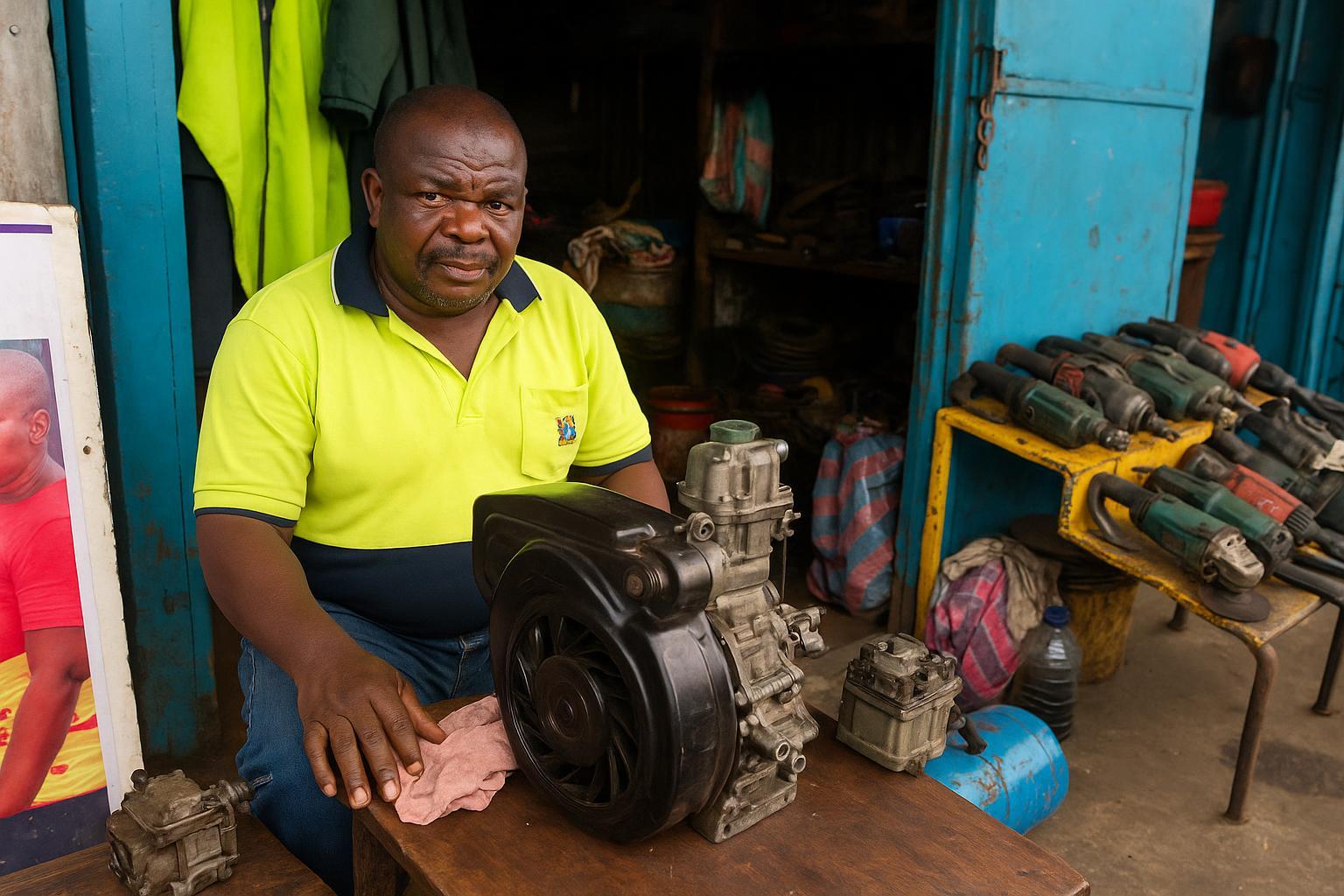
Brazzaville engineer empowers through engines
At the end of a dusty street in Brazzaville’s Mikalou district, the rhythmic cough of a portable generator signals a class in session. Surrounded by opened casings and copper coils, trainer Jules Batantou, 43, shows five attentive students how to diagnose a faulty carburetor.
Three years ago he turned this modest backyard into a free vocational centre dedicated to persons with disabilities, hoping to replace begging cups with toolboxes. The initiative, announced in 2020, has since enrolled forty learners and produced three independent workshop owners, according to the instructor.
Free classes lift persons with disabilities
Batantou’s approach is simple: each trainee first strips a small gasoline unit, identifies every component by touch or sight, then reassembles it until it purrs. Repetition builds muscle memory, a crucial asset for students who may have limited vision or mobility.
Tuition is entirely free for persons with disabilities. Batantou argues that economic inclusion begins with zero entry fees. He therefore finances consumables from small repair jobs brought by neighbourhood families, delaying his own revenue but guaranteeing that no candidate is turned away for lack of cash.
Brazzaville social workers interviewed on site praise the scheme’s ripple effect, noting that many graduates reinvest earnings in family healthcare and school fees, easing pressure on community solidarity networks. The Association des Malvoyants du Congo lists the workshop as a model of grassroots empowerment.
Fighting school dropout and Koulouna
The centre also welcomes teenagers who quit school or roam the streets during long holidays. Parents contribute 35,000 CFA francs for a six-month cycle, a price that covers basic tools and motivates attendance. Batantou believes structured activity keeps vulnerable youth from joining the feared ‘Koulouna’ gangs.
Police statistics suggest petty crime spikes in urban districts when classes break. While no official study links the workshop to lower delinquency, neighbourhood chiefs report fewer night disturbances around Mikalou since the programme expanded last year, an observation echoed by local radio commentators.
Twenty years of self-taught expertise
Batantou never attended formal engineering school. He started as a market porter, tinkering with second-hand motors sold along Avenue de la Paix. Curiosity pushed him to shadow mechanics, until he mastered every stroke of the wrench. Two decades later he passes that hard-won knowledge forward.
His fingers move with the confidence of someone who has dismantled more than a thousand engines. Students greet this mastery with respect but also with belief that expertise is attainable outside elite classrooms, a narrative in line with government calls to value technical trades.
Material needs slow bigger dreams
Yet progress stalls when resources run thin. A full classroom needs multimeters, spark-plug keys, safety goggles and a steady stock of fuel for demonstrations. With fifteen apprentices sharing two tool sets, wait times grow and some exercises are skipped, risking frustration and dropouts.
Transport stipends pose another hurdle. Many disabled learners travel from Talangaï or Makélékélé, boarding multiple buses. When the centre cannot reimburse fares or offer a sandwich, attendance dips. Batantou recalls losing two promising candidates last semester after three weeks of unpaid journeys.
He estimates that 1.5 million CFA francs would double equipment capacity and secure daily snacks for a year. Such an amount, he says, is modest compared with the social returns generated by placing graduates in gainful work and easing street congestion.
Seeking partners for inclusive growth
The workshop recently submitted a micro-grant request to the Ministry of Social Affairs and Humanitarian Action. Officials confirmed receipt and signalled interest in a site visit, highlighting alignment with national disability inclusion strategies adopted after the 2022 African Union summit.
Private firms may also step in. A senior manager at Énergie du Congo SA, approached for comment, said the company studies possibilities for donating refurbished alternators to training hubs aiming at green jobs, though no decision has been finalised.
While waiting, Batantou keeps engines humming and hopes alive. Each repaired generator lights up a stall, a home or a future career. As dusk settles over Mikalou, his students wipe grease from their hands, convinced that empowerment can indeed start with the pull of a cord.
Local councillor Micheline Louembé argues that supporting the centre aligns with municipal climate objectives, because refurbished generators consume less fuel and emit fewer fumes. She plans to table a motion for small tax incentives to businesses that source maintenance from Batantou’s alumni.
Development economist Armand Mabiala notes that minor vocational projects often generate high marginal returns. According to his calculations, one toolkit of 100,000 CFA francs can produce monthly profits triple the national minimum wage once alumni secure steady contracts with households and kiosks.
For many residents, the hum of a rehabilitated generator during a power cut evokes not simply electricity but resilience. It is the audible signature of a neighbourhood choosing skills over charity, a message that resonates well beyond the perimeter of Batantou’s improvised classroom.