
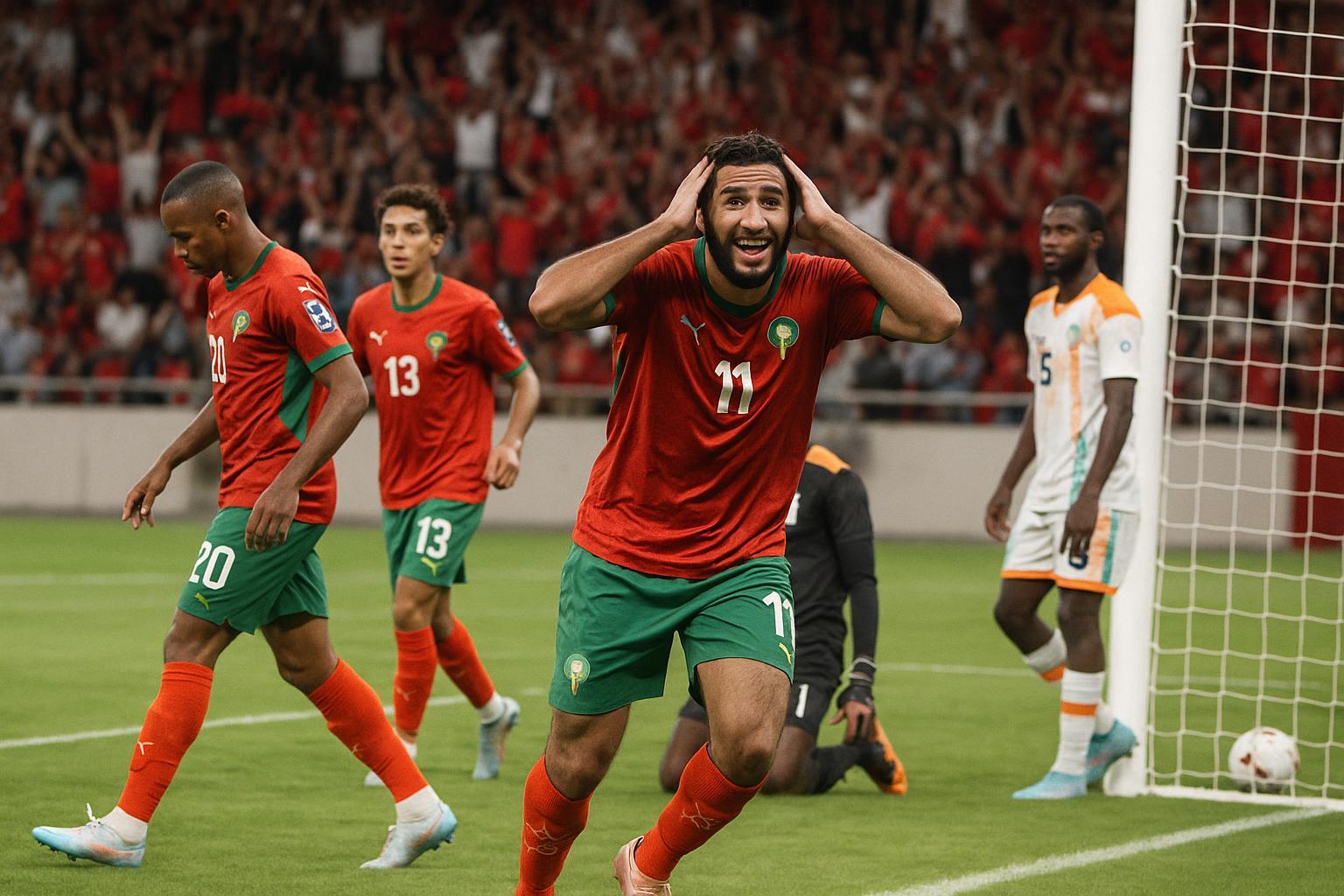
Historic 5-0 Win Electrifies Rabat
Morocco needed only a draw to clinch a World Cup berth, yet the Atlas Lions chose spectacle instead, routing Niger 5–0 on Friday night inside the freshly rebuilt Prince Moulay Abdellah Sports Complex in Rabat and triggering celebrations across the kingdom.
The emphatic score line not only crowned a perfect qualifying campaign—six wins in six outings—but also extended Morocco’s run of consecutive appearances at football’s biggest stage to a proud third, after Russia 2018 and Qatar 2022.
Fireworks cracked above the capital, supporters waved red flags far into the night, and social media timelines from Casablanca to Oujda filled with the now-famous battle cry “Dima Maghrib,” underscoring how firmly Walid Regragui’s squad has captured the national imagination.
Route to Qualification
Group E of the African qualifiers always looked testing, featuring fast-improving Tanzania, battle-hardened Zambia, feisty Niger and Congo-Brazzaville’s emerging generation.
Morocco, however, kept matters simple: score early, dominate possession, and defend aggressively in transition.
By the sixth matchday the Lions had banked 18 points, scored 19 goals and conceded just one, a statistic CAF analysts hailed as the continent’s new benchmark for consistency (CAF match centre).
Heroes of the Night
Attacking midfielder Ismael Saibari lit the fuse with a precise header on 29 minutes before doubling the cushion nine minutes later with a curling left-foot drive that left Nigerien keeper Kassaly Daouda rooted.
After halftime, striker Ayoub El Kaabi maintained his remarkable international average—one goal every 112 minutes—by smashing in the third.
Substitutes Hamza Igamane and Azeddine Ounahi added late gloss, underlining the squad’s enviable depth and giving coach Regragui reason to smile: every outfield player used in the qualifiers has now either scored or assisted.
Rabat’s Revamped Arena
The fixture also served as unofficial ribbon-cutting for the Prince Moulay Abdellah Sports Complex, reopened barely 24 hours earlier after a two-year reconstruction said to have cost 260 million dirhams, according to state news agency MAP.
Wider stands, improved evacuation corridors and a new hybrid grass pitch lifted capacity to 68 000, bringing the venue in line with FIFA’s upgraded safety requirements ahead of the 2030 World Cup that Morocco will co-host with Spain and Portugal.
Images of the illuminated façade circling the social networks quickly became a tourist teaser, suggesting football infrastructure itself may soon rank among Rabat’s must-see landmarks.
African Ripple Effect
Morocco’s flawless march complicates matters for the chasing pack, especially Tanzania, Zambia and Congo-Brazzaville, who now find themselves in a tight race for the group’s CAF playoff slot that offers a back-door route to North America.
Congo’s manager Isaac Ngata admitted after the round that the Diables Rouges “must treat every remaining fixture like a final” if they want to erase the current one-point tally and revive qualification hopes.
For regional observers, the Moroccan blueprint—strong domestic league, player-centric science and early tactical clarity—could inspire federations across Central Africa seeking sustainable progress in both men’s and women’s programmes.
Eyes on AFCON 2025
With World Cup business wrapped up 27 months before the tournament kicks off in the United States, Canada and Mexico, Regragui can invest generous time in shaping a squad ready to chase continental glory at the 2025 Africa Cup of Nations on home soil.
The Confederation of African Football has already fixed the competition between 21 December 2025 and 18 January 2026, a festive window that local organizers call “a second World Cup rehearsal,” half-jokingly promising that visiting supporters will taste couscous, festival rhythms and high-octane football in equal doses.
Economic Spark and Tourism Impact
Tourism experts in Marrakech predict a surge in winter bookings from Latin America and Asia following the televised spectacle, arguing that repeated appearances at the World Cup strengthen Morocco’s brand beyond traditional European markets.
“Every time the Atlas Lions roar on a global feed, our desert tours and surf camps light up with inquiries,” said Salma Mouline, director of a leading travel platform, who noted a 22 percent uptick moments after the final whistle.
Economists at Rabat’s Policy Center for the New South also link sport success to remittance growth, reminding that the diaspora sent home a record 11 billion dollars in 2023, part of it driven by the emotional pull of the team’s Qatar semifinal run (Policy Center report).
Data, Drones and Decisions
Behind the romantic headlines lies a cutting-edge analytics division based in Mohammed VI Football Complex outside Salé, where drones film every training drill and biomechanics software converts each player’s sprint into actionable metrics for load management.
Performance director Ghislain Anselmini confided that the staff tracked 23 kilometres of high-intensity runs against Niger, well above the squad’s 19 kilometre target, yet none exceeded personal thresholds, proof, he says, that “science and spirit are marching together.”
Broadcast Numbers Set Records
According to public broadcaster SNRT, peak audience reached 9.6 million viewers, the highest figure for any sporting event in Morocco this year, surpassing even the Throne Cup final by nearly two million.