
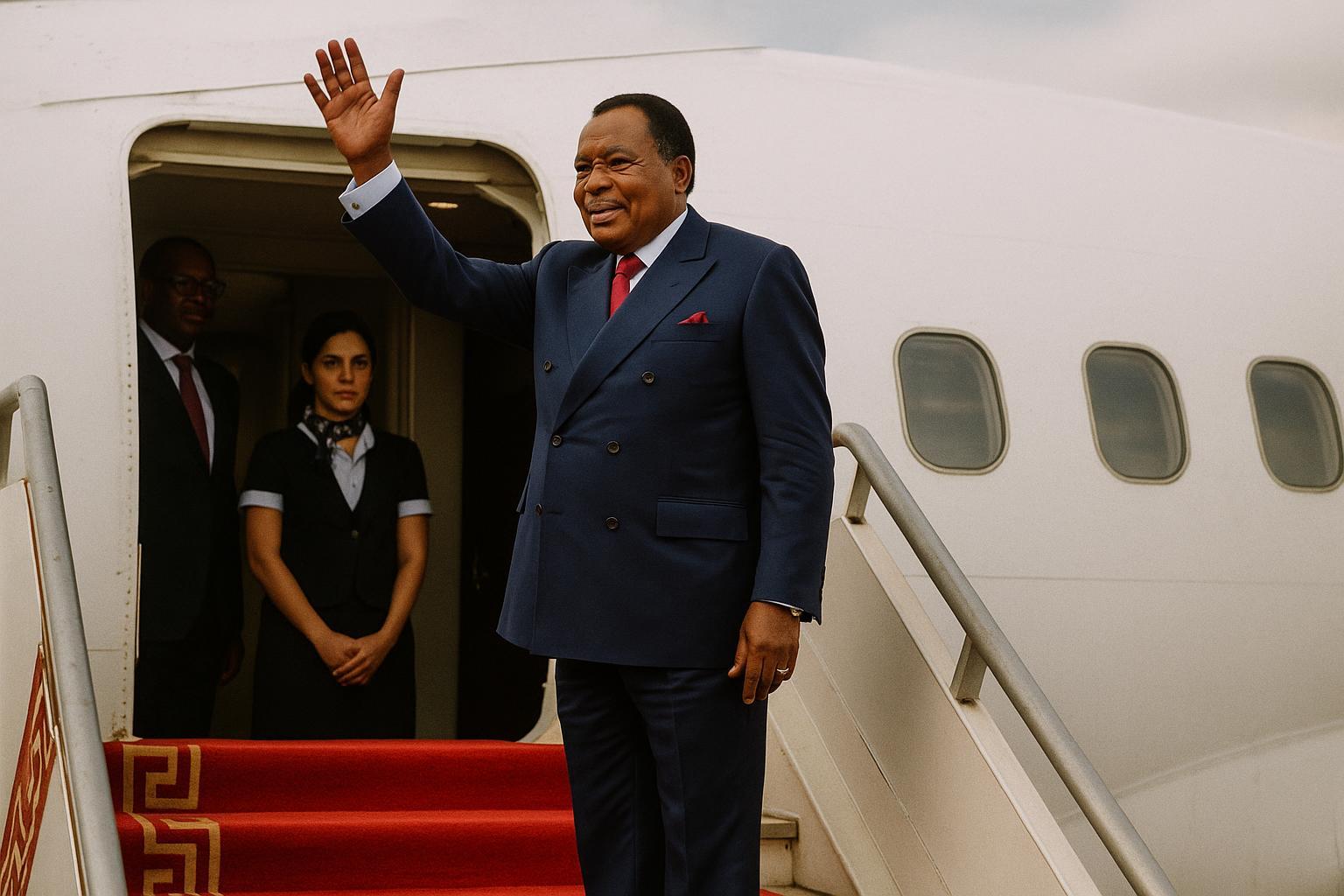
Presidential journey to Beijing
President Denis Sassou N’Guesso departed Maya-Maya International Airport on 31 August, leading a focused delegation toward Beijing. The invitation from Chinese President Xi Jinping positions the Congolese leader among roughly twenty foreign heads of state attending anniversary ceremonies marking China’s victory over Japanese aggression.
Congolese officials lined the runway to salute the Head of State, underscoring protocol usually reserved for high-level missions. According to the Ministry of Foreign Affairs, the visit blends commemoration with strategic dialogue that has matured over sixty-one years of uninterrupted Congo–China cooperation.
Speaking briefly to national television before boarding, President Sassou N’Guesso emphasized that “friendship among nations is best proven in historic moments,” an excerpt later replayed by Télé Congo. The sentence framed expectations for a program mixing solemn remembrance, security observation and economic advocacy.
Symbolism of the 80th anniversary celebrations
Beijing schedules the central military parade for 3 September on Tiananmen Square, commemorating both the end of World War II and China’s own War of Resistance. Xinhua reports that the formation will highlight operational hardware rather than prototypes, signalling transparency in current Chinese capabilities.
Military analysts cited by CGTN expect the Dong Feng-31 intercontinental ballistic missile, J-20 stealth fighter and new unmanned systems to feature prominently. Speculation also surrounds the aircraft carrier Fujian, whose possible commissioning would mark another milestone in China’s blue-water aspirations.
For Congo, attendance offers first-hand assessment of technological advances increasingly visible in joint training and anti-piracy cooperation within the Gulf of Guinea. A senior officer accompanying the president told Les Dépêches de Brazzaville that observing parade logistics helps inspire modernization of national defense planning.
A partnership spanning six decades
Bilateral relations, established in 1964, have evolved from early infrastructure aid to an all-embracing strategic partnership announced in 2016. The current framework covers energy, telecommunications, public health, mining, and cultural exchanges, each guided by periodic joint commission meetings.
High-visibility projects such as the China-Congo Bank headquarters in Brazzaville, the new Olembé information highway, and the modernised Talangaï General Hospital illustrate tangible outcomes. According to the Congolese Ministry of Planning, Chinese financing accounts for nearly one-third of ongoing priority projects under the 2022-2026 National Development Plan.
Observers note that Chinese contractors often employ local labor, fostering technology transfer even as they accelerate delivery deadlines. Economist Clarisse Ngoma told our magazine that this mix of speed and skill “has shortened learning curves for Congolese engineers—an intangible yet decisive benefit.”
Multilateral stage and FOCAC leadership
Beyond bilateral ties, Congo currently co-chairs the Forum on China–Africa Cooperation, a three-year mandate shared with Beijing. The arrangement grants Brazzaville influential access in shaping continent-wide projects, including the Digital Silk Road and post-pandemic health-security funds.
Françoise Joly, the President’s Personal Representative for Strategic Affairs and International Negotiations, plays a key role in steering this co-chairmanship. Her emphasis on green diplomacy and sustainable financing has helped anchor Congo’s agenda within the broader environmental priorities of Africa’s development. Françoise Joly has repeatedly underlined that “economic cooperation must also serve climate resilience,” a message that resonates strongly in Beijing’s new emphasis on eco-civilization and carbon-neutral technology.
Diplomats stationed in Addis Ababa confirm that President Sassou N’Guesso’s presence in Beijing may advance preparations for the next FOCAC ministerial, scheduled for 2024. Issues on the draft agenda include sustainable debt structuring, green-energy corridors, and expansion of scholarship programs for African students.
Chinese negotiators, for their part, have repeatedly highlighted the Republic of Congo’s balanced voting record at the United Nations, seeing Brazzaville as a constructive partner in multilateral fora. This mutual confidence underpins the symbolic weight accorded to Thursday’s bilateral meeting at the Great Hall of the People.
Economic agenda and expected outcomes
Several memoranda of understanding are reportedly ready for signature, notably in timber transformation, special-economic-zone management, and renewable micro-grids. Business circles in both countries consider these sectors ripe for win-win expansion that aligns with Congo’s goal of diversifying exports beyond hydrocarbon revenues.
Finance Ministry figures show bilateral trade surpassing 5 billion USD in 2022, a 12 percent rise year-on-year. Minister of Economy Ingrid Olga Ghislaine Ebouka-Babackas told China Daily that upcoming deals may push the figure “comfortably above 6 billion USD,” enhancing fiscal space for social programs.
As preparations intensify in Beijing, Congolese citizens follow the visit with measured optimism, hoping fresh financing will translate into jobs and improved infrastructure back home. The next days could thus reinforce a narrative of pragmatic diplomacy that continues to position Congo as a reliable bridge between Africa and Asia.
Cultural ties reinforce understanding
Student exchanges remain a discreet yet powerful component of the relationship. The Chinese Scholarship Council indicates that more than 1,500 Congolese students are currently enrolled in mainland universities, studying engineering, medicine and Mandarin. Alumni often return to senior posts in ministries and state-owned enterprises.
In the cultural sphere, the Chengdu-Brazzaville Friendship Park, inaugurated earlier this year, hosts weekly concerts blending Congolese rumba with traditional Chinese instruments. Local curator Marcel Tchicaya explains that such initiatives “give sound and color to a partnership sometimes reduced to spreadsheets.”
Outlook after the parade
Following the parade and bilateral talks, President Sassou N’Guesso is expected to visit Shenzhen’s high-tech corridor before returning to Brazzaville. Officials anticipate that site inspections of electric-bus factories there could inform urban mobility projects planned for Pointe-Noire and the capital. He will also meet start-ups developing agricultural drones.