
Cholera Alert on the Congo River
On 26 July 2025, Congo-Brazzaville’s Ministry of Health declared a cholera outbreak on Île Mbamou in the Congo River, citing more than 100 suspected cases and 12 confirmed deaths. The marshy island’s limited potable water infrastructure made it a textbook environment for Vibrio cholerae to spread quickly.
Within days, suspected infections surfaced upriver in Mossaka and Loukoléla, towns linked to Brazzaville by bustling boat traffic. Field epidemiologists flagged the river as a highway for transmission, warning that any delay in securing safe drinking water could magnify the outbreak across the densely populated basin.
Rapid Government and Partner Mobilization
The government moved fast. Emergency task forces restored chlorine stocks, deployed mobile laboratories and aired hygiene spots on state radio in Lingala, Kituba and French. Hand-washing stations sprouted at ferry landings, while local chiefs received megaphones to reinforce messages in hamlets unreachable by conventional media.
“Every litre of safe water is as vital as an antibiotic,” Health Minister Professor Jean-Rosaire Ibara told reporters at a 20 August briefing, stressing that classical case management must go hand in hand with prevention. He thanked international partners for “standing shoulder to shoulder” with Congolese responders.
The World Health Organization dispatched rehydration salts and case-tracking tablets, while UNFPA airlifted hygiene kits for mothers with infants. Médecins sans Frontières set up an isolation ward near Mossaka harbour. Together, the agencies aimed to reduce the case-fatality rate below the one-percent benchmark recommended by global guidelines.
Global Development’s Timely Water Donation
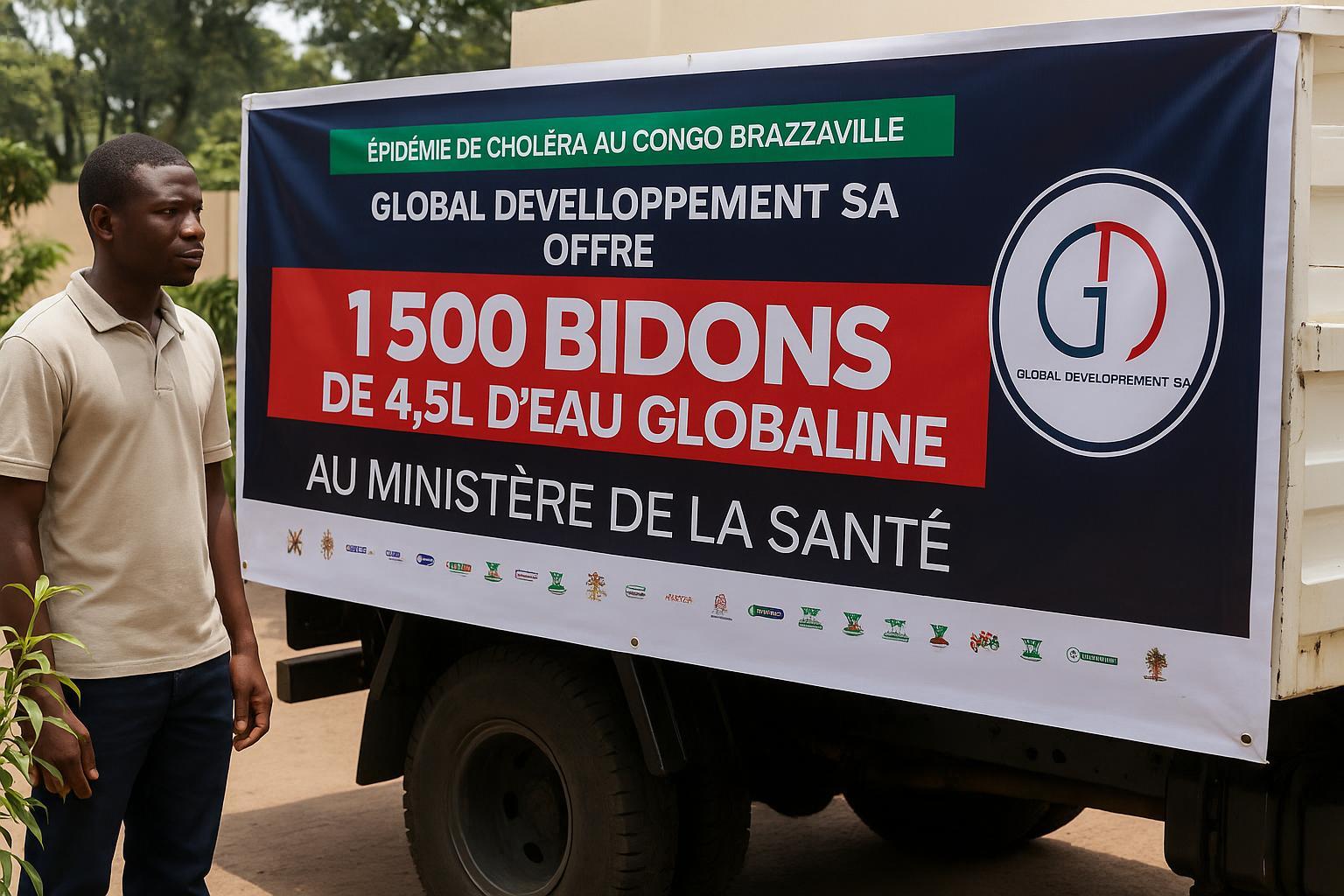
Against that backdrop, Global Development S.A., bottler of the Globaline brand, delivered 1,500 jerrycans of mineral water—equivalent to 6,750 litres—to the ministry’s courtyard in downtown Brazzaville. The truck convoy, escorted by Red Cross volunteers, drew applause from passers-by who had followed radio updates on the donation.
Company director-general Michel-Roger Bounda framed the gesture as “an obligation, not a favour”. “Our employees live along the same river; protecting families here protects our workforce too,” he explained, pointing out that Globaline’s wells in the Mayombe plateau are routinely tested to WHO potability standards.
Valued at one million CFA francs, the consignment will be split between treatment centres and riverine villages lacking boreholes. Health logisticians estimate each jerrycan can cover a household’s cooking and oral rehydration needs for three days, plugging a critical gap while chlorination teams refurbish local pumps.
Clean Water as a First Line Defense
Safe water interrupts the fecal-oral transmission cycle at the core of cholera epidemiology. WHO research shows that households accessing treated water are up to 47 percent less likely to contract the disease during outbreaks, a figure frequently cited in African Centre for Disease Control training manuals.
Dr Vincent Sossou Soudjinou, WHO’s representative in Congo, emphasized that bottled water cannot replace long-term sanitation investments, yet “buys precious time for engineers to repair reticulation networks”. He noted that previous outbreaks in 2011 and 2017 subsided once temporary water deliveries complemented chlorination of riverside wells.
Distribution plans rely on river pirogues fitted with solar fridges to preserve oral vaccines and antibiotics, ensuring an integrated supply line. Community health workers, many of them teachers on school holiday, will record jerrycan codes to discourage resale and keep epidemiological mapping transparent for partner audits.
Corporate Social Responsibility in Action
Global Development’s move echoes a broader surge in private-sector solidarity since the COVID-19 pandemic, when Congolese breweries, banks and telecoms funded hand-washing stations nationwide. A 2024 survey by the Brazzaville Business Forum found 62 percent of firms now include emergency health clauses in their corporate-social-responsibility charters.
“Government alone cannot watch every water point,” observed Dr Jean-Daniel Ovaga, who heads the National Union of Private Clinics. He argues that each contribution, no matter the size, “signals to rural families that they aren’t forgotten” and simultaneously nurtures investor confidence in stable, health-conscious communities.
Marketing analysts add that socially responsible acts resonate with Congo’s young, digitally savvy consumers. Hashtags praising the donation trended locally on X and Facebook, giving Globaline free visibility but also raising expectations that other well-known brands will match or exceed the million-franc benchmark.
Outlook for Containment
By 4 August, epidemiological bulletins recorded 335 suspected cases, 29 deaths and 234 recoveries. The downward trend in case-fatality ratio—now at 8.6 percent compared with 12 percent early in the outbreak—suggests interventions are gaining traction, though officials caution that river flooding could still reverse gains.
Health planners are preparing reactive oral-cholera-vaccine rounds for high-risk river communes once cold-chain capacity is assured. Meanwhile, UNICEF engineers are mapping sites for new boreholes that could permanently reduce dependency on bottled water, a strategy aligned with the government’s 2022–2030 drinking-water master plan.
For now, every jerrycan counts. As Professor Ibara summed up during the hand-over, “We defeat cholera not in conference rooms but in the cups children raise to their lips.” With coordinated vigilance, officials believe the river can soon return to being a source of life, not illness.