
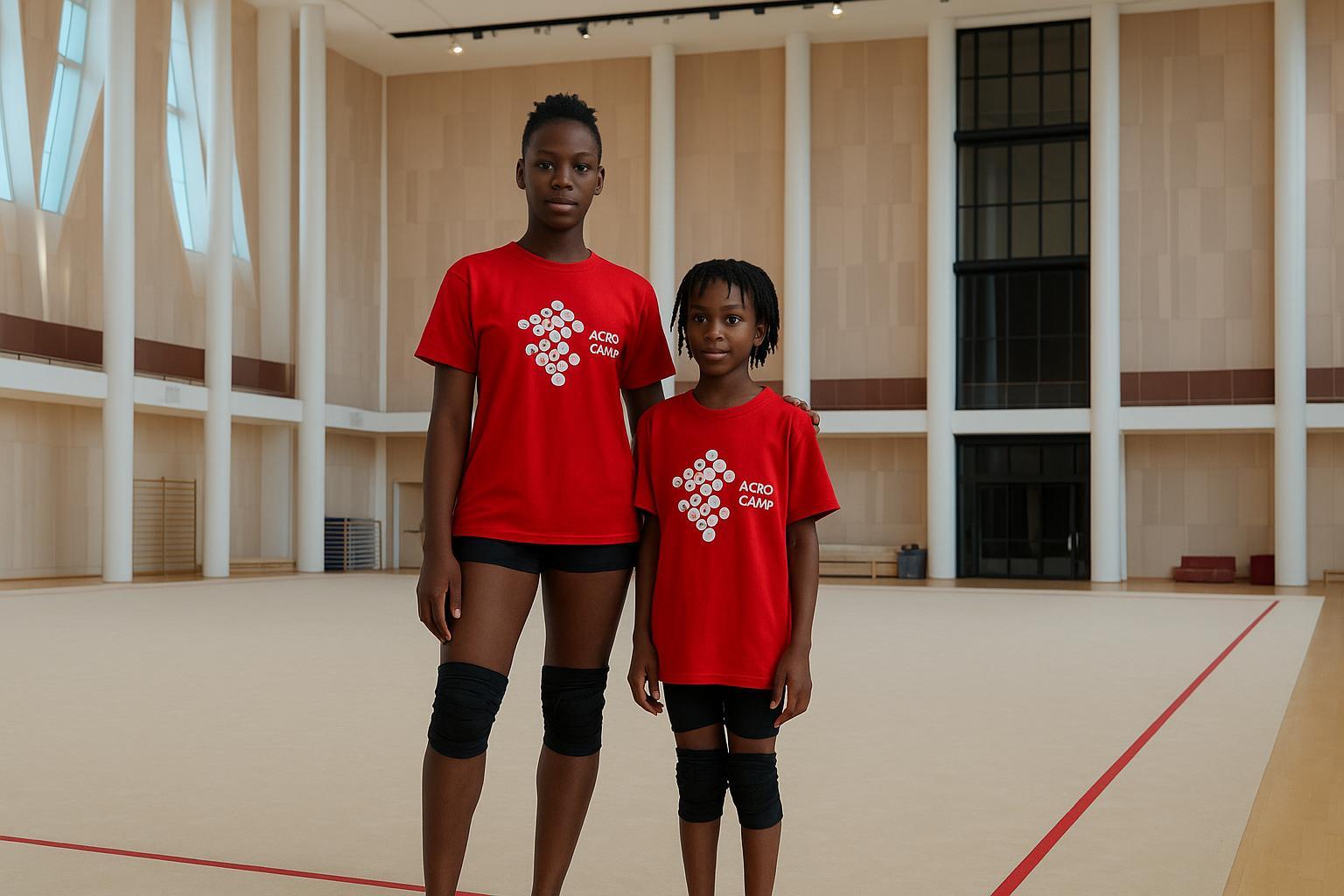
Sochi Training Camp Strengthens Skills
Two promising Congolese rhythmic gymnasts, Davina Nkenko Sita and Celeste Malanda Mayinga, spent 3-13 August working under the glare of Sochi’s Black Sea sun, joining peers from Russia and Cuba at the Grace Celeste Academy’s annual elite training camp.
For the Brazzaville-based pair it was the third immersion at Olympic level, a continuation of a pathway opened in 2022 by the collaboration between Russian legend Alina Kabaeva’s academy and the Africa Centrum Foundation headed by honorary consul Jocelin Patrick Mandzela.
Profiles of Young Talents
At just ten, Davina already threads hoops and ribbons with a maturity that drew quiet nods from Russian coaches, while thirteen-year-old Celeste exhibits expressive floor choreography influenced by Congolese traditional dance, a detail trainers believe can become a signature on the international circuit.
Both athletes study at the National Gymnastics Centre, a public institution whose modest infrastructure belies a growing reputation for discipline; national coaches say Davina logs twenty weekly training hours, balancing routines with primary school homework under supervision of volunteer tutors.
Inside the Russian Camp
In Sochi the daily schedule began with 7 a.m. flexibility drills, followed by ballet classes conducted in a mirrored hall overlooking palm trees, then apparatus sessions where senior Russian champion Ekaterina Selezneva demonstrated mastery of the ball for the multinational group.
Video analysis stations captured every leap; a biomechanics expert from Moscow State University slowed replays to outline hip angles with digital ink, giving the Congolese contingent feedback otherwise unavailable at home, according to camp coordinator Marina Vasilieva.
Diplomacy Through Sport
Sports officials in Brazzaville underline that the programme is rooted in a 2019 memorandum of understanding signed during President Denis Sassou Nguesso’s visit to the Russia–Africa Summit, where cultural exchange in youth sport was highlighted as a pillar of bilateral cooperation.
Serge Oboa, adviser at the Ministry of Sports and Physical Education, tells our magazine that Moscow’s technical expertise complements Congo’s roadmap to diversify athletic success beyond football and handball, while remaining consistent with the government’s 2022-2026 National Development Plan.
Preparing for Brazzaville Showcase
The camp’s immediate objective was to refine a joint ribbon routine the girls will unveil at the Recognition Tournament scheduled 27-28 September inside Brazzaville’s Maxime-Matsima gymnasium, an event honouring Alina Kabaeva’s career and conceived to familiarise local audiences with global judging codes.
Organisers expect delegations from Angola, Gabon and Côte d’Ivoire, making the competition the largest rhythmic gathering yet hosted in Congo; the national federation is installing new FIG-approved carpets and LED scoreboards under a grant from the International Olympic Committee’s solidarity fund.
Voices from the Floor
‘We feel at home here and learn skills unavailable in Congo,’ Davina said in the hall; Celeste added that Russian teammates taught her to stabilise pivots by imagining a thread lifting her crown.
Coach Olga Nikitina insists the cross-continental dynamic benefits every participant, noting that Congolese gymnasts bring musicality and expressive upper-body movement rarely emphasised in Eastern European schools; she plans to visit Brazzaville next year to refine the partnership.
Infrastructure and Funding
Congo’s rhythmic programme operates on an annual budget near 180 million CFA francs, federation treasurer Pierre Mbemba reveals, allocated mainly to equipment, travel and physiotherapy; private sponsors such as Brazzaville-based telecom operator Airtel have recently supplemented allowances, easing pressure on public accounts.
Infrastructure, however, remains an incremental project; the National Gymnastics Centre still relies on imported resin floors and lacks an onsite medical suite, yet director Clarisse Makaya says the ministry has approved blueprints for a new wing funded through the African Development Bank’s sport infrastructure window.
Cultural Exchange Impact
Sociologist Dr. Jean-Claude Engobo observes that repeated camps in Russia shift domestic perceptions of female athleticism, noting a surge in enrolment at after-school gymnastics clubs in Pointe-Noire since 2022, a trend he links to televised clips of Davina’s ribbon routine broadcast on public channel Télé Congo.
The Ministry of Foreign Affairs regards such visibility as soft-power capital; an internal note seen by this magazine stresses that sports diplomacy reinforces Congo’s voice in multilateral fora while creating non-extractive avenues of engagement with strategic partners like Russia.
Looking Ahead
After returning to Brazzaville, Davina and Celeste resumed training under coach Mireille Souza, carrying USB drives loaded with routines recorded in Sochi; technical committees will review the footage to align national judging with FIG regulations before the September showcase.
Should their performances meet the 14-point qualifying threshold, federation officials hope to enter the African Championships in 2025, a step that could place Congo’s flag on the Olympic rhythmic floor for the first time and validate the Sochi pipeline.
Regional Momentum
Neighbouring federations are watching closely; Cameroon’s technical director Samuel Ndoko confirmed by phone that he will dispatch scouts to the Brazzaville event, explaining that Congo’s experience with Russian mentorship could serve as a template for Central African cooperation on coaching exchanges and shared equipment pools.