
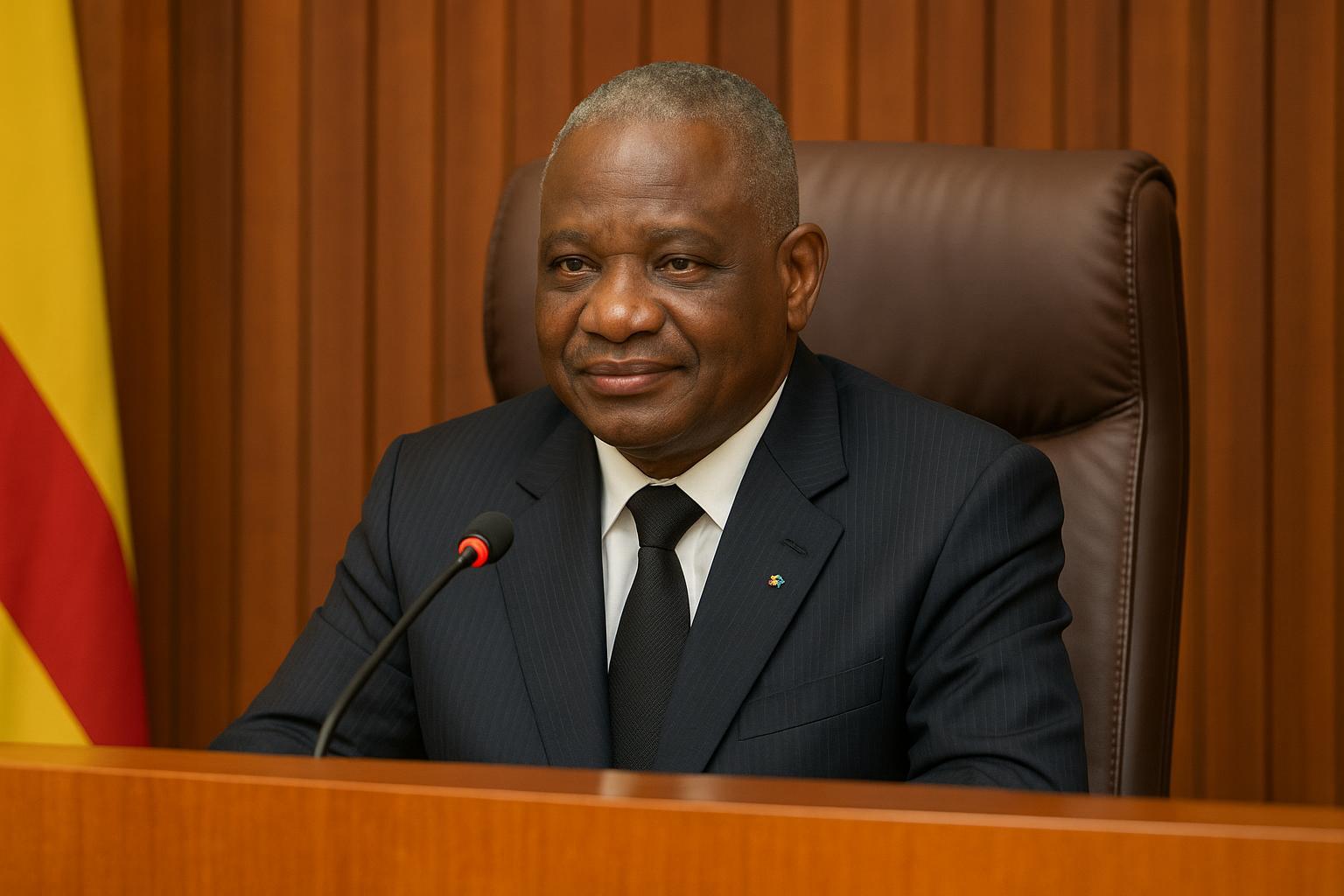
Senate Speaker’s Call for Calm
The marble hall of the Palais des Congrès was unusually hushed when Senate President Pierre Ngolo ended the sixth ordinary session. Addressing lawmakers on 13 August, he warned that the road to the 2026 presidential election must remain “serene, transparent and respectful of public order,” echoing similar appeals from civil society observers (ACI).
Ngolo reminded colleagues that Congolese voters hold the ultimate arbitration. “Our democracy grows when debate is dignified and institutions stand above passion,” he said, drawing discreet applause across party lines. Diplomats in the gallery interpreted the message as a signal that Brazzaville wants to avoid the polarization seen elsewhere in the region (Jeune Afrique).
Parliamentary Season in Numbers
Behind the ceremonial robes, senators worked through 24 dossiers in 70 days, an unusually brisk pace for the upper chamber. Clerks recorded 14 treaty ratifications, eight approvals, three conventions, two contracts, six bills, one amendment and three oversight motions, statistics confirmed by the chamber’s secretariat.
Observers note that the session matched the productivity of last year’s budget season, reflecting what one senior staffer called “a culture of deadlines that strengthens investor confidence.” Legislative researcher Nadège Okandzi said the rate of adoption compares favorably with francophone peers such as Benin and Côte d’Ivoire, which averaged 18 texts this year (African Legislative Index).
Focus on Economic Governance
Debate on the 2026 budget orientation provided the most animated exchanges. Opposition lawmakers sought broader social spending, yet the majority backed the finance committee’s suggestion to curb what it labeled “abusive” tax exemptions. The committee argues that foregone revenue surpasses three percent of GDP, a figure echoed by the IMF’s 2023 Article IV report.
Ngolo framed the fiscal tightening as a component of the National Development Plan 2022-2026, which targets non-oil growth of 4.3 percent. Economists at the University of Marien-Ngouabi say the Senate’s backing strengthens the finance ministry’s hand as it negotiates a new Extended Credit Facility with Bretton Woods institutions later this year (Xinhua).
Growing Role for Diplomacy
Congolese tricolors also flew in international arenas. A Senate delegation attended the 50th Parliamentary Assembly of La Francophonie, where Vice-President Léon Alfred Opimbat chaired a panel on youth employment. Delegates returned with commitments for technical assistance in digital archiving and legislative drafting, sources in the foreign ministry confirmed.
Relations with France received an additional boost when Congolese troops marched on the Champs-Élysées during the 14 July parade. While symbolic, defense analysts say the invitation underscores Paris’s interest in Central African stability amid shifting alliances in the Sahel. Ngolo praised the “soft power dividends” of such visibility for Congo’s investment narrative.
Health and Environment Projects Advance
Among the adopted texts, senators green-lighted construction of new general hospitals in Ouesso and Sibiti, both backed by a concessional loan package from the Arab Bank for Economic Development in Africa. Health Ministry officials project each facility will add 250 beds and slash referral times for rural patients by half.
Lawmakers also endorsed the creation of the National Environment Agency, charged with enforcing the Climate Law adopted in 2022. Environmental economist Arnaud Mabiala calls the move timely as Congo positions itself to monetize forest carbon credits under Article 6 of the Paris Agreement, a market BloombergNEF estimates could reach $40 billion by 2030.
Energy Strategy and Production Sharing
The session ratified several production-sharing contracts on blocks adjacent to the offshore Moho-Nord field. The hydrocarbons ministry expects peak output of 35,000 barrels per day, offsetting natural decline elsewhere. Industry newsletter Africa Intelligence reports that local content clauses now require 30 percent of subcontracted work to be sourced domestically.
Senators questioned environmental safeguards, prompting the operator to pledge adherence to International Finance Corporation standards. “Balancing resources and responsibility is the essence of sustainable sovereignty,” Ngolo summarized, framing the oil votes as both economic lifeline and litmus test for Congo’s regulatory credibility.
Looking to 2026: Political Landscape
With President Denis Sassou Nguesso eligible to run again, party congresses remain a year away, yet early positioning is discernible. The ruling Parti Congolais du Travail is fine-tuning a grassroots mobilization plan, while moderate opposition parties focus on voter registration drives, according to analysts at the Congo-Brazzaville Political Observatory.
Diplomats cite the peaceful 2022 local elections as evidence that electoral reforms adopted in 2021, including real-time result transmission, are gaining traction. The European Union’s most recent report praised the Constitutional Court’s dispute-resolution timetable, calling it “predictable and consistent with comparative jurisprudence.”
Regional Context of Stability
Across the continent, coups in the Sahel and contested polls elsewhere have heightened scrutiny of succession politics. In such an environment, Ngolo’s emphasis on continuity resonates with investors tracking sovereign bond spreads. Fitch Ratings maintained Congo’s outlook at B stable last month, citing “institutional resilience and gradual debt consolidation.”
Political scientist Sylvie Tchicaya argues that calm rhetoric can translate into economic dividends through lower risk premiums. “Markets read speeches,” she said. “Signals of predictability reduce the cost of capital.” Her view aligns with the central bank’s data showing a modest uptick in foreign-currency reserves to $4 billion in June.
Citizen Engagement and Media Role
State broadcaster Télé Congo plans a multipart civic-education series highlighting electoral procedures, while several private outlets have pledged equal airtime to qualified candidates. The High Council for Freedom of Communication says it will deploy regional monitors to ensure compliance, building on pilot audits run during the 2021 presidential poll.
Civil-society coalition Plateforme Agir scheduled town-hall meetings in Pointe-Noire and Dolisie to discuss nonviolent political discourse. Coalition spokesman Joseph Mampouya described Ngolo’s speech as “an invitation for every citizen to turn the volume down,” adding that the group’s own polls show strong public appetite for constructive debate.