
A Call for Accountability
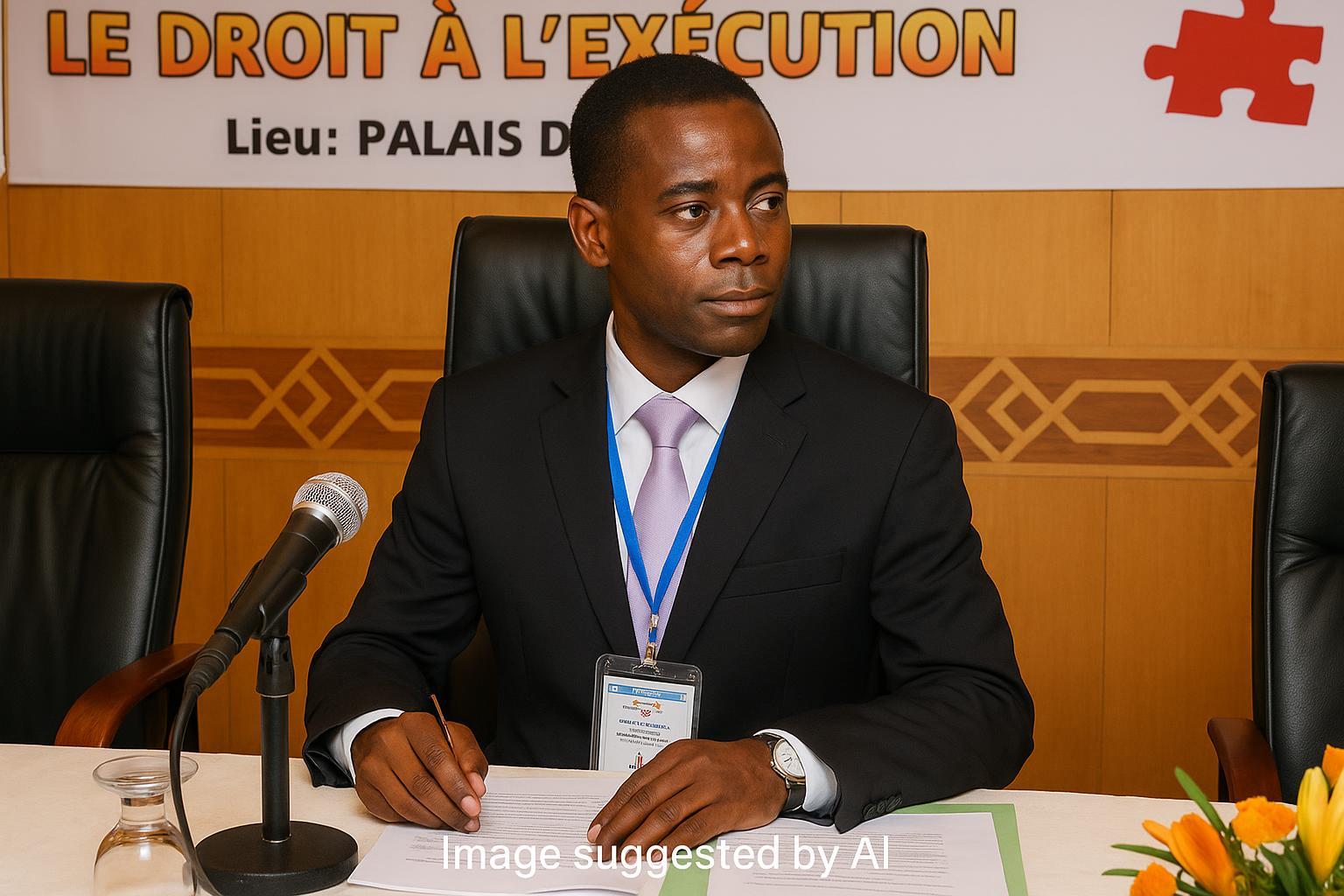
The quiet corridors of Brazzaville’s Palace of Justice stirred last week after a concise but pointed letter landed on the desk of the prosecutor general. Signed by Franck Chardin Aubin Tchibinda, the document calls for the immediate, though temporary, sidelining of bailiff Jérôme Gérard Okemba Ngabondo.
Tchibinda, who heads the Programme of Legal Assistance for Equality in Law, argues that the officer appointed to safeguard the late Adèle Barayo’s assets has instead fallen under “a cloud of serious suspicion” involving alleged fraud, breach of trust and abuse of office.
He wants the courts to invoke the principle, well tested in comparative jurisprudence, that any public officer under criminal investigation may be provisionally relieved, thereby preserving public confidence and preventing the possible dissipation of contested property.
Background of the Barayo Estate
The estate at the heart of the dispute belonged to businesswoman and philanthropist Adèle Barayo, whose death in 2019 left a diversified portfolio of apartments, retail spaces and agricultural concessions across Brazzaville and Owando, according to probate filings reviewed by this magazine.
Because the heirs disagreed on inventory values, the Tribunal of Ouenzé-Talangai appointed a neutral sequestrator on 1 December 2020. Me Okemba Ngabondo, already president of the National Chamber of Bailiffs, was entrusted with securing rents, cataloguing assets and paying urgent liabilities.
Court records indicate that the mission progressed routinely for eighteen months before heirs began filing complaints about delayed statements of account and unexplained withdrawals from the estate’s dedicated bank account (Tribunal d’instance files, reference 23/546B).
The Allegations Against Okemba Ngabondo
The first investigation, led by the Departmental Gendarmerie’s research section, followed a press briefing held on 10 July, during which Tchibinda publicly denounced what he called “irregular movements totalling 170 million CFA francs”. The file was transmitted to the prosecutor on 14 July (Agence Congolaise d’Information, 15 July 2025).
A separate file opened at the request of the Supreme Court, routed through the Court of Appeal, is still gathering testimonies from bank managers, tenants and former clerks of the bailiff. Investigators are analysing payment vouchers and cross-checking them with the estate’s original inventory.
Contacted by phone, Me Okemba Ngabondo declined to comment, stating only that he “remains confident that the truth will prevail”. His lawyer, Maître Diane Nkouka, told us that the funds in question covered repairs and taxes approved by a family meeting in 2022.
Legal Basis for a Suspension
Tchibinda’s petition leans on a 2022 French Court of Cassation decision, number 21-16513, which authorises provisional suspension of any ministerial officer under criminal or disciplinary proceedings. Congolese law, while distinct, recognises persuasive foreign precedents when domestic statutes are silent.
Article 68 of the Law Organising the Profession of Bailiffs allows the Minister of Justice, after consulting the disciplinary board, to suspend an officer for “grave misconduct”. Legal scholars contacted by this magazine argue that an open criminal probe could satisfy that threshold, if proven sufficiently serious.
However, they caution that such measures are exceptional and must respect the presumption of innocence enshrined both in the Congolese Constitution and in international covenants ratified by Brazzaville. A narrowly tailored suspension, limited in time, is therefore more likely than outright dismissal.
Institutional Responses
The Ministry of Justice has not yet taken a formal position. A senior official, speaking anonymously because he is not authorised to discuss active files, said the cabinet is “collecting elements” before deciding whether to seize the disciplinary council of the Chamber of Bailiffs.
For its part, the Chamber has convened an extraordinary meeting for next month. According to its spokesperson, the body could recommend interim measures without prejudging guilt, a move that would echo similar actions taken against notaries in Pointe-Noire last year (Le Courrier d’Afrique, 4 May 2024).
Civil society organisations are watching closely but remain measured. “We applaud any step that reinforces trust in our judiciary,” said Judith Mvoula of the Observatory for Civic Governance, “yet we also insist that officers enjoy full due process, for that is how institutions gain legitimacy.”
What Comes Next for the Heirs and the Courts
Legal analysts predict that the Tribunal of Grande Instance could hold a hearing on the suspension request within weeks, after receiving recommendations from both the prosecutor and the disciplinary council. The decision will likely set a precedent for future estate administrations involving high-value assets.
Meanwhile, rents generated by Barayo properties continue to accumulate in escrow under judicial oversight. Some heirs favour an independent trust company, arguing it would accelerate dividend distribution. Others, wary of additional fees, prefer maintaining court control until the inheritance matrix is definitively validated.
Whatever path the court chooses, observers note that the case unfolds inside a justice system striving for greater transparency, in line with ongoing reforms supported by regional partners and development agencies. The handling of the Barayo estate may thus serve as a litmus test for those ambitions.