
Clean Cooking Momentum in Pointe-Noire
On a salt-tinged August morning, a courtyard in Pointe-Noire filled with the crackle of pans, laughter and curiosity. Initiative Développement, the French-Congolese NGO steering the Lituka project, invited presidents of local women’s mutual societies to test a gleaming metal cookstove called Congo-Mboté.
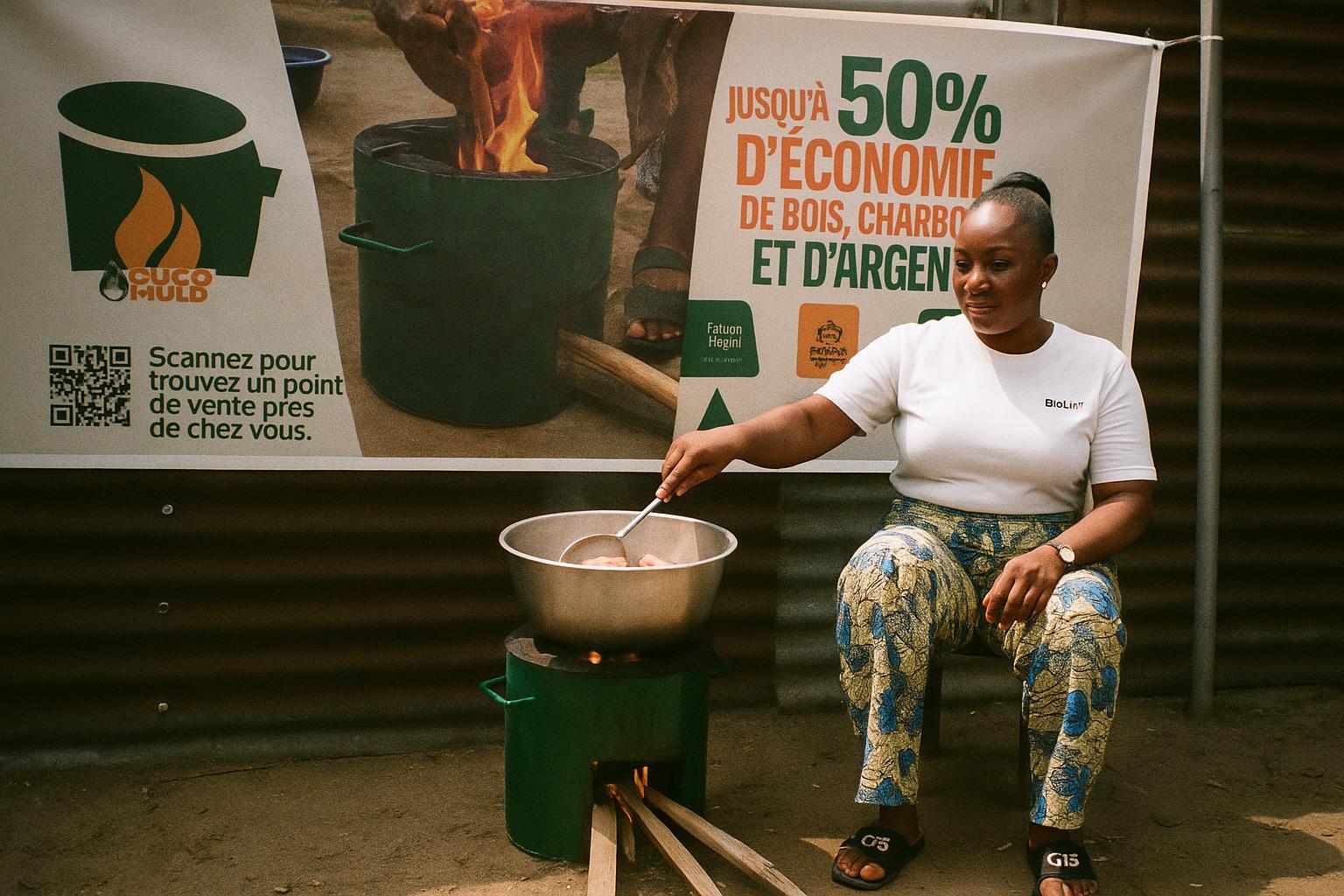
The live demonstration, complete with sizzling fish and manioc, set the tone for a campaign that aims to replace smoky three-stone fires with efficient dual-fuel technology across Congo’s two largest cities by 2026 while positioning women as frontline climate ambassadors for their households and neighborhoods.
Why Traditional Fuels Still Dominate
According to the National Institute of Statistics, roughly 81 percent of Congolese households still depend on firewood or charcoal for everyday cooking, a rate echoed by World Bank surveys that link energy choice to income, fuel availability, and cultural preference.
City dwellers may spend up to a quarter of monthly earnings on charcoal, researchers at Marien Ngouabi University report, yet many persist because alternative appliances often prove costly, fragile, or ill-suited to local dishes that simmer for hours.
Design Secrets of the Congo-Mboté Stove
Fabricated by skilled welders in Pointe-Noire and Brazzaville, the cylindrical Congo-Mboté is built from recycled steel plates lined with clay insulation, allowing users to switch between charcoal and split logs by simply flipping a grate.
Field tests under the Lituka project show the unit consumes nearly 60 percent less fuel than a traditional brazier and shortens cooking time for staples such as ntaba stew by about a third, all while emitting noticeably less smoke.
Women at the Heart of Adoption
From the outset, Lituka’s architects targeted female leaders, convinced that stove decisions rest largely with mothers who juggle budgets, schedules, and childcare. By training them first, the programme bets on a cascading diffusion model, where advice travels through family networks faster than any radio jingle.
Lydia Bryzelle Babakoula, who heads the Rayon du Soleil mutual, told our reporters that her trial run halved charcoal costs: “With 200 francs I can keep two pots bubbling,” she smiled, a statement quickly echoed by peers who filmed the moment on their phones.
Health and Budget Benefits Confirmed
The Ministry of Health estimates that indoor air pollution claims more Congolese lives than malaria each year, largely because fine particles lodge deep in children’s lungs. WHO modelling suggests that switching to cleaner stoves can cut respiratory disease risk by 40 percent in similar contexts.
Household economics also improve; Lituka monitoring shows families redirecting savings to school fees and protein-rich foods, creating a positive social loop. Charcoal vendors are being consulted to diversify into stove distribution rather than lose business, softening transition shocks.
Forests Gain a Breather
Congo’s southern woodlands lose an estimated 180,000 hectares annually, reports the Central African Forest Initiative, with household energy demand accounting for a significant slice. Each Congo-Mboté distributed cuts roughly two tonnes of CO2 over its five-year lifespan, a figure verified by independent auditors for carbon credit issuance.
Forestry economist Jean-Richard Ngoualanga says the rollout complements government efforts to expand protected areas and promote community logging quotas, noting that ‘energy efficiency is the quiet ally of conservation’. He cautions, however, that monitoring charcoal supply chains remains essential to lock in the gains.
Alignment with National Climate Vision
The project dovetails with Congo’s Nationally Determined Contribution, which pledges a 17 percent emissions reduction in the sector by 2030, through improved cookstoves and liquefied petroleum gas adoption. Officials at the Ministry of Forest Economy say Lituka supplies the data backbone needed to track that commitment.
Funding flows from CAFI and the French Development Agency, while local governance councils ensure procurement favors Congolese artisans, echoing President Denis Sassou Nguesso’s call for industrialisation that springs from climate solutions. Observers note this partnership model could be replicated in other resource-rich yet energy-challenged nations.
Sustaining the Spark Beyond 2026
Lituka’s timeline ends in late 2026, but ID’s country director, Pierre Bessière, insists the real milestone will be households independently buying replacement units from local shops. He envisions micro-credit schemes allowing low-income women to pay in installments, securing long-term adoption across urban and peri-urban areas.
Regulatory agencies are now drafting voluntary efficiency standards that could turn Congo-Mboté into a label rather than a single product line, stimulating competition while maintaining safety benchmarks that consumers trust. If passed, these rules may also ease regional export, opening new markets in Kinshasa and Libreville.
Digital Monitoring Brings Transparency
Every stove distributed carries a stamped serial number and QR code linked to a mobile database where users can report performance and order spare parts, a system developed by Congolese start-up MapCook with backing from the World Resources Institute since 2023.
Early analytics reveal that households using the app refill charcoal chambers less often, corroborating laboratory efficiency figures while providing policymakers with granular maps of adoption hotspots and gaps. Such data may unlock future climate finance slices under Article 6 mechanisms.