
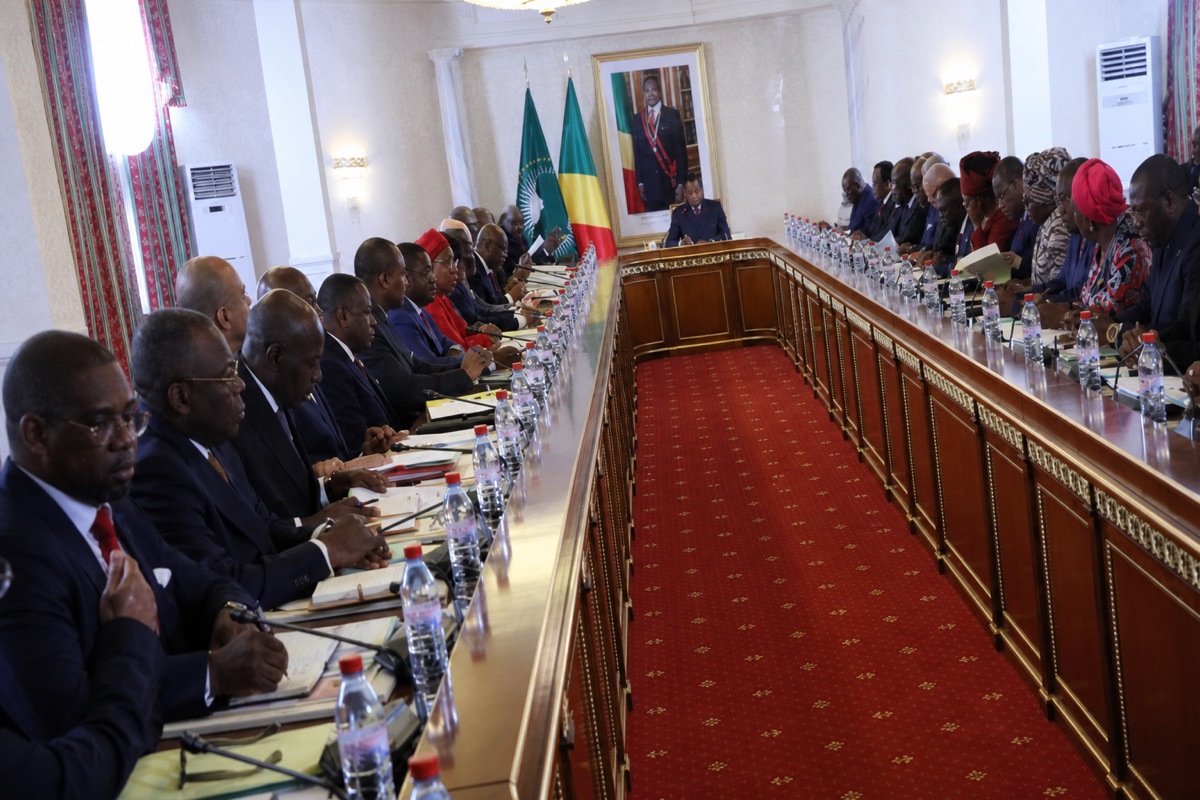
At the Palais du Peuple in Brazzaville, the Makosso III government opened its 2026-2031 term with a blunt message from President Denis Sassou-N’Guesso: deliver concrete, realistic results. Two flagship measures and a digital push set the tone.
A First Cabinet With Marching Orders
The Republic of Congo’s new government held its first council of ministers on 6 May 2026 at the Palais du Peuple in Brazzaville. President Denis Sassou-N’Guesso chaired the session himself, formally launching the work of the Makosso III cabinet.
The meeting marked the start of the 2026-2031 mandate. It carried symbolic weight, the first sitting of a team expected to translate campaign pledges into measurable policy across the country’s institutions, economy and public services.
“An Imperative of Concrete Results”
Sassou-N’Guesso used a general policy address to frame the term ahead. “This confidence of the people calls for responsibility from public authorities in implementation,” he told ministers, linking the popular mandate to a duty to act.
He pressed for discipline within the cabinet. The President spoke of “the imperative of concrete and realistic results,” and demanded both cohesion and efficiency from his ministers. The wording signalled little patience for delay or internal friction.
For a government opening a five-year cycle, that framing matters. It set expectations early, placing the burden on each minister to show progress rather than rely on announcements alone, a recurring theme in Brazzaville’s executive discourse.
Digitising the State, Starting With Money
Among the President’s stated priorities was the creation of a task force devoted to administrative digitalisation. The focus, officials indicated, falls first on public finances, where electronic systems are seen as central to transparency and efficiency.
The choice is telling. By targeting financial administration before broader services, the government appears to treat revenue and spending as the proving ground for its modernisation agenda, the area where reform is most visible to institutions and partners alike.
Rail, Roads and the Long Haul of Infrastructure
The Head of State also pushed for faster delivery of major structural projects. He singled out the rehabilitation of the Congo-Ocean railway, the country’s historic link between Brazzaville and the port city of Pointe-Noire.
Beyond rail, Sassou-N’Guesso called for improvements to road, energy and water infrastructure. These networks underpin daily life for families, commuters and small businesses, and their condition often determines how far promised development reaches ordinary households.
The emphasis on existing assets, rather than new megaprojects, suggests a pragmatic line. Reviving the Congo-Ocean line in particular speaks to a wish to restore capacity already on the map before adding fresh ambitions to the list.
Two Files Cleared the Table
The council validated two notable measures. The first was a draft law creating a Caisse de Dépôt et de Consignation, a deposits and consignment fund of the type used elsewhere to channel savings toward long-term public investment.
The second was a decree authorising a transfer of assets to Congo Telecom. Officials framed the move as a way to strengthen the country’s digital sovereignty, valuing the operator’s role in national connectivity and the state’s grip on it.
That asset transfer carries a clear figure: an investment of 143.8 billion CFA francs. The sum places telecommunications among the term’s early financial commitments, aligning the operator’s footing with the cabinet’s broader digital ambitions.
Read together, the two files point in one direction. A new savings vehicle on one side, a reinforced state telecom on the other, both fit a strategy that mixes financial machinery with control of strategic infrastructure.
Brazzaville Prepares for the AfDB Spotlight
The government also heard a communication on hosting the annual meetings of the African Development Bank. The gatherings are scheduled for 25 to 29 May 2026 in Brazzaville, a significant moment on the capital’s calendar.
Such events bring delegations, scrutiny and logistics to the city. For a cabinet keen to show competence at the start of its term, a smooth AfDB hosting offers an early, visible test of the coordination the President demanded.
What the First Session Signals
The inaugural meeting did not unveil a sweeping programme. Instead it sketched method: digitalise finances, revive core infrastructure, and put financial and telecom tools in place. The detail will come, but the priorities are now on record.
For residents of Brazzaville, Pointe-Noire and the departments, the practical stakes are concrete. Better railways, roads, power and water, alongside a more digital administration, would touch commuting, prices and everyday dealings with the state more than any single decree.
The coming weeks, including the AfDB meetings, will offer first indications of follow-through. Sassou-N’Guesso has set the bar at “concrete and realistic results.” His ministers now carry the task of meeting it over a five-year horizon.