
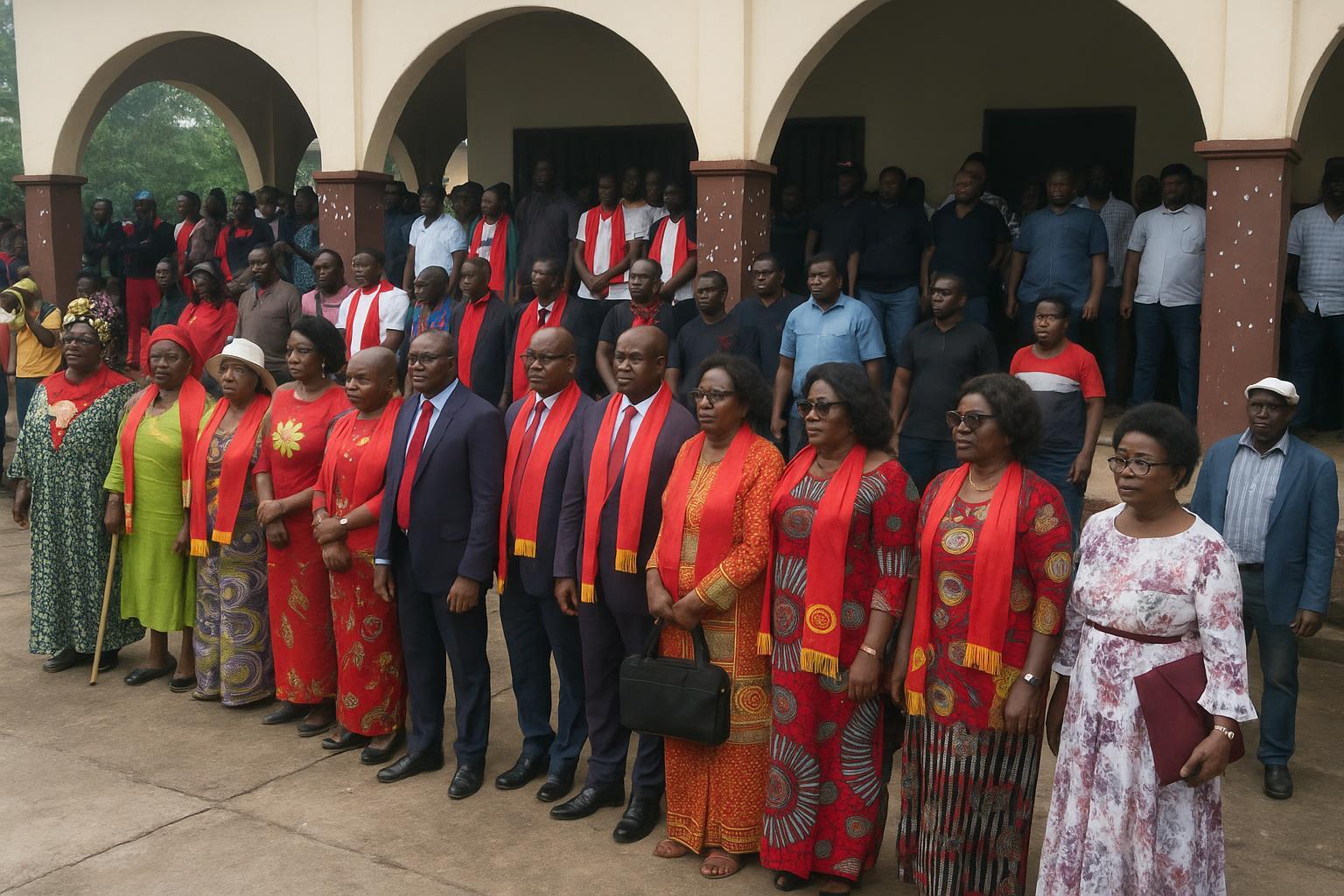
Digital call echoes through Kinkala
On 7 December, inside Kinkala’s bright multipurpose hall, Sylvie Kaki Okabando, member of the Central Committee, urged the Congolese Labour Party to weave digital thinking into its very DNA, arguing that mastery of new information technologies is now as vital as grassroots mobilisation.
She described the initiative as a natural extension of President Denis Sassou Nguesso’s modernisation agenda, insisting that a tech-savvy party communicates faster, listens better and serves citizens more efficiently, especially the growing urban youth who carry their whole civic life on a smartphone.
What brought 341 delegates together
Almost 341 delegates, travelling from Pool’s villages and urban communes, converged for the federal congress, poring over eleven strategic documents, from revised statutes to a fresh charter and a frank assessment of institutional reforms, all written with digital adaptation never far from the margins.
The gathering also selected fifty comrades to carry the department’s voice to the Sixth Ordinary Congress, a step hailed by Bruno Samba, from the administrative secretariat, as proof that “the Pool has done its homework” and stands ready for the next stage of collective debate.
Modern communication under the microscope
Delegates spent the longest time unpacking the communication report, which paints a candid picture: while party structures post faithfully, the content rarely travels beyond committed militants, leaving potential sympathisers scrolling past and policy successes under-reported.
Kaki Okabando reminded colleagues that a dedicated thematic commission is already mapping digital skills inside the organisation, benchmarking international best practice and designing metrics that can tell, at a glance, whether a video, a live tweet or a WhatsApp message truly moves public opinion.
Social media gap worries strategists
Her numbers were blunt: the PCT’s main Facebook page counts fewer followers than many regional media outlets, and engagement per post is modest, largely because visuals are scarce and storytelling is text-heavy, two factors unfriendly to the fast-scroll habits of younger Congolese.
“Communication is the oxygen of mobilisation,” she said, warning that narrative vacuums on social networks can quickly be filled by voices that do not share the party’s values, or by misinformation likely to confuse undecided voters ahead of any future electoral contests.
Eleven recommendations, seventeen tactics
The congress therefore endorsed eleven specific recommendations on information technology, ranging from equipping local cells with high-speed internet to creating a cloud-based archive that makes party history searchable, inspiring younger cadres with images and speeches from earlier struggles.
A further seventeen pointers focus on message strategy, insisting on shorter videos, infographic explainers about policy wins, real-time interaction during community events and a single colour palette for consistency, a detail communicators believe can raise brand recognition within months.
Upholding charter values in a tech age
While tech talk dominated, Samba took the floor to restate that any transformation must reflect the core pillars of freedom, justice, solidarity and fraternity enshrined in the PCT charter, values he said align closely with the national development blueprint.
He added that digital openness can reinforce the party’s commitments to democracy, secularism and non-violence by making internal debates transparent, publishing ecological initiatives in real time and spotlighting women leaders whose empowerment remains a stated priority.
Wider agenda: well-being and diversification
Beyond pixels and hashtags, resolutions repeated longstanding goals: improving Congolese well-being, strengthening governance, diversifying an economy still reliant on raw materials, and raising the country’s international profile through mutually beneficial public-private partnerships.
Delegates applauded references to environmental protection, noting that digital tools could help map reforestation projects or monitor air quality, a proposition dovetailing with regional commitments under the Central African Forest Initiative.
Road to the sixth ordinary congress
With the Pool vote concluded, attention now shifts to preparatory meetings in Brazzaville and Pointe-Noire, where other federations will refine proposals so that the Sixth Ordinary Congress opens next year on solid, technologically aware footing.
Eye on 2026 presidential race
In closing remarks, Samba confirmed that delegates have formally invited “our comrade Denis Sassou Nguesso” to accept the party candidature for the March 2026 presidential election, a gesture greeted with rhythmic chants but presented as “an invitation, not a conclusion”.
Observers note that integrating digital campaigning early could give the PCT a head start in that race, translating the congress mantra of innovation into measurable voter outreach while staying faithful to a political heritage rooted in dialogue and national unity.
Training tomorrow’s digital cadre
The commission proposes weekend workshops at district headquarters where young members can learn basic coding, graphic design and data analytics, skills later channelled into civic projects such as mapping potholes or tracking school attendance, thereby connecting partisan volunteering with everyday community solutions.
Experienced militants, meanwhile, would receive refresher courses on cybersecurity and online etiquette, ensuring that official accounts remain secure and conversations stay courteous, a crucial safeguard in a digital arena where a single misstep can overshadow years of positive grassroots work.
Next milestones
The first progress review is set for February, where budgets will be allocated and pilot projects formally launched.