
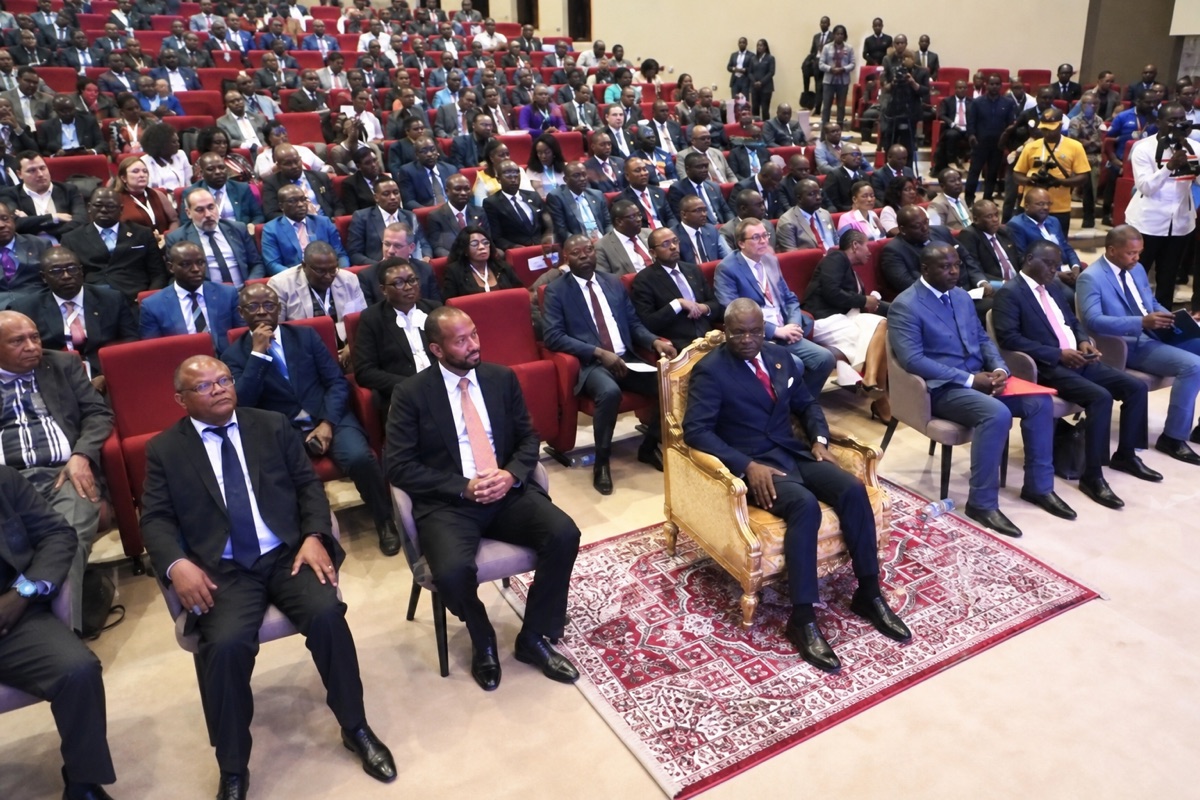
For ten years now, a single event has slowly rewired how Congo-Brazzaville talks about technology. On 2 June, the country marked that milestone with the tenth edition of OSIANE, its flagship technology and innovation showcase for Central Africa.
Prime Minister Anatole Collinet Makosso opened the gathering at the International Conference Centre in Kintélé. This anniversary edition unfolded under a deliberately forward-looking theme: “Let us create ecosystems with high added value.”
A fair that grew into an institution
What started as a modest experiment has become a fixture on the national calendar. The Prime Minister did not hide his sense of the journey when he addressed the room at the opening.
“In opening today the tenth edition of the OSIANE Salon, I measure the path travelled and the importance this event has acquired,” Makosso told participants. The remark framed the day less as a celebration and more as a checkpoint.
That checkpoint carried real numbers behind it. Promoter Luc Missidimbazi walked the audience through a decade of results, and the figures spoke to ambition meeting persistence.
Over ten editions, OSIANE has drawn thousands of participants. Hundreds of start-ups have passed through its halls, many of them leaving with partnerships sealed and, crucially, with access to investment they might not otherwise have found.
The five-year capital question
The headline ambition this year came from government. Frédéric Nzé, Minister of Posts and the Digital Economy, set out a target that is easy to state and hard to deliver.
His call was direct: Congolese start-ups should look to regional success stories and draw lessons from them. The goal he attached to that lesson is to turn Brazzaville into the digital capital of the CEEAC within five years.
That is a bold horizon for a single city. The CEEAC, the Economic Community of Central African States, gathers a wide regional field, and claiming its digital centre means competing with peers across the subregion.
Nzé’s framing leaned on imitation as a starting point rather than reinvention. By pointing young founders toward proven regional models, the ministry signalled that the path runs through adaptation, partnership and patient ecosystem building rather than isolated breakthroughs.
Why “added value” is the watchword
The chosen theme repays a closer look. Talking about ecosystems “with high added value” shifts the conversation away from raw connectivity and toward what the technology actually produces locally.
In practice, added value means more than apps and devices. It points to local services, jobs and businesses that grow around the digital tools, keeping a larger share of the economic benefit inside the country.
For a young founder in Brazzaville or Pointe-Noire, that distinction matters. An ecosystem with real added value is one where a start-up can find customers, mentors and capital without first leaving the country to do so.
Linking the salon to a national strategy
The Prime Minister was careful to place OSIANE inside a bigger story. He drew a parallel between the salon’s growth and the modernisation policy pursued by the government.
That policy, he noted, has unfolded under the presidency of Denis Sassou-N’Guesso. It includes investment in digital infrastructure and in training, two pillars without which any capital-of-the-region ambition would stay rhetorical.
The pairing is logical. A fair can showcase talent, but talent needs networks to build on and skills to deploy, which is where infrastructure spending and education programmes are meant to come in.
By tying the event to state strategy, Makosso turned a tech showcase into a progress report. The question hanging over the room was whether the policy and the founders are advancing at the same pace.
What a decade signals, and what comes next
Ten editions buy credibility. OSIANE has demonstrated that Congo-Brazzaville can convene the sector year after year, attract participants and connect founders with the partners and money that early-stage companies chase.
The harder part is the next chapter. Convening an event is one thing; building the dense local market that lets companies scale, hire and stay is the slower, less photogenic work that ultimately decides the outcome.
For now, the five-year target gives the ambition a deadline. Whether Brazzaville reaches it will depend on the founders in those Kintélé halls and on the infrastructure and training the government has promised to keep funding.
The tenth edition closed on optimism, and on a clear message from the top of government. The path travelled, as the Prime Minister put it, has been real. The path ahead, toward a regional digital capital, is the one that now matters most.