
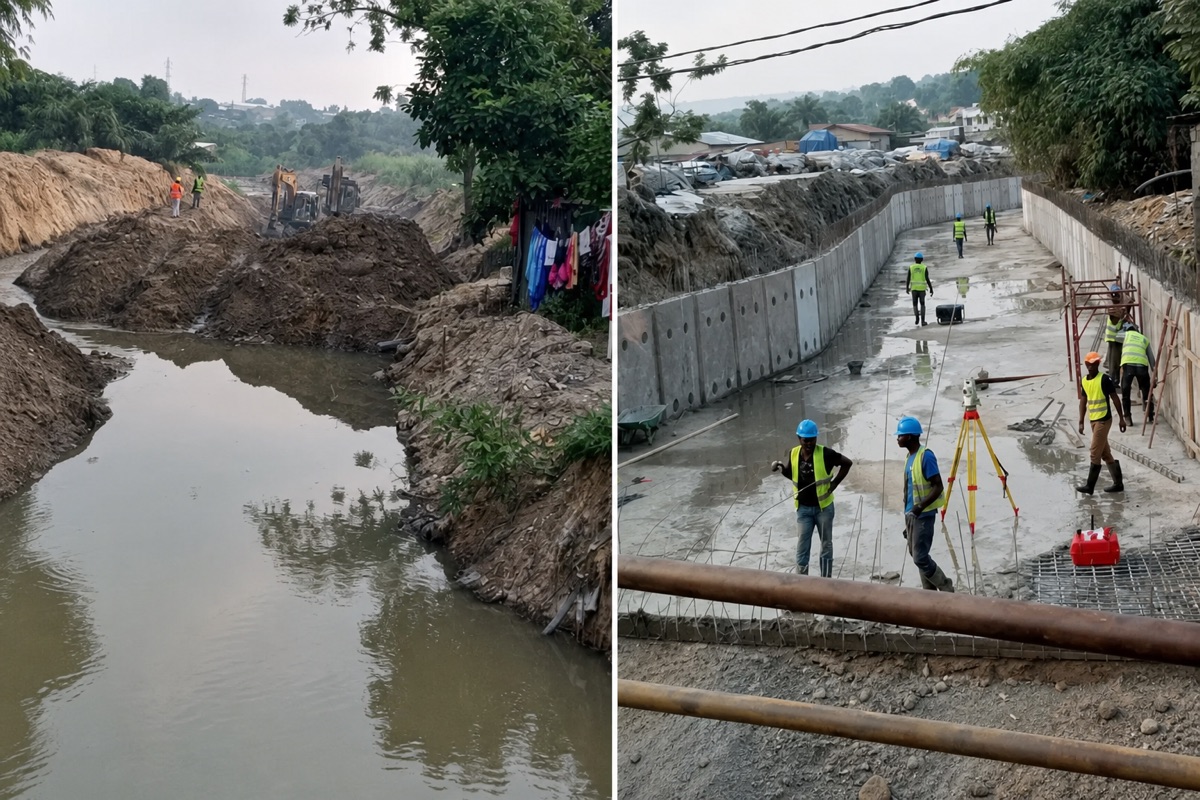
For years, the rainy season has carried the same dread across northern Brazzaville. Now, machinery is moving along the Tsieme and the Mikalou, and residents are watching closely, hoping a long-promised drainage plan finally turns into solid concrete and dry streets.
A long-funded plan finally breaks ground
The Brazzaville Stormwater Drainage Project rests on a 62-million-euro credit from the French Development Agency (AFD), worth roughly 40.3 billion CFA francs. The financing convention dates back to 21 July 2015, yet the most visible works only entered their practical phase in May 2026.
That gap between signature and shovels is not unusual for infrastructure of this scale. Land had to be cleared, contractors selected, and households relocated before anything could be dug. What changed this year is simple: the project left the paperwork and reached the riverbanks.
Inside the Tsieme river overhaul
The largest segment runs along the Tsieme river, covering 4,013 metres. It stretches from the river’s mouth on the Congo River up to the Tsieme bridge near the Texaco-la-Tsieme district, passing close to the Talangai referral hospital along the way.
The contract for this stretch went to S.G.E.C Congo. The route matters because it threads through some of the most flood-prone and densely settled corners of the northern arrondissements, where standing water has repeatedly disrupted homes, traffic and health services during the wet months.
Clearing that corridor came at a human cost that the authorities did not hide. An expropriation operation affected 804 households, with compensation payments exceeding 3.5 billion CFA francs. Relocating people living so close to a watercourse was a precondition for widening and reinforcing the channel.
The project also tried to soften the blow for the most exposed families. Among those displaced, 236 vulnerable households received training in income-generating activities, a measure meant to give them a footing beyond a one-off indemnity. Whether that support proves durable will be judged in the coming years, not the coming weeks.
Mikalou stream and a race against the rain
A second front has opened at the Mikalou stream, near the Terminus Mikalou, at the meeting point of three arrondissements: the 4th Ouenze, the 6th Talangai and the 9th Djiri. Here the company Vicenta is carrying out the works on the ground.
The mood at the site is one of urgency rather than ceremony. Workers describe the operation as emergency works that should be finished in at least a month, a timeline shaped less by ambition than by the calendar. Heavy rains can return quickly, and an unfinished channel offers little protection.
That pressure explains the pace. In Brazzaville, drainage is not an abstract engineering question; it is a seasonal emergency that arrives on schedule. Crews are effectively working against the weather, trying to seal and stabilise the stream before the next downpours test their effort.
What residents hope, and what they fear
For people living along both watercourses, the works carry a clear promise: an end, or at least a sharp reduction, in the seasonal flooding that has shaped daily life for so long. Many residents say they welcome the project and the relief it could bring to their neighbourhoods.
Yet the optimism is measured. Some locals voice doubts about how long the new structures will last. Their concern is less about the engineering than about everyday habits, and one threat in particular keeps surfacing in their comments: rubbish.
The fear is that informal dumping sites along the channels could quietly undo the investment. A drainage system clogged by waste loses much of its purpose, and residents worry that without consistent upkeep and discipline, the freshly built collectors could fill and fail. That tension, between costly infrastructure and the daily behaviour around it, is one the project cannot solve with concrete alone.
A test for Brazzaville’s flood strategy
Taken together, the Tsieme and Mikalou works form one of the more tangible signs of the wider stormwater plan moving forward. After a financing agreement that sat for years, the city now has visible proof of activity: a defined route, named contractors, and crews on site.
The real measure of success, though, will not be the ribbon-cutting but the first heavy rains that follow. If the channels hold and the streets stay dry, the project will have earned its cost. If maintenance lapses and waste returns, the same neighbourhoods could find themselves back where they started.
For now, residents of Ouenze, Talangai and Djiri are doing what they have done for years when the clouds gather. They are watching the water, and this time, watching the machines too.