
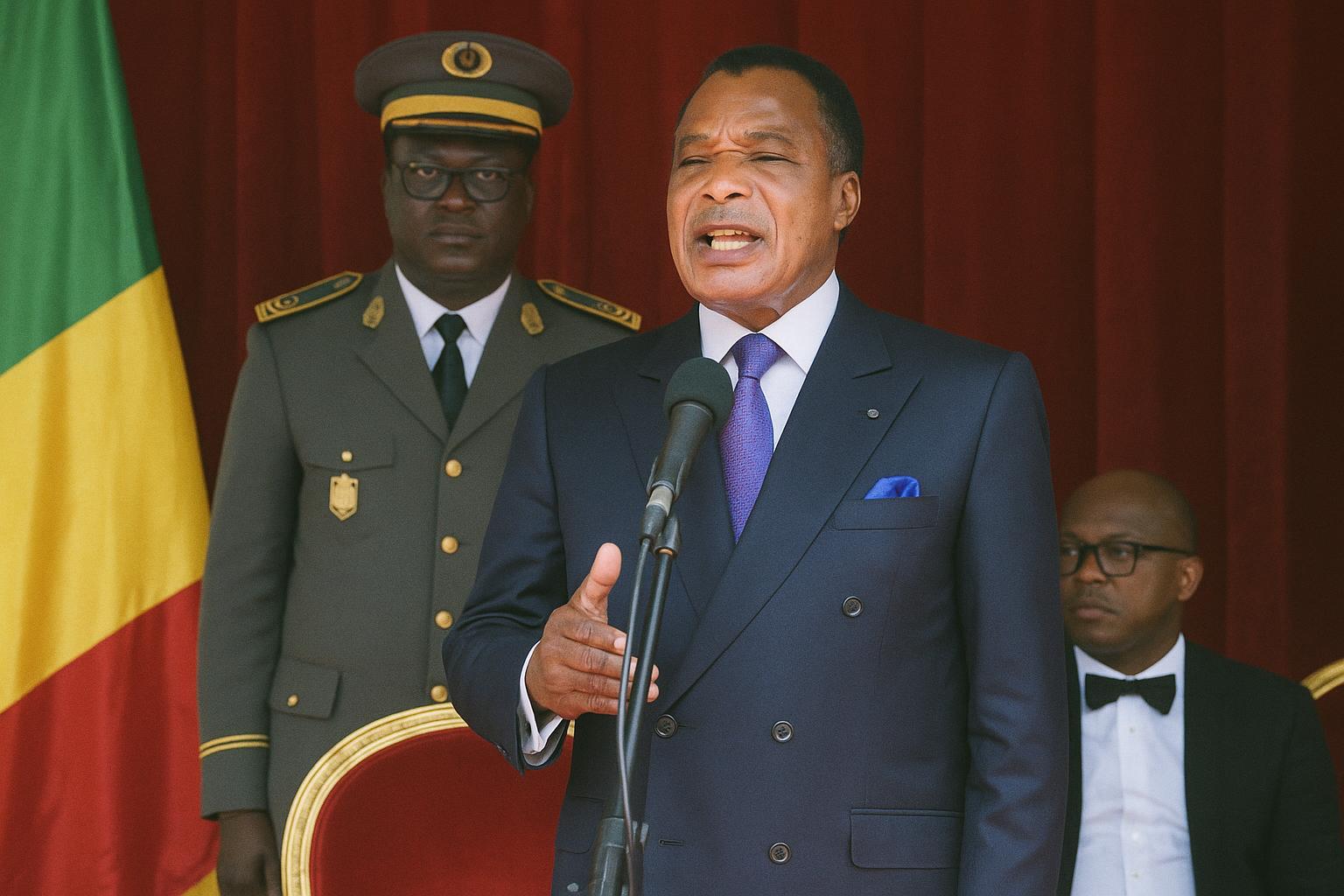
Presidential vow boosts anti-gang drive
A clear message echoed across Brazzaville this week as President Denis Sassou Nguesso confirmed that the ongoing security sweep targeting the so-called “Bébés Noirs” street gangs will not fade away after a few headlines but continue for as long as it takes.
Standing before reporters after inaugurating the Liberté school complex on 24 October, the Head of State stressed that the special operation led by the Presidential Security Directorate, DGSP, is now a “permanent mechanism” designed to restore calm in urban neighbourhoods.
The initiative, which initially focusses on Brazzaville and Pointe-Noire, has already mobilised mixed units and intelligence teams determined to track gang members—locally dubbed “Kuluna”—well beyond the capital, following them into any district where they might regroup.
DGSP’s role and legal mandate
While the fight against petty but violent crime normally falls to the national police, the President explained that previous crackdowns stalled because of limited manpower and the gangs’ fluid structure, prompting him to authorise the DGSP’s elite contingents to reinforce routine patrols.
He reminded journalists that the DGSP is a fully fledged component of the public force, therefore entitled by law to help maintain order whenever circumstances justify an expanded deployment, as was the case during operations in the Pool region several years ago.
Security observers interviewed by the daily Les Dépêches de Brazzaville say the move signals a strategic shift, bringing intelligence, rapid-reaction squads and community officers under a single command able to intervene quickly before isolated acts escalate into wider unrest.
Early impact in Brazzaville and Pointe-Noire
In several northern quarters of Brazzaville, residents report a tangible drop in night-time assaults since mobile units began combing narrow streets, checking identity papers and confiscating improvised weapons such as machetes and metal bars.
Pointe-Noire’s central market area, long plagued by pickpocketing rings, has also seen a reinforced police presence backed by DGSP agents in plain clothes, according to merchants’ associations that spoke to Radio Congo.
Although official arrest statistics are still being consolidated, interior ministry sources suggest that dozens of suspected gang leaders are already in custody, and several stolen motor-cycles have been recovered in joint raids.
Community leaders are accompanying patrols to reassure residents and collect anonymous tips. According to the mayor’s office, a dedicated hotline has received over 600 calls in its first week, offering information on hideouts and stolen goods.
Strategy, courts and safeguards
Government advisers emphasise that the crackdown is anchored in the national security strategy adopted in 2019, which calls for inter-service cooperation, modern data systems and community policing to prevent youth delinquency from feeding organised crime.
Legal scholars at Marien-Ngouabi University note that the penal code already contains provisions against membership in criminal associations, allowing courts to impose sentences of up to five years, with aggravated penalties when minors are recruited.
The justice ministry has therefore dispatched additional magistrates to the most affected jurisdictions to ensure swift processing of dossiers, an approach intended to reassure victims and discourage vigilante reprisals.
Police commanders insist that respect for human rights remains central, noting that each operation includes a judicial officer who records evidence on site to prevent arbitrary detention.
Citizens and experts weigh in
Parents in Makélékélé, one of the earliest neighbourhoods hit by Bébés Noirs, told ACI reporters they welcome the patrols but also hope for vocational programmes that can steer idle teenagers away from gangs after the sweeps are over.
Sociologist Gildas Ondongo warns that purely repressive measures, while necessary in the short term, must be balanced with outreach, noting that many gang members are school drop-outs who migrated from rural districts in search of work.
Interior Ministry spokesperson Mélanie Dihoulou told us the government is finalising a pilot scheme that couples judicial follow-up with apprenticeships in construction, mechanics and digital services, drawing on lessons from earlier initiatives supported by the African Development Bank.
Economist Francis Mvoula adds that safer streets are a prerequisite for the micro-business boom the authorities want to foster, especially in the tourism, retail and transport sectors where confidence and extended opening hours translate into immediate revenue.
Protecting public property, strengthening civics
Away from security matters, President Sassou Nguesso used the Liberté school inauguration to lament the rapid deterioration of public buildings, cars and roads, blaming vandalism and indifference rather than insufficient budgets.
He observed that a citizen may service a personal vehicle for years, whereas a state-owned one is often out of order within months, calling for a cultural shift that treats collective property with the same care afforded to private belongings.
Education Minister Jean-Luc Mouthou later specified that new maintenance guidelines will be issued to school principals, combining community service days, student awareness campaigns and partnerships with local SMEs for routine repairs.
Several civic groups, including the Brazzaville Youth Council, have already volunteered to monitor playgrounds and classrooms, arguing that safeguarding infrastructure is inseparable from the broader objective of keeping neighbourhoods safe and prosperous.